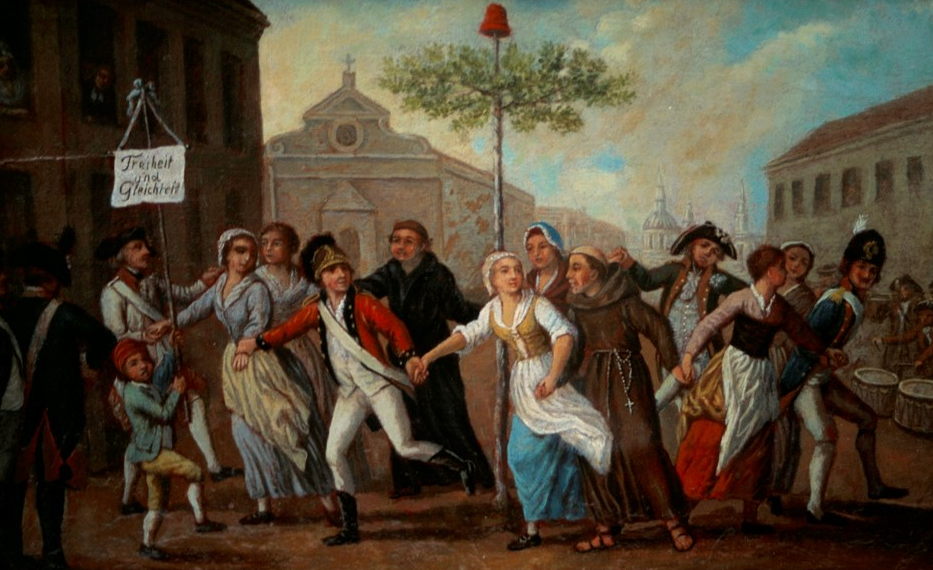
The European Right in the Era of Republicanism
The attitudes and thinking-patterns of intellectuals on the political Right in the eighteenth and nineteenth-century remain as they are in today’s American Right.
From Jacobite to Conservative: Reaction and Orthodoxy in Britain
In James J. Sack’s From Jacobite to Conservative, speaking of the “ubiquitous right-wing hatred of Dissenters” he explains:
“It has often been recognized that the British Right in the eighteenth and nineteenth centuries, as exemplified by Burke and his disciples, though not only by them, mightily distrusted the attempted application of abstract principles and greatly favored the notion of the utility of prescriptive rights. What is perhaps less emphasized in modern discussions of the meaning of early modern conservatism is the role which unalloyed hatred played in defining ideology: hatred for certain forms of dissent, for domestic and foreign radical movements, for Voltaire and the philosophes, for atheists and infidels, for Jews, and above all, for the ancient enemy, Whiggery. (…) Those on the Right also hated, of course, the main intellectual analysis of the philosophes, most pronouncedly when it verged on Deism. Praise of both Voltaire and Rousseau, for example, was fairly common in the Tory press of the 1750s and 1760s, but after the outbreak of the French Revolution, one can find little save the most vicious attacks upon either individual in “Church and King” circles.” (James J. Sack, From Jacobite to Conservative: Reaction and Orthodoxy in Britain c. 1760-1832, pp. 38-39)
James J. Sack confirms Gordon S. Wood’s research on the early relationship between liberals, republicanism, the upper-class and the monarchy until the French Revolution commenced.
Sack continues on more critically about the European Right, explaining that it is the same thinking patterns as modern American “Conservatives.”:
“The Right hated Jacobinism and other foreign-sounding European radical movements. It particularly despised female radicals, domestic and foreign (…) All such received from the Right in general a sustained and unbending critique bordering on hysteria. The short-lived Tory Sunday newspaper, The Brunswick or True Blue was typical in its assessment, in 1821, when it lumped together the Jacobins of France, the Radicals of England, the Carbonari of Italy, and the Illuminati of Germany as “one and the same kidney” and “bound in common bond of hatred against order, religion, and the best interests of mankind.” (Sack, 39-40)
EDMUND BURKE’S REACTION TO RISE OF EUROPEAN FEMINISM
James J. Sack goes on in his book to funnily quote Edmund Burke’s blood-curdling explosion in a letter (Anti-Jacobin, April 9, 1978, pp. 119-21) about the rise of European feminism after 1789, imploring to his friend, Mrs. Crewe to make the names of those feminists “odious to your Children.” Sack explains, the conservatives were so reactionary, the issue was not about agricultural interest, or opposition to land taxation, but were reactions, and rising perfervid emotions toward any suggestion of sexual or religious deviance.
Despite major political shifts in our country’s history of the political parties and citizen rights, Conservatives reject that “The Switch” happened. Yet, take this thinking of the Southerners in James McPherson’s This Mighty Scourge, showing the lack of differentiation of those Southerners from modern Conservatives fear of a “hispanization of america” by its pundits and in their publications.
“The conflict between slavery and non-slavery is a conflict for life and death,” a South Carolina commissioner told Virginians in February 1861. “The South cannot exist without African slavery.” Mississippi’s commissioner to Maryland insisted that “slavery was ordained by God and sanctioned by humanity.” If slave states remained in a Union ruled by Lincoln and his party, “the safety of the rights of the South will be entirely gone.”
“If these warnings were not sufficient to frighten hesitating Southerners into secession, commissioners played the race card. A Mississippi commissioner told Georgians that Republicans intended not only to abolish slavery but also to “substitute in its stead their new theory of the universal equality of the black and white races.” Georgia’s commissioner to Virginia dutifully assured his listeners that if Southern states stayed in the Union, “we will have black governors, black legislatures, black juries, black everything.”
Anti-Jacobin, April 9, 1978, pp. 119-21

 The American Minervan
Leave a comment