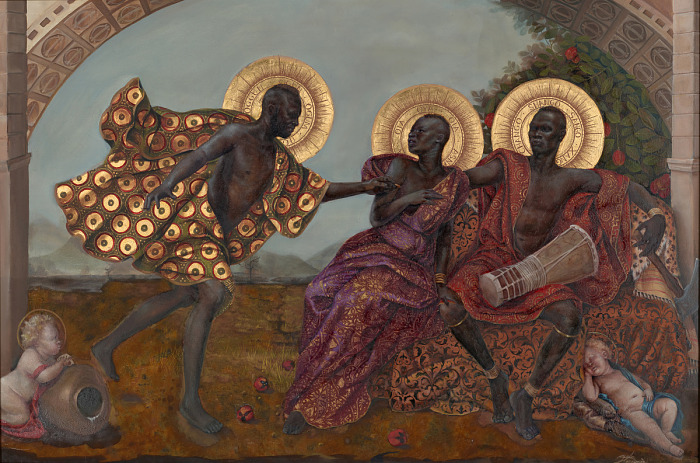
The statement that oral traditions in Africa predate writing for example is well-supported by scholarly consensus in African historiography, linguistics, archaeology, and anthropology. The only people that initially denied these facts were scientists with bias during the colonial-era. Oral traditions tend to encompass storytelling, epics, proverbs, genealogies, praise poetry, and historical narratives transmitted verbally across generations. It represents one of the oldest forms of human cultural expression worldwide, predating the invention of writing systems by tens of thousands of years in Africa as elsewhere.
Sources on this information derive from: Ruth Finnegan, Oral Literature in Africa (originally 1970; repr. from Open Book Publishers, 2012) which is fieldwork-based study emphasizing the sophistication and antiquity of African oral forms. Jan Vansina, Oral Tradition as History (University of Wisconsin Press, 1985) with foundational methodology for validating oral sources, demonstrated reliability of this information back centuries. Djibril Tamsir Niane, Sundiata: An Epic of Old Mali (trans. G.D. Pickett; Longman, 1965/2006) contained classic transcription of the griot-performed epic. David Henige, Oral Historiography (Longman, 1982) is a critical analysis of oral sources’ strengths and limitations. Joseph Ki-Zerbo (ed.) in UNESCO General History of Africa, Vol. I: Methodology and African Prehistory (1981) include chapters on oral traditions and early writing. David C. Conrad & Barbara E. Frank (eds.), Status and Identity in West Africa: Nyamakalaw of Mande (Indiana University Press, 1995) discusses griots and oral professionalism. Stephen Belcher, Epic Traditions of Africa (Indiana University Press, 1999) is a comparative study of oral epics like Sundiata, the legendary founder of the Mali empire in the thirteenth-century. Joseph C. Miller (ed.), The African Past Speaks: Essays on Oral Tradition and History (Dawson, 1980) provides essays correlating oral data with archaeology.
These writers demonstrate to us some points to consider that oral traditions are inherent to all pre-literate human societies. In Africa, they preserved histories, laws, genealogies, cosmology, and social norms for millennia before any script. Scholars note that “oral traditions preceded written records or documentation” in African contexts, filling gaps where writing was absent. Oral accounts often align with archaeological findings (e.g., migration patterns reconstructed utilizing linguistics and glottochronology) and predate written records by centuries or millennia. Jan Vansina’s pioneering work showed oral traditions in equatorial Africa reliably reflect events from 500 or more years prior when cross-checked with archaeology.
In West Africa, e.g., hereditary griots (the jali or historian, poet, musician, praise singer or storyteller in West African traditions) maintained detailed royal genealogies and epics orally, revering the spoken word as authoritative. This system predates Islamic Arabic literacy in the region (e.g., Mali Empire’s griots preserved the Epic of Sundiata from the 13th century CE, centuries before widespread writing in local languages).
The Epic of Sundiata (Mali Empire founder, d. 1255 CE) was transmitted orally by the griots for 700 years before transcription in the twentieth-century. It blends verifiable history (e.g., battles, alliances) with myth, corroborated by Arabic chronicles (e.g., Ibn Khaldun, fourteenth-century) and archaeology. Similar oral epics and histories exist among Yoruba (Nigeria), Akan (Ghana), Zulu (South Africa), and others, often tracing lineages back centuries before colonial-era writing. Oral traditions enabled reconstruction of pre-colonial histories where no written sources exist.
Modern humans (Homo sapiens) are said to have originated in Africa around 300,000 years ago, with evidence of symbolic behavior (e.g., ochre use, bead-making, and abstract engravings) dating back over 100,000 years, such as at Blombos Cave in South Africa (77,000 BCE). These early symbolic systems relied on oral transmission long before any form of proto-writing or full scripts emerged. This history of the transmission of wisdom through oral tradition in Africa reveals to us a different past, that is not centered on colonial and racist narratives about the peoples of Africa, and especially does not exclude their contributions to the legacy of Wisdom Tradition.
 The American Minervan
Leave a comment