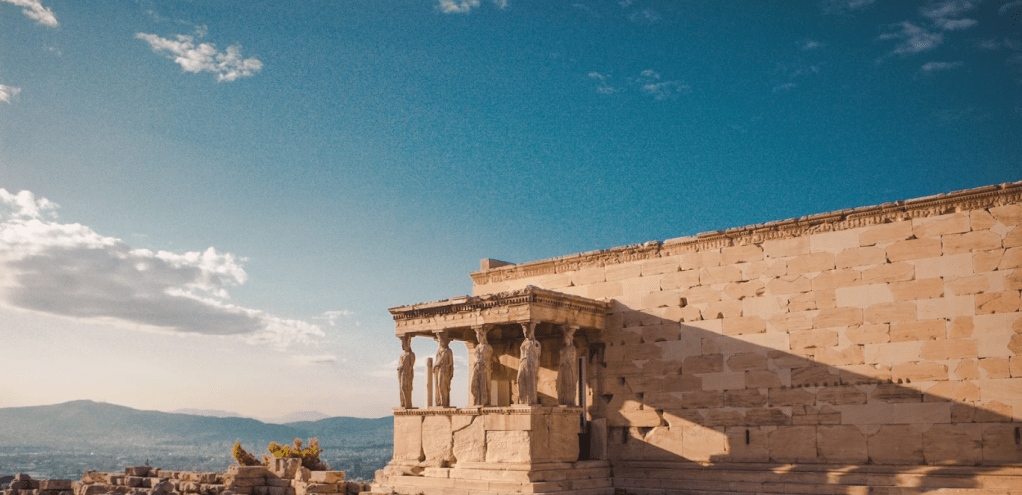
In the spirit of the ancient Ionian and Eleatic thinkers, who sought the archē1, the fundamental principle of all things through reason and observation of physis or dynamic generative nature as a self-unfolding process of emergence.
INTRODUCTION
The key to Theosophy can also be found in the Hellenic cosmology2 of the early Greek natural philosophers such as Thales, Anaximander, Heraclitus, Parmenides, Empedocles, Anaxagoras and the atomists. These early Greek philosophers of physis at the foundations of Western Philosophy taught a unified doctrine of order (or KOSMOS), revealing inherent laws of physis self-ordering by inevitability of those laws, or necessity (anankē). Here, the universe emerges not from divine caprice, but proceeds by natural necessity, a harmonious order where multiplicity arises from unity, and becoming unfolds through ceaseless cycles.
All manifested things have their portion (moira), or natural boundary and unfolds in accord with its inherent pattern. Theosophy posits no gods as personal agents but an impersonal LOGOS or rational principle that binds all and a cosmos that maintains itself through justice (dikē) and restored balance.
The Three Archai of Existence
At the heart of this teaching lie three primordial truths, like the foundational inquiries of the Milesians, revealing the essence of TO PAN (the ALL): (ENA) the Apeiron as the eternal Archē; (DIO) the cyclical flux of Becoming and (TRIA) the Unity of Psyche in the Nous.
Firstly, there is a boundless, ungenerated, and indestructible source, the apeiron, as Anaximander conceived it from whence all things emanate and to which they return. This infinite, undifferentiated principle is neither water nor air nor any sensible element, but the root of being itself, encompassing all opposites (hot and cold, wet and dry) in potentiality. It is the one unchanging reality behind the veil of phenomena, impervious to time or space, from which the kosmos unfolds as an ordered emanation. No mortal mind can fully grasp it, for it transcends the senses, yet it is the substratum of all manifestation.
The ancient Greek philosophers speak the wisdom of Laozi, as in an old Chinese book, it says:
The Great DAO has no form, yet gives birth to Heaven and Earth.
The Great DAO has no passions, yet it sets the sun and the moon in motion.
The Great DAO has no name yet nourishes all phenomena.
— Qingjing Jing (Classic of Purity and Tranquility)大道無形,生育天地; 大道無情,運行日月; 大道無名,長養萬物。
Secondly, the kosmos operates through eternal rhythms of generation and dissolution, as through the perpetual strife of opposites and PANTA RHEI (meaning “all things flow”) in the teaching of Heraclitus. Just as day yields to night and seasons revolve, so does the universe alternate between periods of activity (kosmopoiia, or world-formation) and rest (kataklysmos, or dissolution). This periodicity is no chaos but a natural law of equilibrium, where excess in one direction demands compensation, ensuring perpetual renewal. From the boundless origin (apeiron), worlds emerge, evolve, and subside in vast cycles, like the ebb and flow of the sea or the condensation and rarefaction of air in Anaximenes’ vision.
Third and lastly, all psyches (souls or vital principles) are fundamentally identical with the universal NOUS as the ordering mind or INTELLIGENCE posited by Anaxagoras, and as fragments of the same infinite whole. This implies a natural communion (or koinonia) among all beings, not as a moral edict but as PHYSIS itself. PHYSIS is the interconnected web where each atom or seed participates in the greater harmony. The purpose of existence is the progressive awakening of this NOUS within, leading from fragmentation to wholeness, as in Pythagoras’ notion of the soul’s journey toward purification.
These three archai render the kosmos intelligible, blending the permanence of Parmenides’ Being with the change of Heraclitus’ LOGOS, showing that nature is a self-regulating system governed by anankē (necessity). Physis, Heraclitus taught, has a natural tendency by its innate being to conceal itself (Heraclitus – Fragment 123, The Numinous Way), thus rooting esotericism in physis. This philosophy of physis also explores the atomists’ pursuit of the unseen ATOMS and VOID.
STRUCTURE OF THE UNIVERSE
Dikē, the cosmic justice of Anaximander operates as the inexorable law where every action begets its equal reaction, balancing opposites across the flux of time. What one sows in thought or deed ripples through the kosmos, demanding atonement not by vengeful gods but by natural consequence. Metempsychosis, the transmigration of the psyche as taught by Pythagoras and Empedocles, allows this balance to unfold over multiple embodiments: the soul, an eternal particle of the DIVINE NOUS, cycles through forms of mineral, plant, animal, and human to refine itself, shedding illusions until it reunites with the whole. This is no punishment but evolution, moved by the strife and love that Empedocles taught as binding and separating the elements.
Anaximenes (sixth-century BCE) taught that air (aēr) is the fundamental principle (archē), presenting the earliest Western theory of matter as a continuum, so Anaximenes’ physics becomes a metaphysics of evolution. For Anaximenes, the universe is ordered in strata, from the subtlest aithēr to the densest hylē, leading to Empedocles’ four roots (or rhizomata) under earth, water, air, and fire combined by philia (attraction) and neikos (repulsion).
For Pythagoreans, the universe is a harmonious series of spheres. Modern Theosophy’s concept of graded worlds or as it is called “Seven Globes” is a metaphysical elaboration of this sevenfold harmonic cosmology. In Theosophy, a “planetary chain” is not a single physical planet but a series of seven globes, each existing on a different plane of matter. Worlds form chains of spheres or globes, each evolving through rounds of condensation and rarefaction, as Anaximenes envisioned air transforming into wind, cloud, water, earth, and stone. As Heraclitus taught, the soul is made of rarefied fire (a form of aithēr), like the stars; and the condensation (element unfolding denser matter) of worlds corresponds to the embodiment of nous in Man, who is a miniature of the world, the cosmic organs (sun, moon, stars) and the cosmos itself. This observes, not a literal chain of physical planets, but a continuum of states of being. This hierarchy reflects the macrocosm in the microcosm: “As above, so below,” where the human mirrors the starry heavens. Modern Theosophy’s concept of Seven Globes (stages from the most rarefied or aetheric to the dense physical and back to subtlety) is a metaphysical expansion of this continuum into cosmic cycles, though the basis was first theorized by Anaximenes. Heraclitus provided the theory of cyclic worlds. Anaximander provided a philosophy and metaphysics of the source of multiple worlds with his concept of the apeiron, or boundless ONE, from which opposites emerge from the apeiron and return to it “according to necessity,” which Empedocles expanded on. In relation to this dualism of Love and Strife in the metaphysics of Empedocles is the previous article, Time’s Circle in Zurvanite Philosophy and Theosophy: Monism beyond Dualism.
The planes of ousia comprises interpenetrating levels of substance, from the rarefied and noetic to the gross and visible, much like the gradations of pneuma (breath or spirit) in Anaximenes’ teaching or the infinite mixtures in Anaxagoras. These are not separate worlds but densities of the same apeiron, accessible through the disciplined exercise of nous, revealing the hidden symmetries of physis.
HEPTADIC CONSTITUTION OF MAN
In the Heptadic Constitution of Man (ANTHROPOS), human nature, as a microkosmos is heptadic or sevenfold structure. This division arises from the interplay of elements and forces, grouped into higher (noetic) and lower (somatic) aspects and their role in human physis.
| NOUS | The divine intellect; a spark of the universal ordering mind. | The eternal essence, connecting the individual to the apeiron. |
| SOPHIA | Intuitive wisdom; the faculty of discernment beyond mere sense. | Perceives eternal truths, harmonizing opposites within. |
| LOGOS | Rational mind; bifurcated into higher (abstract) and lower (egoic). | Mediates between spirit and matter; enables thought and self-reflection. |
| THYMOS | Spirited desire; the seat of passions and drives. | Fuels action and emotion, binding the soul to the cycle of becoming. |
| PNEUMA | Vital breath; the animating force circulating through the body. | Sustains life, linking the subtle to the gross. |
| EIDOLON | Shadow-form or ethereal double. | Subtle mold shaping the physical; persists briefly beyond death. |
| SOMA | Gross body; the earthly vessel of compounded elements. | Temporary instrument for experience in the sensible world. |
This heptad can be simplified into a higher triad of the noetic as nous-sophia-logos, the middle vital logos or lower thymos, and the somatic (pneuma-eidolon-soma), illustrating how Man (or ANTHROPOS) evolves through the flux, purifying the lower elements, as Empedocles urged the soul to ascend from strife to unity.
PRAXIS
In this praxis of THEOSOPHY, it calls for independent inquiry into physis, through contemplation, disciplined reasoning, acting in accordance with dikē and finding ourselves within the natural order of the cosmos. The telos (end) is an idea most commonly known to the Stoics called autarkeia or self-mastery, which unfolds latent powers of the mind to transcend the illusions of multiplicity and achieve oneness with the eternal archē. Thus, the philosopher lives in accord with nature, navigating the river of becoming toward the unchanging sea of being.
This advice to the philosopher, from the Milesian and early Ionian philosophers to each other follow the same of the Chinese philosophers3 on the Doctrine of the Mean, teaching us that the Way of Heaven and Earth is eternal and never-ceasing. The gentleman (or junzi) emulates the vigor of Heaven’s motion, thereby strengthening himself without rest.
FOOTNOTES
- Ancient Greek Dictionary, Lexilogos ↩︎
- When removed from its Western reinterpretations through rationalism, scholasticism, mechanistic scientific explanation and Christian moral structures. ↩︎
- Read Fabrizio Musacchio, Greek and Chinese philosophy: A comparative Analysis ↩︎
 The American Minervan
Leave a comment