INTRODUCTION TO THE AMERICAN MINERVAN
THE AMERICAN MINERVAN (MINVRA) celebrates the path of human struggle to wisdom in life, encouraging us to adopt balance: a sincere martial attitude towards life, that sustains strong spiritual and moral discipline, with a soulful and genuine love of ancient wisdom, life, art and education. We are lovers of wisdom and protectors of the People and encourage this attitude in the citizen. We develop and learn to be wise to the abuses of power, and we study power — from the world of Man to the world of the gods.
Ovid, the Roman poet expresses this beautifully in Fausti when it was written:
“I reigned in days when earth could bear with gods, and divinities moved freely in the abodes of men. The sin of mortals had not yet put Justice to flight (she was the last of the celestials to forsake the earth): honour’s self, not fear, ruled the people without appeal to force: toil there was none to expound the right to righteous men. I had naught to do with war: guardian was I of peace and doorways, and these,” quoth he, showing the key, “these be the arms I bear.” The god now closed his lips. Then I thus opened mine, using my voice to lure the voice divine.”—OVID, FAUSTI BOOK I
THE CIVIC REPUBLICAN TRADITION
The United States political system of government was founded upon a new re-construction of an ancient Roman civic philosophy called Republicanism, inspired itself by a lineage of political figures, philosophers and eclectics. Classicism was an essential element to Republicanism and a colonial education in the United States before the American Revolution. Early American thinkers deliberately incorporated classical attitudes and appeals to antiquity for this system. The U.S. ‘republic’ was constructed to embody what early political figures believed constituted a true republic in distinction from a ‘pure democracy’ and the failures of the popular governments of Greece and Italy
The philosophy of Republicanism inspired global revolutionary causes for liberty, equality, rebellion and participatory civics. You will learn its ancient roots and then use this knowledge. You will discover and embrace the highest elements, meanings and ideals of American Republicanism to reflect upon and imbue civil society. This vision challenges exploited and divisive limitations about American Identity and Western Civilization, Religion and Culture in our day. We take up the head and limbs of Republicanism as a championing cause of liberty, progress, secularism and enlightenment once more, and its symbols for association and solidarity.
THE CIVIC REPUBLICAN TRADITION VERSUS THE MODERN REPUBLICAN PARTY

The only true Red cap we recognize is the Red Bonnet Phrygian cap of Liberty in the revolutionary and emancipatory cause of REPUBLICANISM. The American Minervan, or MINVRA claims a right to the re-construction of Republicanism as a political and spiritual regenerative and prime force for national unification and progress. I want to create an association of true republican thinkers, as it does not exist in our time. Perhaps, the inspiring vision may become a force for national unification and progress, but at this time in history, there are in the U.S. only a very small few students and scholars of Republicanism. We do not refer in any sense to the Republican Party in the United States, which we cannot define as Republican (see Noam Chomsky on Populism and ‘Off the Spectrum’ Republican Party). Using little or capital R provides no greater difference, in that the U.S. American psychologically associates this term with the political party, which has changed drastically since its origins into Conservative tradition, and continues to use that name. Those negative associations with the word, republican as representing a party of racism, religious dominionists and oligarchic greed describes something explicitly anti-republican.
The ‘Republican Party’ chooses to model itself upon and represent a political lineage and blend of old Right worldviews, which defines itself historically as being in a sacred civilizational battle with REPUBLICAN tradition (James J. Sack on Right-Wing Hatred of Dissenters in the 18th century). Using the term, they are able to deceptively maintain the illusion in the public consciousness, that their political side represents an originalist American political position against their subverted so-called “Communist” opponents in the Liberals and the Left.
In The Loose Tradition of Republican Writers, according to the Stanford Encyclopedia of Philosophy, REPUBLICANISM can be understood in two senses. In one sense, Frank Lovett states that Republicanism refers to a loose tradition or family of writers in the history of western political thought: “Machiavelli and his fifteenth-century Italian predecessors; the English republicans Milton, Harrington, Sidney, and others; Montesquieu and Blackstone; the eighteenth-century English commonwealthmen; and many Americans of the founding era such as Jefferson, Madison, and Adams. The writers in this tradition emphasize many common ideas and concerns, such as the importance of civic virtue and political participation, the dangers of corruption, the benefits of a mixed constitution and the rule of law, etc.; and it is characteristic of their rhetorical style to draw heavily on classical examples—from Cicero and the Latin historians especially—in presenting their arguments.”
“Ever to Excel” (an Ancient Greek motto from Homer’s Iliad)
I ask you to imagine a Republic, which cultivates and nurtures the citizen and the sovereign people. Imagine a people ready to mature, knowing this maturity comes through knowledge of the highly developed republican ideology at our roots, or alignment with the principles of a wise republic. Visualize a wiser Republic for an invigorated, unified people that actually advances its root principles and morals. If very few will listen, and the U.S. collapses, the only thing we can concentrate on is the creation of association.
ECLECTICISM AND RELIGIOUS PLURALISM IN THE CIVIC REPUBLICAN TRADITION
This vision of MINVRA expresses itself against limitations born from the duopolistic and monopolized bipolarity of U.S. party politics; the Post-WWII Liberal World Order that is collapsing; the “culture war” or hybrid war speeding this collapse; the degeneration of civics education and our political language (a concern raised by Tocqueville even in the 1830s about the American people); and the structure and polemics of the Abrahamic religions as addressed in the Age of the Rule of Faith series that limits religious perspective. This negatively affects our sense of connection to our classical roots and leads us to understand the real and abandoned value of Eclecticism and American Esotericism. If we cannot transcend the superficialities as a People with religion, we cannot truly embody the Republican Ideal.
The American Minervan wants you to become fully acquainted with the ancient philosophical origins of Republicanism — from the Stoa, the Pre-Socratics and other influences. This will even help us better reflect upon and rectify the dark history of genocide, racism and imperialism. Republicanism is the soul of our political and civic life, and it transcends the destabilizing and stifling expression of the left-right spectrum (see The Political Spectrum is a Myth) Americans have become familiar with. Republicanism is not an expression of racism, racial or ethnic identitarianism, oligarchy, the false populism of Trump and white nationalism, Christian nationalism, post-constitutionalism, Hitler’s NAZISM or Mussolini’s FASCISM.
The limitations in the modern political party bipolarity and understanding of religion limit the American perspective, but there is a way out of this limitation — by studying the past.
The theosophy of the eclectic Stoa is at the heart of Republicanism, e.g., the ancient cosmological idea that in Man exists divine potential and divine qualities. We must not view this through the distorted lens of Western Race Science, or biogenetic Racism. Despite excuses for the continuation of the legacy of chattel slavery, the U.S. founders believed in the former position, such as James Madison; and there are Masons among the founders and framers. The highest ideals in the language that frames our system of government (in the founders’ observations of ancient Republics and Democracies) — and this is even within our secular context, cannot be understood nor truly embodied if this is ignored with indifference as mere antiquated beliefs. These high ideals break through their human flaws or mental limitations, and we should carry them in truer practice.
“For Wood, one of Bailyn’s former students, Republicanism was much more than a political philosophy; it was, rather, organic, a lifestyle and a way of thinking. Republicanism, a utopian movement striving for the full reconstruction of society, explains Wood in his Pulitzer-Prizing winning book, The Radicalism of the American Revolution, represented a historical phase lodged between monarchy and democracy. This phase encompassed the time period surrounding the American Revolution and the first twenty-five years of the Republic. All educated Americans knew the histories of the Greek, Roman, and Italian Republics. They also knew that republics were inherently fragile. Only virtue, the sacrifice of the personal to the public good, could preserve a republic. Love, not fear, was to rule.”—Bradley J. Birzer, Republicanism in the Radicalism of the American Revolution.
MINERVA IN AMERICAN REPUBLICANISM, ART AND SYMBOLISM
In myth and art, we find Minerva tempering her opposing principle: the aggressive warlike deity — MARS (Ares). This Etruscan and Roman goddess was commonly used in early American republican symbolism, inspired by early Graeco-Roman neoclassical art. The first personification of America was created during the Revolutionary War in a poem by a recently-freed woman at the time, an African American slave named Phillis Wheatley (1753-1784).
The Roman MINERVA or Greek Athena in her mythology is a Deity of DIVINE WISDOM (Jove’s INTELLIGENCE, Nous), War, Handcrafts and Art. She is the deliverer, a liberator or savior goddess (see The Liberator-God in Ancient Religion: Salvation and Resurrection of the Initiated). She is the combined Greek meaning of THEOS and SOPHIA. The Roman MINERVA was represented in art and myth as a warrior with: — Valor, Wisdom-Intelligence, and Grace.

In Where Authority Lies: Republicanism, Liberalism, and Progressive Morality, I explain that the “Early thinkers considered the model of the citizen of Sparta and in Athens when constructing ideals of a New Citizen — the American. In “American Romanità: What we lost when we Abandoned Classical Education,” we learned that “Americans turned increasingly to the Roman heroes of their youth for pseudonyms, symbols and an iconography that could guide and shape the institutions of their dangerous and unsettling revolution.” Joseph Addison’s 1713 play, Cato embodied the self-sacrificing ideal of liberty that was to represent what the new social virtue of the American would be. This new social virtue was softer than the masculine and martial classical virtues, so that it can be practiced by men and women. This idea of our social virtue is part of the concept of EQUALITY in the Republican motto, which we can actually live up to in our Age more than before and lift each other up.
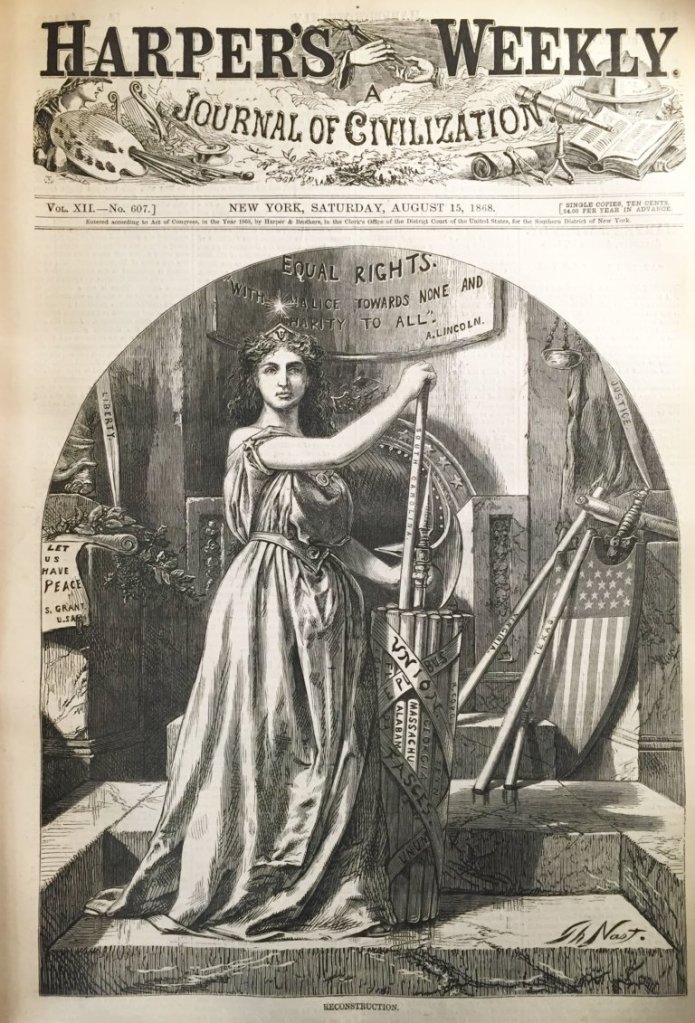
In Columbia (American Minerva) in Harper’s Weekly “Reconstruction” for Equal Rights 1868, we learn that the creator of the symbolism for the Democratic and Republican Party represented another symbol of the Republic, the FASCES as a symbol of Equality and the Abolition of Slavery. The Fasces in American Republicanism, as seen on the walls of the chamber of U.S. Congress represents unification, Law, Order, Justice, our constitution and its interdependent institutions — not the Executive Chief as an authoritarian ruler circumventing courts. The Chief is an upholder of the Law and a representative of the People and Union, rather than its abuser. The sole association in the minds of citizens of the Fasces or the word Republic with Authoritarianism, Oligarchy, Elitism and Racism is an abuse and a sign of decay. You must vigilantly continue to explain this to the People and educate them as a means to protect the People and Constitution.
Columbia, or Minerva was a symbol of the United States before the Statue of Liberty replaced this, yet both the Statue of Liberty and Columbia represent our values. The image and influence of Minerva as the goddess of wisdom and art survives today used on the seal or logo of many institutes of higher learning (Etruscan Visual Representations of the Birth of Athena and Minerva).


 The American Minervan