Category: Theosophy
-

James M. Pryse On The Delphian Key-Note of Esotericism: Plato’s Four Degrees of Knowledge
Theosophist, James Morgan Pryse describes the true meaning of the Delphian axiom, “Man, Known Thyself,” in his highly interesting work, Apocalypse Unsealed: Being an Esoteric Interpretation of Initiation (1910). Pryse argued, that the “Book of the Revelation” of Iaonnes (John) is not a book detailing the past, nor the future; but was a book designed to…
-

Alexander Wilder on Pagans and the Value of the Classical Religions
Limited Knowledge of Religion in Antiquity The term Pagan, or paganus originally meant, an inhabitant of the village, or a peasant, but came to refer to perverted heretical and heterodox beliefs outside of the theology of the Catholic Church. Therefore, what is considered perverted must come from the devil, hence, idolatrous and pagan. The Jews, Christians,…
-

Gottfried De Purucker defines Religion in “Occult Glossary”
What does it mean, when we use the broad term religion? Gottfried de Purucker† (1874-1942), who was head of the Pasadena Theosophical Society from 1929-1942, had a good definition in his Occult Glossary (1933). It follows on pages 148-9: “Religion. An operation of the human spiritual mind in its endeavor to understand not only the how and the why of…
-
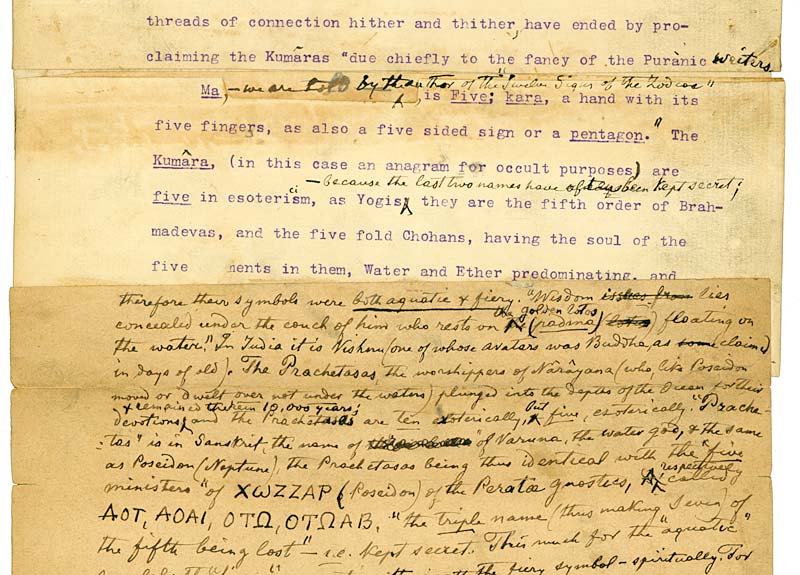
Analysis of the ‘Würzburg Manuscript’ of The Secret Doctrine (1888)
Officially published in 1888, The Secret Doctrine was a project began by HPB. From as early as 1885-86, we find a partial or portion of the manuscript when she stayed in Germany and Belgium this time, called the “Würzburg Manuscript.” In studying how The Secret Doctrine was written, we see the modern example of a work…
-

“Use the Eyes of the Spiritual Intelligence” | H.P. Blavatsky
“First let the student clearly realize that he cannot see things spiritual with the eyes of the flesh, and that in studying, he must use the eyes of the Spiritual Intelligence, else will he fail and his study will be fruitless.” HELENA BLAVATSKY, COLLECTED WRITINGS, VOL. 12, P. 691
-
“The Religion of the Future”
‘No human-born doctrine, no creed, however sanctified by custom and antiquity, can compare in sacredness with the religion of Nature.’ (Helena P. Blavatsky, The Secret Doctrine, Vol. 2, pg. 797) The Religion of the Future [Helena Blavatsky, The Theosophist, Vol. IV., No. 8, May, 1883.] “Occultism teaches us that ideas based upon fundamental truths move…
-
Geraldine Beskin: Manly P. Hall, The Murdered Mystic
The Murdered Mystic Geraldine Beskin’s contribution and insightful lecture at a Theosophical Society in London, U.K. on the life and works of Manly Palmer Hall at the Theosophical Society in London.
-
Survival of Post-Christian Successors to the Mysteries
“Thus it is not Judaism and Christianity that remodelled the ancient Pagan Wisdom, but rather the latter that put its heathen curb, quietly and insensibly, on the new faith; and this, moreover, was still further influenced by the Eclectic Theosophical system, the direct emanation of the Wisdom-Religion. All that is grand and noble in Christian…
-

The Seven Numerations of Nature in the Egyptian Hieroglyphs and Trans-Himalayan Occult Tenet
The Secret Doctrine defends the doctrine on the Seven Numerations of Man and Nature, held by the Trans-Himalayan Occultists’ School taught in the Theosophical system. Helena Blavatsky did not invent Theosophy, nor this concept, but explains it in no way others have hitherto done. She further tied this to Greek Esotericism (Theosophy and Platonism: The Seven…
-

The Context of Alfred P. Sinnett’s ‘Esoteric Buddhism’
A.P. Sinnett’s Esoteric Budhism 1884 In learning about ‘Theosophy,’ it is still wise to return to the very first installments, expressing what it is, namely Alfred Percy Sinnett’s Esoteric Buddhism (online 1884 ed.), or rather Budhism. This 1884 work was the result or learning acquired from correspondences between A.P. Sinnett and the two gentlemen, Koot Hoomi…
-

The God of Plato
It is not that Deity geometrizes with numbers, but in relation to numbers—and the numerical phases of cosmogenesis. “Thus, on the very showing of the defenders of this system the Jewish Deity is proved to be, at best, only the manifested duad, never the One absolute ALL. Geometrically demonstrated, he is a number; symbolically, an…
-

The Truth about the Future Maitreya Buddha in Theosophical Writings
H.P. Blavatsky was a Theosophist and Buddhist, and held to the traditional and Theravada Position regarding Maitreya, which is in conflict with contemporary beliefs originating from later Neo-Theosophical influences of a Christo-Buddhist Theosophical innovation, and reinterpretation of Christology as held by Annie Besant. H.P.B. did not advocate or emphasize any millenarian element, or messianism in Theosophy,…
 The American Minervan