Tag: Occultism
-

A Second Look at Blavatsky on Indigenous People in The Secret Doctrine
There are a couple passages in The Secret Doctrine that come to mind when dealing with accusations against H.P. Blavatsky. When she mentions for example, “sterility between two human races” as observed by Darwin, H.P.B. references Sir William Henry Flower, a leading authority on mammals and especially on the primate brain of his time, in speaking of “semi-animal…
-

Blood, the Universal Proteus: Significance of Blood in Ancient Magic and Religion
“…it was then that I understood for the first time a little of that message proclaimed by my ancestors on the banks of the Ganges thirty centuries ago–‘They who see but One in all the changing manifoldness of this universe, unto them belongs Eternal Truth, unto none else!’” (MODERN SCIENCE AND THE VEDANTA, THE BRAHMAVADIN,…
-

Stunning Visual TIMELAPSE OF THE FUTURE: A Journey to the End of Time
Absolutely contemplative, and stunning visual timelapse of the future, based on modern science, created by Melody Sheep https://www.patreon.com/melodysheep., who creates science videos and soundtrack music mashups. When I first happened onto Timelapse of the Future, it had a near 10 thousand views, and I did not see the date, and thought it was one of…
-

The Evolution of the God-Idea | H.P. Blavatsky on the Limits of the Greeks and Christians
DIVINE THOUGHT, OR CINERITIOUS MATTER (The Secret Doctrine Vol. 1, Page 327): A section from the 1888 work of H.P. Blavatsky’s The Secret Doctrine (pp. 326-28: Divine Thought, or Cineritious Matter) discusses the evolution of the GOD-IDEA. This is the beginning of some far more dense commentary on occult physics that will be central to…
-

Anna Kingsford and Helena Blavatsky on the True Ancient Meaning of Satan
INTRODUCTION — THE JEWISH AND THEOSOPHICAL POSITION, AND DEVIL-WORSHIP Satan יְהֹוָה in its original conception means adversary and differs from the later Dantian and Christian conception of popular imagination. According to H.P. Blavatsky, SATAN, a concept held by other ancient nationalities, “is one of the most profoundly philosophical and ideal conceptions of ancient thought” (The…
-
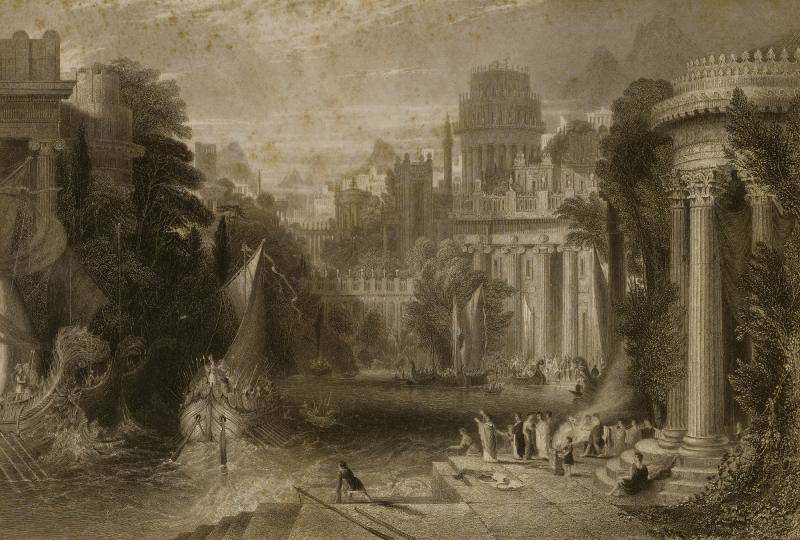
“Your History is Entirely at Sea”: The Legend and Classical Reference to Atlantis
ATLANTIS THE CLASSICAL REFERENCE TO THE MYTH OF ATLANTIS One vital classical source for the Atlantis legendand its remembrance, is from two dialogues writtenby Plato, in Timaeus and Critias.It is described as an island in the Atlantic Ocean.In Timaeus and Critias, Solon, an Athenian andprominent statesman c. 6th c. BCE, described theisland as a country bigger…
-

Maria Carlson on the Influence of Theosophy on Russian Culture in the Russian Silver Age
In September 1990, the Soviet Union officially ended its policy of state-sponsored atheism, approving a tolerant law on freedom of conscience as people were entering the Church in record numbers. The fall of Communism in Russia in 1991 also led to the end of long years of a ban and suppression against Theosophy during the Soviet era.…
-

The Construction of Monotheism: Dever, Stavrakopoulou, LePage, Blavatsky and Others
Prof. William G. Dever (Archaeologist, Anthropologist,University of Arizona) says the Torah is a “Minority Report” “To understand Paul, we have to realize that in antiquity, all monotheists were polytheists by our modern definition. Everyone (…) acknowledged the existence of everybody else’s gods. Back then, not only were you born into cultic obligations to the gods of…
-

Theosophy on Sex and Sex Magic: Suffering, Desire, and Liberation
Originally “Sex in Occult Philosophy,” I wanted to reflect upon and grapple with sex in relation to my life, relationships, and suffering. Rather, this will be mostly about Theosophy and a little reflection on sex in relation to suffering, desire, and spiritual liberation. This is not written as a rule for the general public, but…
-

Theosophy and Platonism: The Seven Principles of the Human Constitution
The concept of the Septenary Constitution describes two distinct beings in man: (1) The spiritual (or monadic); and (2) the physical (or somatic), i.e.— “The man who thinks and the man who records as much of these thoughts as it is able to assimilate.” †In Theosophy, the spiritual constitution is termed the “imperishable triad.” It…
-

Pope Leo XIII’s Encyclical Humanum Genus on Freemasonry
Pope Leo XIII on Freemasonry and the Sacred Congregation on Catholics becoming Masons. Concerning their attitude toward the Freemasons, we may turn to a summation in Pope Leo XIII’s Encyclical on Freemasonry (Humanum Genus). Below is the 1981 document on the Status of Catholics becoming Freemasons in the Church from the Office of the Sacred…
-

Edward Heneage Dering’s “Esoteric Buddhism: The New Gospel of Atheism”
Edward Heneage Dering’s 29 page critique of theosophist A.P. Sinnett’s Esoteric Buddhism, The Occult World, and the Letters in The New Gospel of Atheism” (1887). This work can be compared to Per Faxneld’s Blavatsky the Satanist: Luciferianism in Theosophy and its Implications in its method of quoting, but still manages to misrepresent his opponent. However, what…
 The American Minervan