There is no animosity the writer has against the works of historian, K. Paul Johnson. It is perhaps true to state, that if it was not for K. Paul Johnson, I would have taken no interest as I have been able to replicate in the political and historical side of the history of American esotericism and the Theosophical movement for well near fifteen years.
It is certain, that I am interested in historical contexts, events and lives of persons in the eighteenth-century and leading into the nineteenth-century involved in the founding of the Theosophical Society.
In this sense, K. Paul Johnson’s work is a great contribution to this current of historical research, which lead to a very long legacy of history and endless content. This is undeniable. However, there are persons with all kinds of motive and understanding of this history. What has been the main reason I talk about H.P. Blavatsky? It is primarily, because it is H.P. Blavatsky, that many spurious researchers have an opinion about, that breed more misunderstanding and miss certain other information that counters or seriously questions one or another theory. In the end, what is neglected entirely are the ideological contents of Theosophy, and those we find in the letters of the men regarded as the masters, adepts, disciples and sponsors involved in the early history and operations of the Theosophical Society.
Charles Charlton Massey in 1883 wanted to check a claim made in a letter of K.H. whether K.H. had contact with a German professor and philosopher, Gustav Theodor Fechner. Gustav Theodor Fechner wrote back to Dr. Hugo Wernekke April 1883 and replied yes, that he knew the man referred to, and revealed that K.H. was a student in Leipzig, Germany, but his name was Nisi Kanta Chattopadhyaya. Some contest this account as a mix up. The letter states, that the person Fechner is affirming to Massey was part of a philosophical society and gave lectures on Hinduism and women in Hindu society. At any rate, we cannot say with definite confidence was not Ranbir Singh.
This is the entire problem we are dealing with in the misuse of the names of K.H., Morya, Serapis, D.K. and others eventually made up and placed alongside these men (“I Dread the Appearance in Print of Our Philosophy,” The Mahatma Letter No. 56) as “The Hierarchy” in pseudo-Theosophical orientations. Researchers themselves need these adepts, who did not want their identities or their letters made public, to be grand princes, high dukes, and fantastical personalities of wealthy and notable fame more than Blavatsky who says she is not to blame for myths about them.
As K. Paul Johnson explains in Occultists with Aliases Face Unintended Consequences, there is a long history of occultists taking on aliases through literary pseudonyms, but what are we to make of these wild and contradictory claims of many as to the identity of her “Tibetan?”
I have addressed Alice Bailey’s claims about Djwhal Khul. K. Paul Johnson’s theory was that the original Gjual རྒྱལ Khool ཁུལ (or Djual Kul)1 involved with Morya and Koot Hoomi was Sardar Dyal Singh Majithia (Initiates of Theosophical Masters: 1995, 49). Now, this suspicion of K. Paul Johnson is a theory mind you, not a fact. The main point is that such theories are treated as established or concluded facts by other researchers, which they are not.
There is another theory advanced by Alice Bailey, which takes us into a different direction than K. Paul Johnson’s theory, that the original Djual Kul was Dyal Singh Majithia.
So, who was Alice Bailey’s “Tibetan?” Continuing on from Alice Bailey’s Alleged Tibetan Buddhist Source and Political Idealism, Alice Bailey’s “Tibetan” writes like an apocalyptic evangelist with a familiar anti-Jewish Protestant attitude, and the books of Bailey do not continue the trend from the works of H.P. Blavatsky in the Key to Theosophy in 1889 criticizing prejudices and racist attitudes. Bailey’s works into the twentieth-century perpetuates prejudices about Australian Aboriginals, Japanese people after the war, Arabs, people of African-descent and Judaism.
Bailey’s books critique the Theosophical Society, C.W. Leadbeater and the illusions of astral psychism, as if this could not describe its own content.
In 1919, after leaving the Theosophical Society, Bailey described receiving impressions from a figure she first called “the Tibetan,” whom she later named Djwhal Khul. Elizabeth Claire Prophet made the claim, that Bailey’s “Tibetan” was not a Tibetan, but Casper the Biblical magi mentioned in Matthew 2:1-9!
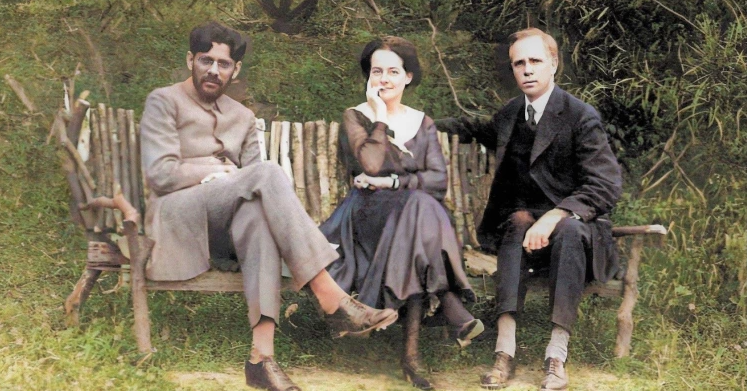
“The Tibetan” of Alice Bailey claims that he is a resident in Northern India, as an abbot and senior executive in a large monastery (Externalisation of the Hierarchy, 682) at the Tibetan border. Alice Bailey explained in her Unfinished Autobiography, that The Tibetan sent her physical parcels and teachings from Tibet (e.g., the Diamond Sutra) and was an abbot living in Tibet.
Some therefore have incorrectly argued, that the identity of “The Tibetan” could be the 9th Panchen Lama, Thubten Choekyi Nyima (1883–1937), but this is not true for two reasons. The first reason is that the travels of Henry Albert Carpenter (1869-1937) in 1926 and 1930, a wealthy American theosophist and Buddhist convert who was in search of “The Tibetan” and the 9th Panchen Lama traveled to Shigatse seeking access to the Tashilhunpo Monastery. This information is taken from Douglas Veenhof’s book, White Lama: The Life of Tantric Yogi Theos Bernard, Tibet’s Lost Emissary to the New World. Carpenter was denied entry to Tibet in 1926 by the Dalai Lama when he made his way to Darjeeling in search of Thubten Choekyi Nyima.
Henry Carpenter had heard of the Panchen Lama’s travels to China, so he left for Beijing, and met the Panchen Lama at Mukden palace (now Shenyang Museum) where he took his Buddhist vows from him. Carpenter acquired permission in 1930 to enter Tibet but was only confined to staying in Gyantse around the Bungalow Dak. Carpenter did not reach Shigatse.
The Panchen Lama continued traveling after this time around Inner Mongolia, while staying at the Huangxi Monastery as his main residence.
If it is not known already, Henry Albert Carpenter belongs to a history of forgotten influence in bringing Yoga and Tibetan culture to America, and he was one of the founding members of Alice Bailey’s “Arcane School” in 1923. Alice Bailey recounts of Henry A. Carpenter, that he became friends with a famous Tibetan named General Laden Lha, who was head of the secret police of the Himalayas. Alice Bailey explains the story of her receiving the gift of an incense, which an abbot gave to Carpenter in her Talk to Arcane School students given on Friday, April 9, 1943. In Carpenter’s travels in Tibet, he met with a lama (a Tibetan Buddhist spiritual teacher) or abbot who asked him about Mrs. Bailey.
When Carpenter came back to England, he told the story of him meeting this abbot, who Bailey states was actually “the Tibetan,” and later claimed was also the original Djual Kul involved with Morya and Koot Hoomi.
“The Tibetan” of Bailey whom she later identified as “Djwhal Khul” is claimed to be an abbot of the Tashilhunpo Lamasery, but he is not Thubten Choekyi Nyima, the ninth Panchen Lama. Due to political tensions at the time, after the death of the 13th Dalai Lama in Tibet, the Panchen Lama was exiled to Mongolia and China.
Thubten Choekyi Nyima had no direct ties to Alice Bailey. Here we have a problem within the historiography.
The Panchen Lama (Thubten Choekyi Nyima) had documented ties to early Theosophy, and the broader critiques of Alice Bailey’s teachings as a form of “Neo-Theosophy” (or pseudo-Theosophy), which has been mentioned in prior entries. The Panchen Lama publicly endorsed the 1927 edition of Helena P. Blavatsky’s book “The Voice of the Silence” (1890), which she presented as her translation and commentary of a supposedly secret Tibetan book called “”Book of the Golden Precepts.” This work was therefore recognized by an authority of Tibetan Buddhism as a representation of high Mahayana Buddhist teaching.
One of Blavatsky’s original “Inner Group” members, Alice Leighton Cleather (1860–1938) broke from the Society in the 1920s, due to its shift toward “Neo-Theosophy” under Annie Besant and C.W. Leadbeater. Cleather’s collaborator and theosophist, Basil Crump (1874–1937) shared her commitment to the “back to Blavatsky” movement.
Theosophy World explained her life in Alice Leighton Cleather:
Cleather was intensely loyal to the teachings of Blavatsky and in 1899 she disassociated herself from the two theosophical groups on the grounds that they were deviating from the pure Blavatsky teachings. In 1920 she was one of five Europeans to take Buddhist vows at Buddha Gaya under the auspices of Geshe Rompoche at the Donkar monastery, Chumbi Valley. These were the first Europeans so to do. At the end of 1925 she journeyed to Peking and met the Tashi Lama who gave her a Buddhist “Testimonial” which read:
Special Gelukpa Buddhist of the English race, faithful and devoted, to be treated as a Buddhist, to be afforded every assistance and help, and not to be injured or wrongfully opposed.
She also received a special passport for Tibet and in company with Basil Crump and her son traveled into Tibet and then down the Yellow River where they were robbed by bandits, arriving at Sining in North West China after six months of exhausting travel. From Sining she traveled by air back to Peking and there published two pamphlets in Chinese: Why I Believe in Buddhism, and Some Thoughts on Buddhism.”
Both Basil Crump and Alice Cleather published the edition of the “The Voice of the Silence” in 1927. This explicit endorsement from the Panchen Lama came during his 1924–1933 exile in China.
The Panchen Lama, as head of the Gelugpa order of the Yellow Hats remains rooted in Tsongkhapa’s non-theistic, tantric traditions. He praised Blavatsky’s work as an alignment with genuine Mahayana and Vajrayana teachings, bridging Theosophy and Himalayan esotericism.
In 1929, Cleather and Crump co-published The Heresy of Dr. Besant in Calcutta, warning against the “Neo-Theosophical” distortions introduced by Besant and Leadbeater through their clairvoyant innovations of “deva evolutions,” the World Teacher campaign, and hierarchical dogmas advancing a quasi-Christian esotericism.
Then, they set their eyes on Bailey’s teachings, channeled from 1919 onward (e.g., Initiation, Human and Solar, 1922). Bailey’s teachings were seen as a further degeneration, through the blending of Theosophy with New Age messianism, Vatican-Jesuit reconciliations, and a theistic “Hierarchy” Cleather and Crump labeled as Christianized pseudo-Theosophy. Surely, Alice Bailey herself critiqued Besant and Leadbeater’s “neo-Theosophy” directly but then turned and developed her own hierarchical and avatar-centered teachings.
In 1933, Alice Cleather wrote “H.P. Blavatsky: A Great Betrayal,” further tying Bailey to these trends as teaching a more semi-Gnostic Christianity, than a non-theistic Theosophy, and lacking more and more a connection to esoteric Tibetan teachings.
Later on, Victor Endersby continued in this direction, noting the differences between Theosophy and Bailey’s “transcendental materialism.”
The Panchen Lama’s endorsement of Blavatsky ties him to Cleather and Crump, positioning him as a validator of non-theistic Theosophy against its later and more popular Christianized offshoots; particularly given, that the Panchen Lama remained in his Gelugpa orthodoxy of non-theistic and tantric orientation. He spent his time in China involved in Kalachakra initiations, not channeling schemes to bring to Rome and the Vatican the seat of spiritual power, as Bailey and her “Tibetan” source sought after.
Theosophists do not believe that a Hierarchy of advanced and immortal beings are being prepared to externalize and govern theocratically through a Unified Church. Such a mission represents a very different path from ours, although the damage to the reputation of Theosophy has been done in by internal and external factors. We still cannot conclude academically who was the identity of Bailey’s source who dictated 24 books to her and is the abbot she claims Henry Carpenter met.
We are able to identify contradictions and discrepancies in Bailey’s works and claims, which are both equated with or asserted to be an evolution of H.P. Blavatsky, and her teachers work.
One of those teachers writes about seers and their contradictions:
“. . . You have heard of and read about a good many Seers, in the past and present centuries, such as Swedenborg, Boehme, and others. Not one among the number but thoroughly honest, sincere, and as intelligent, as well educated; aye, even learned. Each of them in addition to these qualities, has or had . . . a ‘Guardian’ and a Revelator — under whatever ‘mystery’ and ‘mystic name’ — whose mission it is — or has been to spin out to his spiritual ward — a new system embracing all the details of the world of Spirit. Tell me, my friend, do you know of two that agree? And why, since truth is one, and that putting entirely the question of discrepancies in details aside — we do not find them agreeing even upon the most vital problems — those that have either ‘to be, or not to be’ — and of which there can be no two solutions?” (K.H. The Mahatma Letters, Chronological, no. 48)
As was demonstrated in the article Sarat Chandra Das the Bengali Spy, Sengchen Tulku and the Maha-Chohan Connection, there are theo-political complexities in this connected history involving Theosophists in Asia, that cannot be easily ignored or dismissed.
Alot of people won’t like me very harshly critiquing twentieth-century “New Age spirituality” from a Theosophical view (not a Christian Evangelical or the Catholic view), because that period still exercises the most influence. Theosophy is not “irrelevant” because it is not needed, but because the public likes “New Age spirituality” more, and undoubtedly, Theosophists today have compromised and changed to suit this culture to their own detriment. This has only hurt and further diluted a solid understanding of Theosophy.
The “new teachings” as Alice Bailey framed her works and her prophecies, which did not come to fruition provide certain minds a comfort, and not too much of a challenge to religious conditioning.
The concept of the avatar, the mixture of Avalokitesvara manifestations, Shambhala lore, Christian and Kalachakra theo-political prophecies, and Christian expectations of the return of Jesus Christ have nothing to do with Theosophy or my own views. Humanity may have to learn that the hard way in its hunger for external “saviors” and idols in the form of leaders.
These concepts and beliefs prove to play a conceptual and concrete complex role within the turmoil of the twentieth-century.
- Despite the lack of standardization in spelling at the time, we are able to still find that the meaning of the name suggests some epithetic allusion to Shambhala. K.H. states in a letter (The Mahatma Letters, no 75), that Gjual “is the real spelling” of his name “but not so phonetically.” ↩︎
 The American Minervan
Leave a comment