
INTRODUCTION TO THE KALERGI CONSPIRACY
The Kalergi conspiracy has its roots in 1930s German National Socialist vilification of Kalergi for his pro-unity, anti-war views, and directly in the propaganda of Joseph Goebbels. Goebbels portrayed Kalergi’s vision of European federation as a Eurasian-Negroid dystopia ruled by Jews. Austrian Holocaust denier Gerd Honsik revived it and reformulated the propaganda into a far-right conspiracy myth within neo-Nazi circles in the early 2000s, falsely portraying Kalergi as plotting white genocide through immigration. Conspiracies stitch together selective quotes, historical events, and modern policies into a narrative alleging a deliberate “Kalergi Plan” for racial genocide and global control. This is a classic example of a conspiracy theory that distorts the writings and life of Richard Nikolaus von Coudenhove-Kalergi (1894–1972), a Catholic Austrian-Japanese philosopher and advocate for European unity.
Kalergi’s books were banned by the Nazis, as part of their actions, as detailed in Maurice Joly: Origins of the Protocols of Zion and its Impact on Theosophy, to persecute occultists and theosophists, confiscate and burn their books, ban their organizations, and send them to the concentration camps right along with Jews, Christians and other enemies of the State. It is vital to emphasize a parallel tactic of the dog-rancid attacks from Great Replacement propagandists in our day. These are concerted, financed and informational efforts to shift the cultural sentiment, to understand and mobilize in reaction to immigration policies and population migration shifts.
This article has been re-published and heavily modified from its 2018 version.
KALERGI’S VISION OF EUROPE, VIEW OF JEWS, SPIRITUAL NOBILITY AND ETHNIC CONFLICTS.
ARNOLD TOYNBEE’S INTERNATIONALISM AND THE STRUGGLE OF IDEAS
Toynbee discusses the erosion of national sovereignty in favor of international institutions. “The Trend of International Affairs Since the War” was delivered at the Fourth Conference of Institutions for the Scientific Study of International Questions in Copenhagen on June 30, 1931. It was fully published in International Affairs: Journal of the Royal Institute of International Affairs, Volume 10, Issue 6 (November 1931), pages 803-826.
Arnold Toynbee on The Trend of International Affairs Since the War (1931):
“In the world as it is today, this institution can hardly be a universal Church. It is more likely to be something like a League of Nations. I will not prophesy. I will merely repeat that we are at present working, discreetly but with all our might, to wrest this mysterious political force called sovereignty out of the clutches of the local national states of our world. And all the time we are denying with our lips what we are doing with our hands…” (Address to the 1931 Copenhagen conference as published in International Affairs: Journal of the Royal Institute of International Affairs, November 1931)
“If we are frank with ourselves, we shall admit that we are engaged on a deliberate and sustained and concentrated effort to impose limitations upon the sovereignty and independence of the fifty or sixty local sovereign independent States which at present partition the habitable surface of the earth and divide the political allegiance of mankind. It is just because we are really attacking the principle of local sovereignty that we keep on protesting our loyalty to it so loudly. The harder we press our attack upon the idol, the more pains we take to keep its priests and devotees in a fool’s paradise — lapped in a false sense of security which will inhibit them from taking up arms in their idol’s defense. The local national state, invested with the attributes of sovereignty — is an abomination of desolation standing in the place where it ought not. It has stood in that place now — demanding and receiving human sacrifices from its poor deluded votaries — for four or five centuries. Our political task in our generation is to cast the abomination out, to cleanse the temple and to restore the worship of the divinity to whom the temple rightfully belongs. In plain terms, we have to re-transfer the prestige and the prerogatives of sovereignty from the fifty or sixty fragments of contemporary society to the whole of contemporary society — from the local national states by which sovereignty has been usurped, with disastrous consequences, for half a millennium, to some institution embodying our society as a whole.”
I thought of Arnold Toynbee’s bold proclamations in relation to the Kalergi conspiracy, which I will deal with at length in this article. Toynbee, in his position of political-international influence expresses there a relatable frustration against certain divisive political ideologies and propaganda tactics that proliferate in the public mind as strong (or stronger) than any intelligence operation can do. The Kalergi conspiracy relies greatly on fabricated quotes to portray a bold and nefariously, deliberate plan (or contribution or use of Kalergi’s ideas) to eradicate white Europeans through mass non-white immigration, interracial breeding, and cultural replacement, ultimately creating a “Eurasian-Negroid” underclass governed secretly by a Jewish elite plutocracy. It re-circulates during new migration cycles; but essentially, I put Kalergi’s vision of Europe against the obsessive psychic clutch of Third Positionism and American Bill “The Butcher” attitudes on Western minds into our period post-Nazi era and post-WWII.
I argue that the ignoble racist attitudes of the White ethno-nationalists — who would like to be boastfully proud of their forefathers’ adventures of conquest will speed the “degeneration of the West” and help nobody.
The current struggle of the American and the European is a struggle of character, of the value of truth, ethnic tension, lack of care for ancient history, racial animosities, racial jealousies, loss of higher IDEALS, the death of traditional VIRTUES, IDENTITY, IDENTITARIANISM, and rebrandings of nineteenth-century scientific racism (and Nordicism). We are told that our inability to reform within is due to intellectual deficiencies, or the inherent failure in the ideal of “multiculturalism” due to race realist obsessions and manipulated statistics about the crime percentage and lack of intelligence of particular demographics.
In the place of the dethroned spiritual ideas drowning in the sea of modern conspiracy theories, we are instead bombarded with balkanic and segregationist fantasies of organizing civilization on the agreed upon rule that every “race” just ought to go their separate funny ways. Also, that if their racialist fantasies are not achieved, then we ought to live constantly aside the madness of teens and anon tech-nerds with their armies of bots across social media contributing to racism and mass psychosis. Many of us are told, like Kalergi, that we do not belong to Western civilization, but the fate of the Americas and Europe, as anywhere else depends on the collective action, mind and character of the peoples of its regions. Kalergi speaks entirely to the European, a heritage the Nazis denied his claim of. In this sense, the power of Kalergi’s vision holds against the false face of so many contemporary conflicting ethno-nationalist influences.
KALERGI’S PAN-EUROPEAN MOVEMENT AND HIS FIGHT TO END ETHNIC CONFLICTS
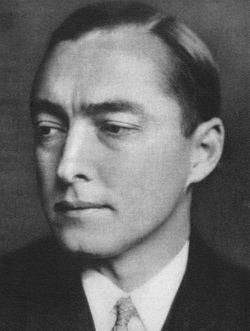
Richard von Coudenhove-Kalergi was the founder and President of the Pan-European Union for 49 years (the forerunner to the European Union), and count of an Austro-Bohemian noble family of Catholic barons being of mixed Flemish and Cretan Greek descent. Kalergi was awarded the prestigious first Charlemagne Prize.
In his work, Praktischer Idealismus (Practical Idealism, 1925), Kalergi describes the role of “Jewish emancipation” during the fall of power in Europe’s feudal aristocracy, and against the phenomenon of modern antisemitism.
It is said, that Count Coudenhove-Kalergi believed in the spiritual supremacy of the Jews, referring to Trotsky as the frontrunner of modern politics and Russian Bolshevism as being a step forward towards the man of the future — the mixed-race Eurasian-Negroid. However, when you read his writings, he is criticizing Bolshevism.
These claims put forth about his work are presented as evidence of Kalergi’s desire for a “homogenous, multi-racial mass” through forced race-mixing, similar to ancient Egyptians. This implies erasure of white Europeans. On “Inbreeding—Interbreeding” (pp. 20-23), he observes neutrally and speculatively on the evolutionary direction, stating that, “The man of the future will be of mixed race. Today’s races and classes will gradually disappear owing to the vanishing of space, time, and prejudice. The Eurasian-Negroid race of the future, similar in its appearance to the Ancient Egyptians, will replace the diversity of peoples with a diversity of individuals.”
Kalergi here does not call for forced immigration or destruction, but it’s a speculative, evolutionary prediction about globalization eroding isolation, leading to greater individual variation, not uniformity. It is certain, that Kalergi’s multicultural background (as half-Japanese, half-Austrian) and experiences fleeing Nazi persecution led him to advocate for a voluntary, peaceful European federation to prevent future wars in the age of world madness.
Austrian Parliament member Martina Edlinger once cited Karl Stojka (1931-2003), an Austrian Roma Auschwitz survivor from his memoirs:
“It was not Hitler or Himmler who abducted me, beat me and shot my family. It was the shoemaker, the milkman, the neighbor, who received a uniform and then believed they were the master race.”
The so-called master race did not like Kalergi’s vision. His books were burned by the Nazis in 1933.
KARLEGI COMPARES JEWISH RESILIENCE AND THE CODE OF THE SAMURAI
He contrasts inbred (rural, uniform) types with hybrid (urban, diverse) ones, arguing that mixing produces “original personalities” and adaptability, using Russians (a “Slavic-Tatar-Finnish hybrid”) as a positive European example. Kalergi viewed this as progress toward peace, reducing ethnic conflicts by emphasizing personal diversity over national homogeneity.
Kalergi’s concept of spiritual nobility here will become important, since he is describing what he saw as an inevitable evolution toward individualism over rigid racial or class divisions, similar to how ancient Egyptians represented a blend of influences. He viewed this positively as progress toward peace, though assuming European (white Christian) culture would dominate and absorb others, not be erased.
True nobility for Kalergi comes from character and intellect, liberal in quality (open to all) and rejecting racial hierarchies. For him, the future belongs to those who overcome prejudices. Due to his Japanese heritage, Kalergi compared Jews to the samurai for their ethical code. He praised “spiritual nobility” emerging from mixing (e.g., Jews as an “intellectual urban master race” refined by history, pp. 49-54), mirroring eugenics aspirations common in the 1920s, but not as a policy for “colonizing” Europe. This is seen when he states, that:
“Instead of destroying European Jewry, Europe, against its own will, refined and educated this people into a future leader-nation through this artificial selection process. No wonder that this people, that escaped Ghetto-Prison, developed into a spiritual nobility of Europe. Therefore a gracious Providence provided Europe with a new race of nobility by the Grace of Spirit. This happened at the moment when Europe’s feudal aristocracy became dilapidated, and thanks to Jewish emancipation.” (Coudenhove-Kalergi, Praktischer Idealismus, 1925)
This comparison of Jewish resilience to the samurai is also most strongly expressed by Kalergi in Chapter 7 titled “The Jewish Race” (Die jüdische Rasse):
“The prominent position held by Jewry these days is due to a number of fortunate circumstances which, taken together, have brought about an artificial over-emphasis of the influence of Jewry. (…) The Jews … have strengthened certain desirable qualities. In proportion to their numbers the Jewish race produces a greater number of men and women with aptitude for business than any other; it can claim more than its share of genius – mathematics, philosophy, and in every form of art. Had the Jews been destitute of a deep love and sympathy for the weaklings and failures of their own denomination – they might have been by this time a race of supermen. … That the Jews have by virtue of that very love and sympathy remained a race through thousands of years of persecution and dispersion is an eloquent testimony to the vitality of that race. (…) The Jewish race, which has preserved its blood and its customs better than any other, has thereby become a model for the future spiritual nobility of Europe.” (Richard von Coudenhove-Kalergi, Praktischer Idealismus, 22)
MODERN PROPAGANDA AS REPETITIONS OF NATIONAL SOCIALIST PROPAGANDA
The Kalergi conspiracy incorporates this into “Great Replacement” fears. Great Replacement propaganda deliberately fabricates quotes, such as claiming Kalergi said “We intend to turn Europe and North America into a mixed mongrel race of Asians and Negros ruled over by the Jews,” and developed a bullet-point plan to subvert Western Civilization. No primary sources out of the more than thirty-books and speeches recorded of Kalergi speak of a “mixed mongrel race.” Repeating this merely repeats the slurs used by the National Socialists.
As half-Japanese and half-European with “no sense of belonging,” he allegedly sought to “destroy the indigenous European race” according to the gross misreadings of his writing. In reality, born in Tokyo to an Austrian diplomat father (Heinrich von Coudenhove-Kalergi, a multiculturalist) and Japanese mother (Mitsuko Aoyama), Kalergi grew up in Austria-Hungary and identified strongly as European. His hybrid heritage informed his globalism, but he was a fervent advocate for European unity against threats like Bolshevism and Fascism. Kalergi’s vision in Practical Idealism celebrated Europe’s technological greatness as a bridge to global harmony (pp. 75, 145), with no calls for “forced immigration” or erasure.
The tactic of labeling this “one of the most extreme racist doctrines” inverts his anti-nationalist, pacifist stance. This tactic is common in antisemitic conspiracies portraying him falsely as a Jewish puppet.
Kalergi’s ideas are claimed to be “successfully implemented” today through the frameworks of Critical Race Theory (CRT) and DEI, implying a covert racial agenda, but this is an anachronistic projection. CRT (emerging in the 1970s-80s) critiques systemic racism in law; and DEI addresses workplace diversity for fairness and equity. Kalergi wrote decades earlier about ethical meritocracy, not identity politics. His notion of “spiritual aristocracy” referred to uplifting society through intelligence, which is vital to democracy, not quotas or anti-white bias (pp. 10-13). The connection is fabricated to tie unrelated progressive policies to genocide.
There is a claim, that the Pan-European Movement began in 1922 post-WWI, allegedly with the idea of using European integration to create a global federation under U.S. leadership, manipulating immigration for demographics.
However, the Pan-European Union started in 1923, not 1922 aimed to unite Europe democratically as a counterweight to U.S. and Soviet power, preventing wars through economic ties and arbitration, not a “New World Order” or immigration scheme. The Kalergi conspiracy is revealed to be conspiratorial fiction when closely examined. George H.W. Bush’s “New World Order” speeches (1990-91) referred to post-Cold War multilateralism (e.g., UN cooperation against Iraq) and differs from Kalergi’s work.
Post-1965 policies did not prove to be a premeditated plan for rapid racial change, tied to Kalergi. The Hart-Celler Act abolished the 1921-1965 national origins quotas (favoring Northern Europeans) to end racial discrimination. This was driven by civil rights momentum, Cold War optics, and family reunification. It capped Western Hemisphere immigration at 120,000 annually, prioritizing skills and relatives, as opposed to a forced inflow from Africa, Asia and the Middle East. According to Migration Policy, demographic shifts resulted from global economics, wars, and voluntary migration, not a concise, agreed-upon plot. Kalergi died in 1972, never referencing U.S. policy; and his writings lack an immigration scheme, as no such views exist in Practical Idealism (see pp. 63–69). Refugee acceptance stems from humanitarian laws (e.g., 1951 UN Convention), and not Kalergi’s influence.
THE NEW EUROPEAN MAN
Kalergi never advocated mass migration or state-enforced mixing, and his focus was voluntary cultural exchange in a united Europe to rival superpowers like the U.S. and USSR. This claim against Kalergi relies on out-of-context quotes and invented connections, perpetuating racial fear and ethnic division. Kalergi’s legacy appears to be one of hopeful federalism for peace, and not destruction or European erasure. In his book, Praktischer Idealismus, Kalergi praises Europe’s “spiritual and cultural superiority” and envisions a federation preserving national identities, not dissolving them, writing that “The European must become a new man (…) but he will remain European.”
This “NEW MAN” in his emancipatory vision of human liberation is the regenerated, ethically elevated European mentioned in Chapter 9 (“The Nobility of the Future”), and is similarly carried in the expression of my writings about the American. They, the NEW MAN, will emerge from a synthesis of traditional nobility and modern intellect, liberated from materialism to lead a unified Europe ethically. The NEW MAN is a regenerated figure embodying progress without abandoning heroic European VIRTUES. He continues to reiterate this point in chapter 16 of Praktischer Idealismus on Pacifism, where he states, that to remain Europeans today is not only a fate, but a duty, upon which depends the future of each and every individual. Man will achieve this through moral and ethical renewal, not war and ethnic division.
Within the context of Europe’s post-WWI identity and pacifist movements, Kalergi explains, that true unity requires Europeans to evolve, while retaining the rational, heroic spirit — in opposition to passivism in Asia and American materialism. Thus, we can argue that Kalergi’s true theosophic vision and federation of European brotherhood, peace and cultural elevation has not been realized. It is fought against ignorantly by conspiracists of the Joly-type of our era, and those apathetic to ideals of renaissance, ethical revolution and self-reform.
 The American Minervan
Leave a comment