
INTRODUCTION
The fasces did not emerge fully formed in Rome and has its roots in prehistoric traditions. Few symbols encapsulate the ideals of unity, authority, and disciplined governance as profoundly as the fasces. In the American psyche, the fasces became tied to Italian Fascism, Adolf Hitler and the hellish drama of World War II. Symbols can embody entire worldviews and philosophies, many which in their origins have cherished spiritual and civil meanings. A fasces is a bundle of sticks or rods (mainly wooden) bound together, often with one or a double-headed axe; but in the symbolism of American and French Neoclassical Republicanism, the axe is sometimes removed from depictions. Long before its co-optation by twentieth-century Fascist regimes, the fasces traced a lineage through Mediterranean civilizations, embodying the philosophical roots of Republicanism in Rome and later inspiring America’s founding vision. This paper strongly provides archaeological evidence and historical texts exploring its true origins, beginning with ancient Crete, its developments in Etruscan and Roman contexts, and its enduring ties to classical philosophy, neoclassicism and revolutionary politics.

This paper is both a follow-up to the recently revised E Pluribus Unum: The Classical Roots of America’s Motto and the Forgotten Meaning of Unity in the Founding Era and built upon and celebrates the first and most comprehensive global history of the fasces in the work of T. Corey Brennan’s The Fasces: A History of Ancient Rome’s Most Dangerous Political Symbol (2022). The book was also introduced in the Antigone Journal in the article The Fasces: A History of Ancient Rome’s Most Dangerous Political Symbol. Brennan’s work traces the symbol’s origins, evolution, and shifting meanings over nearly 3,000 years, from Etruscan roots through the Roman Republic and Empire, medieval and Renaissance receptions, revolutionary adaptations, American usages, Mussolini’s Fascist appropriation, and post-World War II efforts at eradication. The fasces was a bundle of wooden rods typically bound with a leather strap around a single-bladed axe, functioning as a portable instrument of corporal and capital punishment in ancient Rome. Brennan emphasizes the fasces’ original role in evoking both respect and terror as a marker of imperium (magisterial authority), while later interpretations often softened or transformed it into a symbol of unity, justice, or republican liberty.
The book divides roughly into two halves, because the first chapters 1-7 focus on antiquity, drawing heavily on literary sources (e.g., Livy, Dionysius of Halicarnassus, Polybius, Cicero) and material evidence, which will be covered chronologically; and the second half of the chapters explore post-classical receptions. This provides a map to trace the sources.
Tracing this history, the fasces became a symbol forged in Cretan rituals, refined in Etruscan tombs, elevated in Roman thought, and an inspiration on the American experiment in self-rule. Far from authoritarianism, its true essence lies in unity tempered by liberty, as depicted in The Organic State of Fascism: Two Commandments of Rule.
The symbol persisted in Latin texts as representing “supreme power,” with rare artistic depictions until late 15th century, often signifying justice and authority. Medieval glosses associate the fasces with official honors, but visual representations are scarce until Renaissance humanists revive accurate depictions as depicted in the Iconologia (1603 edition) of Cesare Ripa. This gets into an important part of this history in the late 15th century that involves the role of Renaissance humanists’ and their grasp of its appearance. Brennan’s The Fasces explained, that Renaissance Humanists avoided its history of terror-inducing psychological impact that was criticized by Cicero as a misuse of the symbol. The world was forced to witness this side of its imperial meaning when Mussolini revived it as a symbol of the totalitarian State. Perhaps, Mussolini never read Cicero. This development however did not come from thin-air. Despite this development, fasces symbolism persisted into the Byzantine era and it was due to modern unfamiliarity, that allowed such extremist appropriations as in Italian Fascism.
Adoption in royal iconography from the British, Dutch and Spanish arms and neoclassical revival of fasces symbolism continued to all emphasize authority and justice. Post-Renaissance emblem books and royal medals featured the fasces as a symbol of legitimate force (Ripa, Iconologia 1709).
Mussolini’s 1919 revival is definably an authentic reconstruction through archaeology, defining the fasces as “unity by means of authority” in Fascist propaganda, architecture and state symbols. Mussolini propagated the fasces on coins, stamps, and buildings to connect the regime to Roman glory (Baxa 2010). This act in adopting the fasces is similar to Mussolini’s appropriation of Mazzini. By post-1945, there was an uneven purge of the fasces throughout Europe and America, (e.g., the U.S. removed the fasces from the U.S. dime). Post-WWII efforts removed the fasces from many symbols, but remnants persist (Quinn 2017) and modern extremist reuse is again due to its obscurity.
CONTENTS
- INTRODUCTION
- ANCIENT ORIGINS: MINOAN (2700–1400 BCE)
- ETRUSCAN ADOPTION (7TH–6TH CENTURY BCE)
- ROMAN MONARCHY AND EARLY REPUBLIC (C. 616 BCE – 509 BCE)
- INTO THE ESTABLISHMENT OF THE ROMAN REPUBLIC (509 BCE)
- CLASSICAL ROMAN REPUBLICANISM (REPUBLICAN ERA, c. 509 BCE – 27 BCE)
- CICERO’S CRITIQUE OF LICTORS’ ABUSES IN PROVINCIAL GOVERNANCE
- CONSUL ON RESTRAINING USE OF AUTHORITARIAN POWER
- FASCES IN MODERATE POLITICAL RHETORIC
- THE FASCES CONNECTION TO REPUBLICAN IDEALS IN BRENNAN’S WRITINGS
- ANCIENT AESOP’S FABLE (ANCIENT, ATTRIBUTED TO 6TH CENTURY BCE)
- AESOP’S FABLE CONNECTION TO THE FASCES
- NEO-CLASSICAL REINTERPRETATION
- CLASSICAL ROOTS RECONSTRUCTED FOR REVOLUTION
- FRENCH REVOLUTION (1789–1799)
- LEGACY IN THE FRENCH REPUBLIC
- AMERICAN NEO-CLASSICAL REPUBLICANISM (LATE 18TH–19TH CENTURY)
ANCIENT ORIGINS: MINOAN (2700 𔓘 1400 BCE)
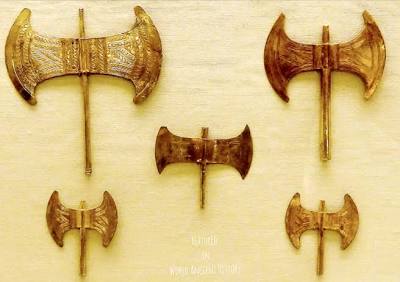
The origins of the fasces is rooted in prehistoric traditions, beginning with a prosperous maritime society known as the Minoans who flourished on Crete during the Bronze Age from 2700 to 1400 BCE. This maritime society in Bronze Age Crete is part of the dawn of European Civilization, thousands of years before classical Greek civilization. In Minoan Crete, the fasces earlier in the shape of the double-axe, called the labrys; and the labrys served as a sacred emblem in religious rituals, often associated with the Mother Goddess and found in palace shrines like Knossos. The term labyrinth etymologically may derive from labrys, demonstrating shared origin to the mythic palace of Minos and its ceremonial power.
This double-headed axe motif persisted into later periods, appearing in Roman Crete and beyond, where it symbolized divine authority and protection.
Scholarly inquiries suggest connections to Minoan Crete, where the double-axe, or labrys, served as a sacred emblem in religious rituals, often associated with the Mother Goddess and found in palace shrines like Knossos. Etymologically, the term “labyrinth” may derive from labrys, linking it to the mythic palace of Minos and its ceremonial power. This double-headed axe motif persisted into later periods, appearing in Roman Crete and beyond, where it symbolized divine authority and protection.
This is a picture of a golden labrys, demonstrating prehistoric craftsmanship from Minoan Crete before 1600 BCE. Its curved blades flare outward like the wings of a sacred bull, forged from polished bronze with engravings along the handle relating to the ritualistic motifs of fertility and divine power.
ETRUSCAN ADOPTION (7TH 𔓘 6TH CENTURY BCE)
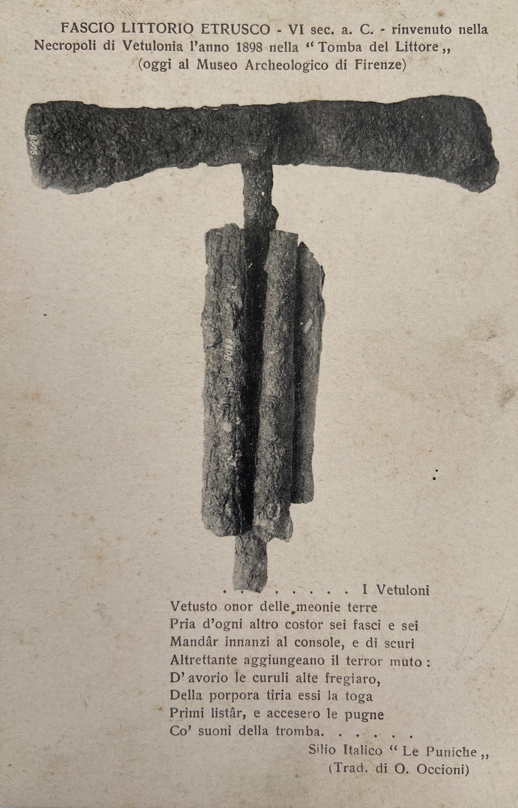
By the seventh century BCE, the symbol had migrated to Etruria, the heartland of the Etruscan civilization in central Italy. Archaeological finds, such as a miniature fasces with a double-headed axe unearthed in a tomb at Vetulonia (dated to around 650 BCE), establishes its Etruscan provenance.
This rusted artifact depicts an iron fasces from an Etruscan tomb in Vetulonia. Its slender rods are bound in a compact bundle around a petite double-headed axe.
The Etruscan culture blended indigenous Italic elements with Aegean influences and used the fasces as a marker of magisterial power. Ancient sources, including the geographer Strabo, attribute its transmission to Rome during the era of the Etruscan kings, such as Tarquinius Priscus (r. 616-579 BCE). In this pre-Roman phase, the fasces represented not just coercion, but collective strength with unbound unity. Archaeological finds, such as miniature fasces with a double-headed axe unearthed in a tomb at Vetulonia (dated to around 650 BCE), confirm its Etruscan provenance.
It traces its roots to Etruscan kings as confirmed by mid-7th century BCE miniature fasces from Vetulonia tomb. Archaeological evidence from the “Tomb of the Lictor” at Vetulonia (c. 630-625 BCE) includes a double-headed axe variant, supporting literary claims of Etruscan origin (Falchi 1898; Bonfante 2003). Roman tradition attributes 12 lictors (attendants) carrying fasces before kings, symbolizing full imperium and punitive power. Ancient authors like Silius Italicus and Dionysius of Halicarnassus link the fasces to Vetulonia and Etruscan regal prestige (Silius Italicus, Punica 8.485-489; Dionysius of Halicarnassus, Roman Antiquities 3.61).
It was adopted into early Rome, with kings wielding 12 fasces each. Rome adopted the fasces along with other insignia like the curule chair and toga praetexta from the Etruscan city of Vetulonia. Dionysius of Halicarnassus, Roman Antiquities — (Greek historian, late 1st century BCE) attributes the fasces explicitly to Etruscan origins in Book 3-5. The 12 bundles symbolized the 12 Etruscan city-states, gifted to King Tarquinius Priscus as a mark of joint military leadership and royal prestige. This reinforced the symbol’s association with unified authority.
ROMAN MONARCHY AND EARLY REPUBLIC (C. 616 BCE 𔓘 509 BCE)
Under the monarchy, it symbolized imperium, or the monarch’s absolute command over life and death, enforced by lictors. Lictors are those who carried the bundle in public processions.
Livy (Titus Livius) in Ab Urbe Condita provides historians the most detailed republican context. In Book 2 (esp. ch. 1-7), Livy describes the transition from monarchy to republic (509 BCE). After expelling King Tarquinius Superbus, the first consul Lucius Junius Brutus adapted the royal fasces. Livy also discusses Etruscan origins in Book 1, aligning with other sources on the symbol’s adoption by Roman kings.
INTO THE ESTABLISHMENT OF THE ROMAN REPUBLIC (509 BCE)
With the establishment of the Roman Republic in 509 BCE, following the expulsion of the last king, the symbol was reformed to align with republican principles, then the axe was removed within the city limits. This change acknowledged citizens’ right of appeal against arbitrary punishment.
With the establishment of the Republic in 509 BCE, following the expulsion of the last king, the symbol was reformed to align with republican principles: the axe was removed within the city limits (pomerium), acknowledging citizens’ right of appeal (provocatio) against arbitrary punishment. This modification reflected a philosophical shift toward balanced governance, where power was checked by law and derived from the people.
To symbolize that power now resided with the people rather than a king, consuls ordered the axes removed from fasces within Rome (recognizing citizens’ right of appeal, provocatio) and lowered the fasces before the people in assemblies (fasces demitti or summitti). This gesture, attributed to consul Publius Valerius Publicola, marked the fasces as emblems of limited, accountable authority under popular sovereignty.
Plutarch’s Life of Publicola also echoes Livy in Ab Urbe Condita. It is learned, that first consul Publicola lowered the fasces before the people and removed axes within the city to affirm republican liberty over regal tyranny, preventing the symbol from evoking monarchical fear.
Upon adopting the fasces, the Romans adapted it to fit their evolving political ethos. Lucius Junius Brutus and Publius Valerius Publicola were foundational statesmen enacting reforms subordinating fasces to popular assent, embodying republican virtue and prioritizing res publica over personal ties (Livy 2.1-8).
In the practical use of fasces, lictors executed floggings and beheadings. Literary accounts describe lictors scourging and decapitating, as in the execution of conspirators under Brutus (Plutarch, Life of Publicola 6-7). Key historical moments include Lucius Junius Brutus ordering execution of his treasonous sons emphasizing republican justice over family ties and abuses like those by Gaius Verres, who was condemned by Cicero. In provinces, axes remained, but in Rome, the axes were often removed to symbolize citizen protections (Cicero, In Verrem 2.5.142).
Axe removal in Rome symbolized provocatio ad populum or right of appeal against capital punishment alternating monthly precedence between consuls and lowering fasces before assemblies. These reforms, attributed to Valerius Publicola (509 BCE), tempered regal terror with citizen rights (Livy 2.7-8; Dionysius of Halicarnassus, Roman Antiquities 5.19). Attributed to figures like Publius Valerius Publicola, significant developments involved historic transition from regal absolutism to restrained republican authority, embedding citizen rights against summary execution (Lintott, The Constitution of the Roman Republic, 1999).
Reforms like axe removal in Rome and appeal rights exemplify republican checks on imperium, preventing tyranny. This is central to Polybius’ admiration of Rome’s mixed constitution and Cicero’s writings (see Polybius, Histories 6.14-18; Lintott 1999).
In the symbolism of the neoclassical Republicanism of the American and French, the axe is removed from depictions.
CLASSICAL ROMAN REPUBLICANISM (REPUBLICAN ERA, c. 509 BCE 𔓘 27 BCE)
In classical Roman philosophy, the fasces embodied ideals of harmony and civic virtue. Statesmen like Cicero, in works such as De Re Publica, drew on the symbol to illustrate republicanism’s core tenet, which was strength through unity, as in the fable of the bound sticks attributed to Aesop and echoed by Sallust:
“with harmony small matters grow, with discord great ones are ruined”
The rods signified corporal punishment or flogging, and the axe signified execution, but together they embodied fraternal bonds (Fraternity, Association, Solidarity in neo-classical republicanism) and e pluribus unum in embryonic form. Magistrates’ authority was visualized by varying numbers of fasces, reinforcing a hierarchical yet accountable system, which influenced Stoic notions of duty and the common good in philosophers like Seneca and Marcus Aurelius.
The classical texts portray the fasces primarily as instruments of coercive authority, tamed in the republic to respect citizen rights. Cicero references the fasces frequently as the insignia of magisterial rank and power in De Legibus, In Verrem, and in letters to his brother Quintus as governor, advising fasces to signify “rank rather than power.” Cicero does not significantly allegorize unity, but treats them as standard emblems of republican office; while neo-classical thinkers drew on his broader republican writings for inspiration.
CICERO’S CRITIQUE OF LICTORS’ ABUSES IN PROVINCIAL GOVERNANCE
Cicero, was a staunch defender of the Roman Republic’s ideals, and viewed the fasces primarily as a potent symbol of magisterial imperium. It had the authority to command and punish, but Cicero emphasized that this power must be exercised with restraint, justice, and subordination to law and civic virtue. He recognized the fasces’ inherent terror as a weapon for corporal and capital punishment through rods for flogging and axe for beheading, while critiquing its abuse by corrupt or tyrannical officials, aligning with republican principles of checked power and citizen protections.
In the Verrine Orations (70 BCE), Cicero repeatedly condemned Gaius Verres, the former governor of Sicily, for misusing lictors and fasces to inflict unwarranted cruelty. He portrayed Verres as perverting magisterial authority into personal tyranny, ordering lictors to beat and execute Roman citizens and allies without due process. For instance, Cicero depicted cases where Verres’ lictors scourged citizens like Gaius Servilius, or enabled illegal executions, arguing that these symbols are used to represent legitimate imperium embody degradation into weapons of greed and oppression. This reflects Cicero’s broader view that provincial governors should wield power ethically, and not through exploitation.
CONSUL ON RESTRAINING USE OF AUTHORITARIAN POWER
In his letter to his brother Quintus (Ad Quintum Fratrem 1.1, c. 59 BCE), then governor of Asia, Cicero explicitly advised tempering the fasces’ intimidating aspect.
“Let the lictor be the dispenser of your clemency, not his own; and let the fasces and axes which they carry before you constitute ensigns rather of rank than of power.”
Here, Cicero urged Quintus to treat the fasces as badges of honorable office (insignia dignitatis) rather than instruments of unchecked dominance, promoting mercy, courtesy, and justice in administration. This embodies Cicero’s republican ethos, that magisterial power should serve the public good, not inspire fear or arbitrary rule.
FASCES IN MODERATE POLITICAL RHETORIC
The fasces carries symbolic weight in political rhetoric. Cicero occasionally invoked the fasces metonymically to denote high office or its responsibilities. In speeches like Pro Sestio, Cicero criticized corrupt consuls who misused their fasces to undermine the senate and republican traditions. He acknowledged the “crushing weight of authority” inherent in the symbol but insisted ethical magistrates must balance it with restraint (modestia) and respect for law.

THE FASCES CONNECTION TO REPUBLICAN IDEALS IN BRENNAN’S WRITINGS
Though not extensively theorized in surviving philosophical works like De Re Publica or De Legibus, where fasces appear minimally, if at all, Cicero’s views fit his advocacy for a mixed constitution with checks on power. Embodied in the statement, provocatio ad populum (right of appeal against magisterial coercion), Cicero contrasted restrained republican use of fasces. Axes were then often removed within Rome to symbolize citizen protections from regal or tyrannical absolutism. This is the heritage of Civic Republicanism.
Overall, Cicero saw the fasces as embodying both the dignity and danger of imperium; thus, essential for order and authority in the Republic, but perilous if divorced from virtue, law, and popular assent. Cicero’s rhetoric often weaponized the symbol against opponents, portraying their misuse as evidence of anti-republican ambition. This perspective influenced later interpretations of classical Republicanism, emphasizing limited, ethical governance.
Brennan utilizes mid-2nd century BCE observations of fasces from Polybius (Histories 6.53), distinguishing ranks and ceremonial uses, and connecting to his theory of Rome’s stable mixed government enabling conquest.
Cicero is cited for critiques of fasces abuse by Brennan, e.g., Verres’ misuse of lictors; advice to brother Quintus on restrained provincial use with the “insignia of rank rather than power, which was explained in Cicero’s critique of the Lictors. Cicero describes fasces’ “crushing weight of authority,” yet advocates ethical restraint, aligning with his republican ideals in De Re Publica and De Officiis (Cicero, In Verrem 2.5; Ad Quintum Fratrem 1.1).
Broadly speaking, in Republicanism, the fasces symbolize transition from monarchy to republic with terror tempered by law — contrasting from imperial absolutism. This influences later republican thought of the Enlightenment to the American founders in Bill Gladhill’s The Republican Fasces: Between Symbol and Instrument (2018).
Brennan introduces the fasces as a “mobile kit for punishment” designed to induce respect and fear. The fasces consisted of elm or birch rods bound around an axe, carried by lictors as a symbol of magisterial imperium, allowing for flogging with rods and decapitation with the axe (Gladhill 2018). Ancient sources frequently use “fasces” nonliterally for the high office, reflecting its psychological impact on Roman society, where it represented terror especially among non-citizens and lower classes (Aldrete 2013).
The Fasces (Brennan) further examines the fasces visual representations, from terrifying 2nd-century BCE murals and coins showing lictors in action to sporadic Republican coinage. Republican denarii, such as those of Brutus (54 BCE), depict lictors with fasces to evoke a sense of ancestral authority (Crawford 1974, RRC 433/1). He notes, that emperors from Augustus to Nerva largely avoided depicting fasces on coins due to associations with terror. Imperial coinage rarely features standalone fasces, preferring symbolic allusions to avoid evoking “republican-era menace” (Mattingly 1936). Significant developments include images emphasizing punishment and menace.
Lictors are defined as a professional class, and the lictors’ numbers expanded in the late Republic and Empire, e.g., 370 lictors were available in Rome by 76 CE. Lictors were organized into decuries, often freedmen, escorting magistrates with varying numbers by rank: 24 for dictators, 12 for consuls (Polybius 6.12) and 6 for praetors. Polybius detailed its use in distinguishing offices, including ceremonial funerals (Polybius, Histories 6.53).
ANCIENT AESOP’S FABLE (ANCIENT, ATTRIBUTED TO 6TH CENTURY BCE)
Aesop’s fable commonly known as The Bundle of Sticks (also titled The Father and His Sons or The Old Man and His Sons) teaches the moral “Union gives strength” or “Unity is strength.” It is numbered 53 in the Perry Index of Aesop’s fables. It is attributed to the the 6th century BCE, but collections are later.
In the classic fable drawn from traditional collections, such as those by Babrius and later translators like George Fyler Townsend or Vernon Jones, a father had several sons who constantly quarreled. Unable to resolve their disputes with words, he decided on a practical demonstration. He brought a bundle of sticks and asked each son to break it. The sons tried but failed. The father then untied the bundle and gave each son a single stick, which the sons broke easily.
The father said:
“My sons, if you are of one mind and unite to assist each other, you will be as this bundle, uninjured by all the attempts of your enemies; but if you are divided among yourselves, you will be broken as easily as these sticks.”
AESOP’S FABLE CONNECTION TO THE FASCES
In neo-classical republican symbolism, this fable’s image of bundled sticks illustrating unbreakable unity became associated with the ancient Roman fasces during the Renaissance and Enlightenment. Although the Roman fasces originally symbolized magisterial authority and punishment, not explicitly unity in ancient texts, 18th c. interpreters blended it with Aesop’s moral to emphasize “strength through unity,” and influenced revolutionary symbols in America and France.
The visual parallel is definitive, even though the origins differ, because the fable reinforced the symbolic interpretation of the fasces in modern republican iconography.
Renaissance misassociation with Aesop’s fable of bundled sticks (strength in unity), shifted meaning from punishment to concord (Babrius, Fables 74). No single ancient text explicitly states “unity makes strength” for the fasces, since that interpretation emerged in Renaissance and Enlightenment readings of these classical sources, blending Roman antiquarianism with moral allegories.
Therefore, we can establish or summarize, that neo-classical republicanism represented by 18th c. Enlightenment and revolutionary interpretations, influences figures like the American Founders and French Revolutionaries. They derived use of the fasces as a symbol of republican unity, liberty, justice, and collective strength primarily from ancient Roman texts, and developed it further to emphasize anti-monarchical and civic ideals rather than raw coercive power.
NEO-CLASSICAL REINTERPRETATION
Ancient texts portray the fasces primarily as instruments of coercive authority, as a mobile kit for punishment, but is tamed in the republic to respect citizen rights. Neo-classical republicanism shifted, by emphasizing the bundled rods meaning as “strength through unity.” This is often conflated with Aesop’s fable of sticks, though the fable is not directly connected in Roman sources. Republican artistic and mobile modifications include lowering the fasces, or removing axes in the city to symbolize liberty against tyranny. This drew heavily from Livy and Plutarch’s accounts of the early republic’s anti-monarchical reforms, influencing symbols in the American Revolution (e.g., on the U.S. Senate seal, Mercury dime) and French Revolution (e.g., Marianne holding fasces topped with a Phrygian cap signifying “unity and indivisibility of the Republic”).
CLASSICAL ROOTS RECONSTRUCTED FOR REVOLUTION
The fasces, originating in Etruscan and Roman traditions as a marker of imperium and disciplined power, found fertile ground in revolutionary France. Revolutionaries, steeped in Enlightenment readings of Cicero and Livy, saw in the bound rods the Aesopic lesson of unbreakable unity: alone, a single rod snaps; together, they endure. The axe, once a tool of execution under kings, now symbolized justified authority wielded by the sovereign people against oppression.
One of the most iconic adaptations was the fasces surmounted by the Phrygian cap (bonnet rouge), the red liberty cap drawn from Roman manumission rites. This combination stripped the symbol of monarchical coercion, placing liberty atop authority to proclaim that power now resided with the liberated citizenry.
In seals, statues, and personifications of the Republic, the fasces appeared on the Great Seal of the First French Republic in 1792, where a standing figure of Liberty leaned upon it, with pike in hand topped by the Phrygian cap. This official adoption marked a deliberate homage to the Roman Republic’s virtues such as unity against tyranny, justice tempered by popular assent.
The allegorical figure of the Republic, soon personified as Marianne, frequently grasped or rested upon the fasces, blending feminine resolve with republican might (see Where Authority Lies: Republicanism, Liberalism, and Progressive Morality).
In festivals, such as the 1793 Festival of Unity, colossal statues like that of Hercules clutched the fasces, trampling federalist discord beneath his feet, visually reinforcing national indivisibility.
FRENCH REVOLUTION (1789 𔓘 1799)
“Tremble, enemies of France,
Kings drunk on blood and pride.
The sovereign People comes forth
Tyrants go down to your graves.”
—Chant du Départ (Song of the Departure)

Amid the tumultuous upheaval of the French Revolution, revolutionaries turned to the classical antiquity of Rome for inspiration, reviving ancient symbols to legitimize their break from monarchical tyranny and embody the ideals of the new Republic. In the hands of the French, the fasces was transformed into an emblem of collective strength, justice, and the indivisible unity of the people, far removed from its later distortions.
LEGACY IN THE FRENCH REPUBLIC
Though its prominence waned under Napoleon, the fasces returned in the Third Republic and persists today in unofficial emblems backed by oak (justice) and olive (peace) on passports, coins, and the presidential standard. It remains a testament to the Revolution’s neoclassical vision: strength through unity, authority checked by liberty.
Like its American counterpart, the French fasces stood firmly against absolutism, a classical republican beacon long before any totalitarian appropriation. In the storm of 1789, it proclaimed not domination, but the unbreakable bond of a free people.
Post-1789 French Revolution: Paired with Phrygian cap for liberty, unity, and popular assent; becomes semi-official state symbol in 1792. Revolutionary iconography uses fasces to symbolize collective power against monarchy, influenced by Roman republican ideals (Agulhon 1981).
AMERICAN NEO-CLASSICAL REPUBLICANISM (LATE 18TH–19TH CENTURY)
The American Founding Fathers, steeped in classical learning, revived the fasces as a emblem of their neoclassical republic. Influenced by Roman models, figures like Thomas Jefferson and James Madison viewed the symbol through the lens of Enlightenment republicanism, where it represented unity against tyranny and the strength of federated states.
It appeared prominently in U.S. iconography: on the Mercury dime (1916-1945), bundled with the motto E Pluribus Unum to denote constitutional fraternity. On the reverse side of this Mercury dime, a robust FASCES bound by two horizontal bands with the olive branches symbolizes peace.

The fasces also shows in statues, such as Jean-Antoine Houdon’s George Washington leaning on a fasces of thirteen rods for the original states. Jean-Antoine Houdon’s majestic marble statue of George Washington stands life-size with dignified poise in his Continental Army uniform. Washington’s expression is calm and resolute with furrowed brow and steady gaze forward, with his right hand grasping a cane as his left rests on his sword hilt, leaning casually yet symbolically against a fasces bundle of thirteen rods tied with ribbons, evoking the unity of the original colonies. The marble surface smooth and luminous highlights folds in his coat and the textured bundle, set in a neoclassical stance that blends revolutionary heroism with Roman republican virtue.

In civic art, it is depicted in Thomas Nast’s 1868 Harper’s Weekly illustration of Columbia clutching the fasces during Reconstruction, advocating equal rights and national healing.
In Thomas Nast’s 1868 Harper’s Weekly illustration ‘Reconstruction,’ Columbia stands resolutely at the center as a classically draped female figure, her form an embodiment of Minerva with a strong, determined expression with Romanesque nose, fixed empathetic eyes, and erect posture radiating vulnerability yet unyielding strength. Clad in flowing garments symbolizing purity, she clutches a fasces bundle emblazoned with ‘Union, Fasces, and E Pluribus Unum,’ her open hand extended in welcome, surrounded by symbolic elements like a plaque invoking Phillis Wheatley’s poetry and echoes of Lincoln’s charity. It highlights the contrast of national healing against the shadows of Civil War division.
The Society of the Cincinnati, founded by Revolutionary officers including Washington, drew direct parallels to Lucius Quinctius Cincinnatus, the Roman farmer-dictator who wielded the fasces briefly before returning to his plow. It is a model of citizen-service echoed in Cincinnati’s city name and statue. The towering bronze statue of Cincinnatus in Cincinnati is over 12 feet tall with muscular build and stoic expression of humble determination, dressed in a simple tunic that drapes realistically over his form. The city’s sculpture is deliberately made with purpose. Cincinnatus’s left-hand rests on a plow handle symbolizing agrarian virtue, while he holds an axe as the emblem of Roman authority in a gesture of relinquishment. The plow’s details etched with the sculptor’s signature is all mounted on a sturdy base that conveys the timeless ideal of selfless leadership transitioning from power to peaceful labor. In this American context, the fasces stood against absolutism, contrasting sharply with later fascist distortions that twisted it into a tool of organic statism and blind obedience.
U.S. adoption post-1789 symbolized union (influenced by Aesop fable) and appears in Capitol imagery, the Lincoln Memorial, currency, and influenced by French and classical models. Early American seals and architecture incorporate fasces for federal unity (e pluribus unum), as in the Mace of the House. Obscure sense of internal connection to this knowledge comes with consequences. Being wise and keen to this history and symbolic meanings as a unified People provides every citizen defense against misuse, as opposed to purging, suppressing or ignoring these roots.

BIBLIOGRAPHY
- Agulhon, Maurice. 1981. Marianne into Battle: Republican Imagery and Symbolism in France, 1789–1880. Cambridge University Press.
- Aldrete, Gregory S. 2013. “Riots in Ancient Rome.” In Ancient History Encyclopedia.
- Baxa, Paul. 2010. “Capturing the Fascist Moment: Hitler’s Visit to Italy in 1938 and the Radicalization of Fascist Italy.” Journal of Contemporary History.
- Bonfante, Larissa. 2003. Etruscan Language and Inscriptions. Oxford University Press.
- Brennan, T. Corey. 2022. The Fasces: A History of Ancient Rome’s Most Dangerous Political Symbol. Oxford University Press.
- Crawford, Michael H. 1974. Roman Republican Coinage. Cambridge University Press.
- Dionysius of Halicarnassus. Roman Antiquities. Loeb Classical Library.
- Falchi, Isidoro. 1898. “Vetulonia e la sua necropoli antica.” Notizie degli Scavi.
- Gladhill, Bill. 2018. “The Republican Fasces: Between Symbol and Instrument.”
- Hough, Richard. 1973. “Symbols of the American Republic.” Numismatic Review.
- Lintott, Andrew. 1999. The Constitution of the Roman Republic. Oxford University Press.
- Livy. Ab Urbe Condita. Loeb Classical Library.
- Mattingly, Harold. 1936. Roman Imperial Coinage. Spink & Son.
- Plutarch. Lives. Loeb Classical Library.
- Polybius. Histories. Loeb Classical Library.
- Quinn, Josephine Crawley. 2017. “Symbols of Authority in the Modern World.” Journal of Roman Studies.
- Ripa, Cesare. editions 1603 and 1709. Iconologia.
- Silius Italicus. Punica. Loeb Classical Library.


 The American Minervan
Leave a comment