There is nothing I write about unconnected or unrelated to my life and studies in my personal life. Within the digital space of my work, I am working on, e.g., a comparative analysis between John Brown, Giuseppi Mazzini, Henry Steel Olcott and Helena P. Blavatsky on the approach, strategy and issues (even flaws) of adherence to non-violent resistance and gradualism (the approach of Olcott and a few of the founders) versus action-oriented resistance that explicitly or recognizes inevitable violent and militant measures towards attaining emancipatory liberation. However, my European History (1348-1789), Theories of Religion and Ethics, Religion and Political Conflict and Catholic Social Justice and Social Change classes this quarter are all connected, even directly connected to everything I am writing about. In them, we are directly going to study Dessalines, the Haitian Revolution, Violence versus Non-Violence in socio-political theories of societal change.
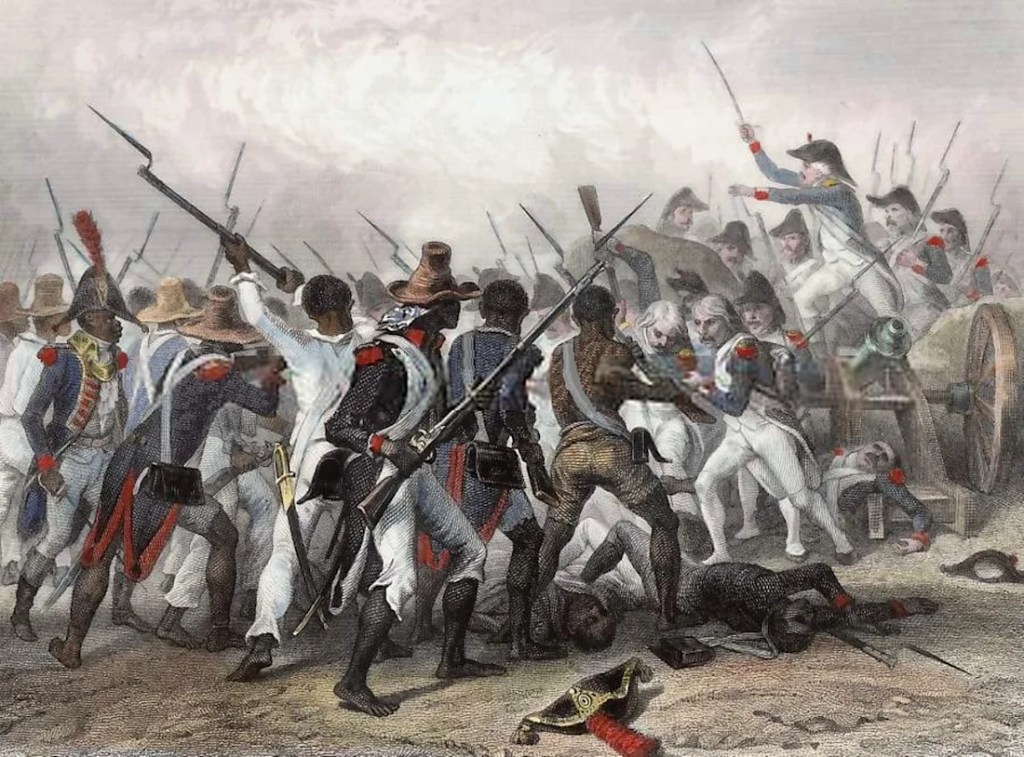
This is the question we are dealing with when studying the Haitian Revolution.
Kwame Ture (Stokely Carmichael) replies to student on the barbarity of non-violent resistance at University of Georgia in 1979.
Author and political activist Arundhati Roy questions Gandhians on nonviolence as Political Theater
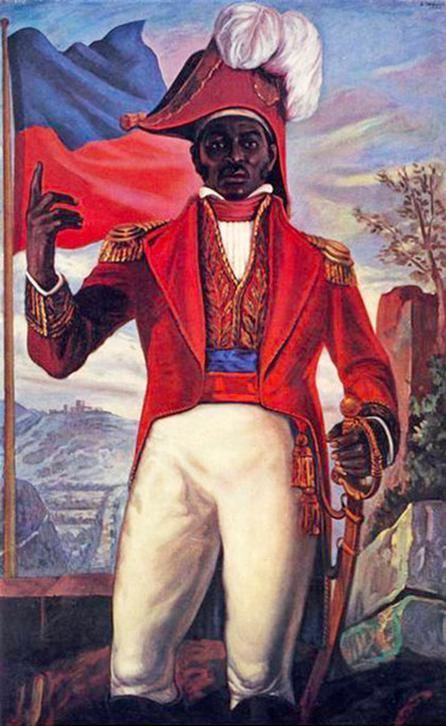
The same civic-republican tradition that produced Haiti and John Brown is the only one that ever actually broke chains. Among the greatest patriots we have seen in this history were figures like Toussaint Louverture and John Brown. The Haitian Revolution of 1791-1804 was the only and greatest successful slave revolt in history, resulting in the establishment of Haiti as the first independent Black Republic and the second independent nation in the Americas after the United States. With Toussaint Louverture (1743-1803) and Jean-Jacques Dessalines (1758-1806) at the helm, it abolished slavery through armed struggle, defeating French, British, and Spanish forces. This event sent shockwaves through the Atlantic world, profoundly influencing American militant abolitionism, particularly among Black intellectuals by providing empirical proof that enslaved people could achieve liberation through forceful action1, inspiring militant resistance and challenging non-violent moral suasion and gradualism.
What does this history teach us today?
This history teaches us:
- The American Revolution is not over until domination itself is extinct;
- True liberty exists when no private or public power can command you without your consent; and
- A real republic is measured by how impossible it is to become anyone’s master.
What constitutes a true republic? A republic is a commonwealth in which no one can exercise arbitrary power over another, rooted in non-domination and freedom from arbitrary power. The true patriot in this context is one who prevents corruption and domination, not a flag-worshipper.
Civic republicanism was not merely present in Haiti; it was the ideological engine of the Haitian Revolution, and the core of the world’s first successful slave revolution. Haiti’s leaders consciously framed their struggle in the language of classical neo-Roman Republicanism, with the understanding: of liberty as non-domination, the corrupting nature of arbitrary power (especially slaveholding power), civic virtue, the mixed constitution, and the absolute incompatibility of slavery with a true republic. Black American abolitionists therefore viewed Haiti as a “beacon of freedom” and a model for self-emancipation, countering White racial fears of Black rebellious upheaval, while fueling hopes among the enslaved and free Black communities.
However, we fail to fully understand the intellectual and sacred traditions Haiti’s leaders were drawing from. The classical influences these leaders drew from is and remains the most potent against the hypocrisies of the other republican governments born of their own violent revolutions; and required no importation of a distant political ideology that could be quickly negated. Their republicanism could not be argued as illegitimate, but the people or race that adopted it could. Therefore, those who saw the Haitian Revolution as a threat expressed hatred, jealousy and maintained cautionary attitude.
VODOU INFLUENCE ON HAITIAN REVOLUTION
In 1791-1793 the Bois-Caïman ceremonies and rites provided meeting grounds for the revolution plans and first insurgent demands. Even before Toussaint Louverture emerged, the initial slave assemblies demanded “liberty and equality” in explicitly republican terms. This meant an end to arbitrary domination by masters and the establishment of a regime in which Black citizens could stand as free and equal members of the polity.
This story is a famous legend at the root of the history of the Haitian Revolution. Haitian Vodou (also spelled Voodoo or Vodun) is a religion blending West and Central African Wisdom-traditions (particularly from Dahomey/Fon, Kongo, and Yoruba peoples) with elements of Roman Catholicism, played a pivotal role in the Haitian Revolution (1791-1804). It served as a source of cultural unity, psychological resistance, organizational framework, and spiritual mobilization for enslaved Africans against French colonial slavery. Vodou ceremonies provided covert spaces for planning revolts, fostering solidarity among diverse African ethnic groups, and invoking lwa (spirits) for protection and victory.
The Bois Caïman Ceremony (Bwa Kayiman) ceremony in August of 1791 was the beginning of the Haitian revolution, representing the most iconic event connecting the role of the Haitian religion Vodou to the revolution. In 1791, in a wooded area in northern Saint-Domingue, led by houngan (priest) Dutty Boukman and mambo (priestess) Cécile Fatiman, hundreds of enslaved representatives gathered for a Petro rite. They represented a fiercer, revolutionary branch of Vodou. A black pig was sacrificed, its blood shared as a pact, invoking lwa like Ezili Dantor (a fierce protector) and Ogou Ferraille (warrior spirit). Boukman delivered a famous prayer rejecting the White God, calling for liberty. This was followed by uprisings days later that burned plantations and ignited widespread revolt. This ceremony unified diverse enslaved groups, provided spiritual sanction for violence against oppressors, and marked the revolution’s coordinated start.
Vodou dynamics bridged ethnic divisions, e.g., Kongo “kindoki” knowledge integrated into rituals, preserving African worldviews while creating a shared resistance culture in Trouillot’s papers on Kongo influences published in 1977. Many rebel leaders were Vodou priests; and rituals boosted morale, interpreted omens, and justified revolt as divine will. The strength in Vodou philosophy affirmed the humanity and agency against dehumanizing slavery, offering hope through ancestral spirits and psychological liberation. Post-revolution, Vodou became central to Haitian identity, though elites often suppressed it.
While Vodou’s role is widely acknowledged, some historians caution against over-romanticizing Bois Caïman as the sole “spark,” since revolutionary planning predated it, and details come from later oral and colonial accounts as in Geggus’s Haitian Revolutionary Studies (2002). Colonial fears amplified Vodou as “sorcery,” fueling repression, while modern evangelical narratives sometimes demonize it as a “pact with Satan.” Vodou was not just incidental but integral: a tool for cohesion, motivation, and framing liberation as sacred duty.
TOUSSAINT LOUVERTURE THE “BLACK SPARTACUS” AND HAITI’S REPUBLICAN REVOLUTION
According to Julia Gaffield in Haitian Connections in the Atlantic World, while empowering Black abolitionists, Haiti terrified Southern slaveholders and many white Americans, reinforcing pro-slavery arguments and leading to U.S. refusal to recognize Haiti until 1862, trade embargoes, and heightened repression of free Blacks.
Haiti forced Napoleon’s sale of the Louisiana Territory (doubling U.S. size) and influenced abolition debates worldwide, proving slavery’s vulnerability to collective resistance (Blackburn, 1988; James, 1938).
The Haitian Revolution transformed abolitionism from moral appeals to a recognition, especially in Black thought, that liberation often required revolutionary violence, and laying the groundwork for later Pan-African and Civil Rights ideologies.
Toussaint Louverture (1743-1803) was a Black Spartacus, a civic-republican general steeped in classical republican sources. He owned and annotated a copy of Abbé Raynal’s Philosophical and Political History, which famously asked when a “Black Spartacus” would arise, and then he rose to the occasion. Toussaint’s 1801 Constitution for Saint-Domingue is one of the most radically republican documents in the history of the Atlantic world. Article III abolishes slavery forever stating emphatically, that “there can be no slaves on this territory; servitude is forever abolished.”
The document declares that “the Republic of Saint-Domingue is one and indivisible,” creating strong civic-republican institutions: a unicameral legislature elected indirectly, a powerful executive with Toussaint as governor for life to challenge Napoleon’s authority to gain control of Saint-Domingue, consciously modeled on Roman dictators in the classical republican sense. Believing that if plantations stopped producing sugar and coffee, the young nation would economically collapse and become vulnerable, Toussaint incorporated forced labor on plantations to produce currency for weapons and ammunition from the U.S. and Britain to defend against France’s attempt to re-enslave them. It was justified as a temporary “corvée” to prevent the corruption of idleness, exactly modeling the same language French Jacobins and American Jeffersonians used.
Toussaint repeatedly invoked the Roman Republic and Cato the Younger as models of resistance to tyranny, just as the founders and thinkers of the early American Republic did.
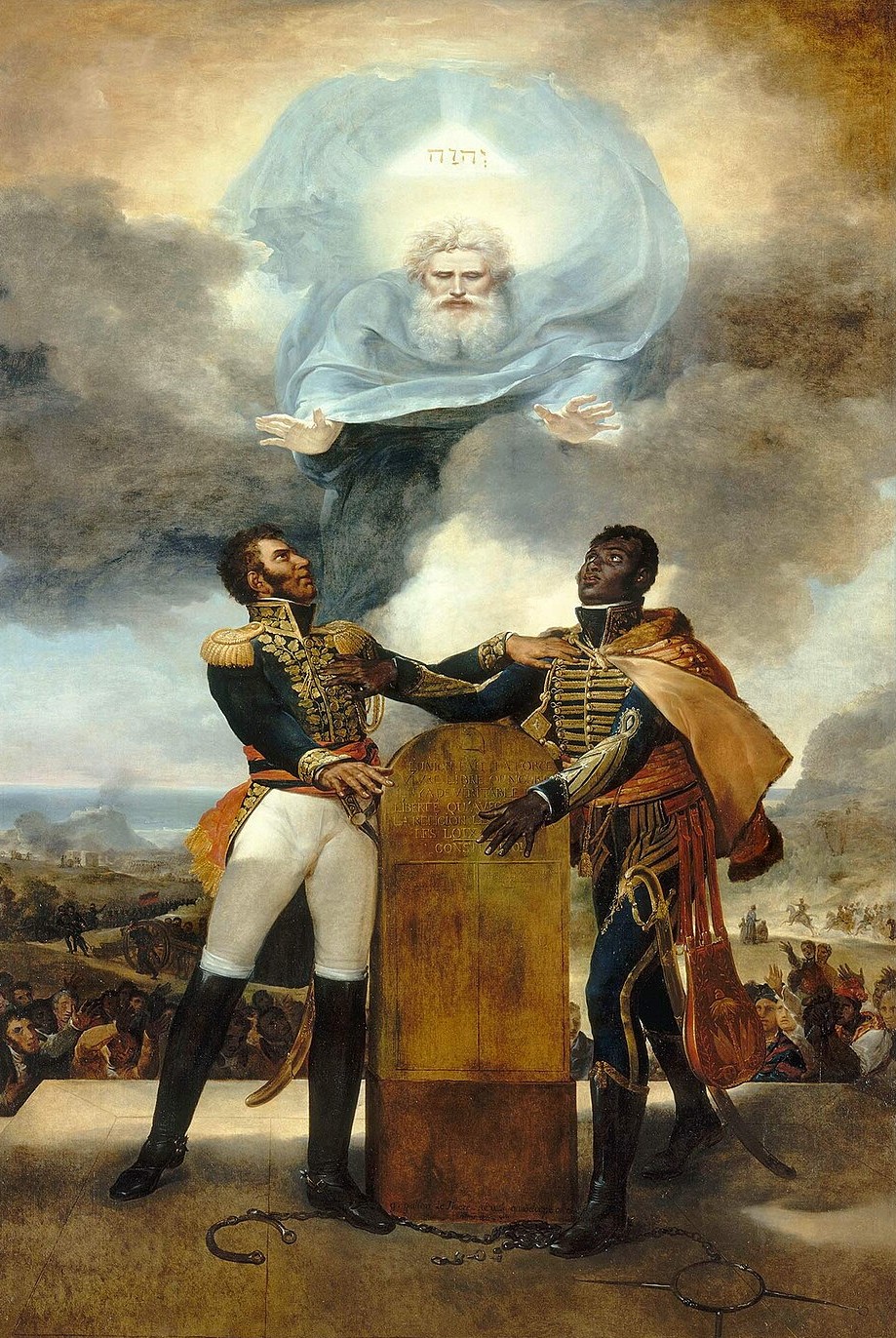
On 1 January 1804 Dessalines proclaimed Haiti independent and explicitly used republican language:
“We have dared to be free when we were not … Let us swear to posterity to live free or die!”
The new state was named “Haiti,” restoring the Taíno name precisely to break with the colonial past and create a new civic identity untainted by slavery. Dessalines’s 1805 Constitution is ferociously republican and anti-aristocratic. In Article XIV it reads that “No White man, of whatever nation, shall set foot on this territory as master or proprietor…,” directly applying the republican principle that domination must be structurally prevented.
All citizens are called “Black” regardless of skin color (Article XIV), creating a civic-republican identity defined by shared non-domination rather than race.
Henri Christophe’s Northern Kingdom (1807-1820) comes into context here. Although Christophe eventually crowned himself king, his early writings and his 1807 Constitution were intensely republican. He built the Citadelle Laferrière explicitly as a “republican monument” to prove that Black citizens could achieve the grandeur of Rome without falling into empire or slavery. Within 19th century Haitian intellectual tradition, later Haitian writers such as Louis-Joseph Janvier, Anténor Firmin, Jean Price-Mars and others repeatedly returned to civic republicanism as the authentic Haitian tradition against both foreign intervention and domestic authoritarianism. Firmin’s De l’égalité des races humaines (1885) is essentially a republican rebuttal to Arthur de Gobineau. True republics require civic equality and the cultivation of virtue across all peoples, and the society and culture must be thoroughly imbued and based on this cultivation.
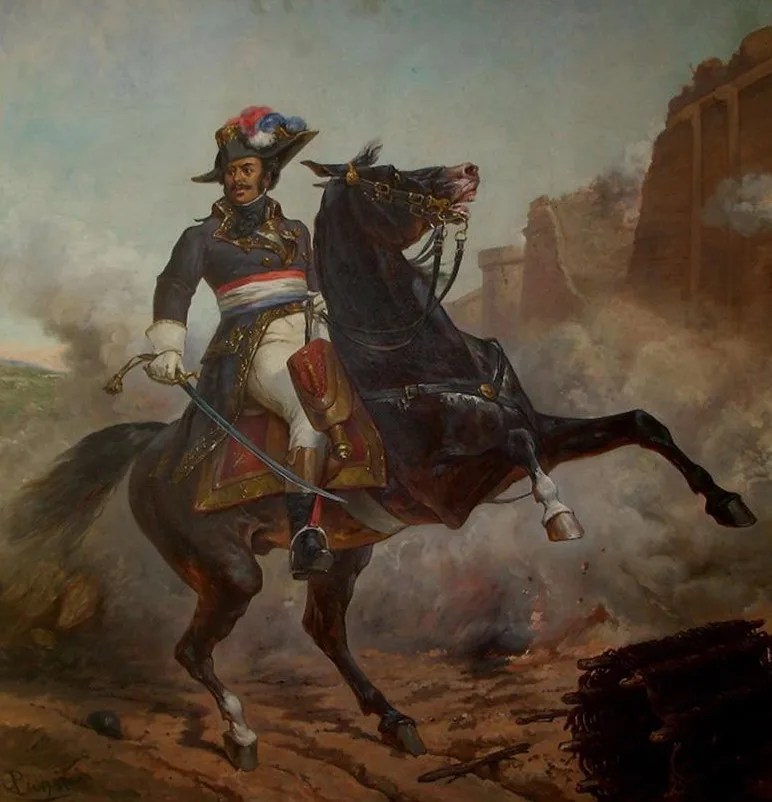
The case of Haiti’s Revolution represents a great example and expression of civic republicanism in the modern world. It carried the logic of 1776 and 1789 to its radical conclusion: if liberty is non-domination, then chattel slavery is the ultimate form of domination, and no “republic” can coexist with it. It rejected the racial exemptions that the United States, France, and Spanish America all retained; and proved that the civic-republican tradition was not inherently “White” or European, but universalist and could be wielded by enslaved Africans with devastating effectiveness.
Haiti is not a footnote to Atlantic Republicanism but is the tradition’s most uncompromising and successful realization. Whenever anyone claims civic republicanism is tainted by slavery or whiteness, the correct response is to say to them: “Tell that to Toussaint Louverture and Jean-Jacques Dessalines!”
The United States used civic-republican language to create a republic for White men only (Slavery and the Limits of Democracy in the Early Republic, Leslie Alexander) and accommodated itself to slavery for almost another century. Haiti used the exact same civic-republican tradition, often the exact same authors such as Raynal, Rousseau, Montesquieu, Sidney, to create the first republic in world history made by formerly enslaved people, for formerly enslaved people; and abolished slavery permanently on day one — extending citizenship without regard to race.
In purely theoretical terms, Haiti is the more consistent and radical application of civic republicanism. The United States is the partial, compromised, and in the end racially circumscribed application of Republicanism. Whenever people claim civic republicanism is inherently White or pro-slavery, Haiti is the decisive refutation. I think that Black Americans would do far better in continuing this early pre-Marxist strategy first to bend the affected U.S. oligarchy on course. The U.S. does not need to become China. We have our expression and our philosophy, and far better reciprocal relations with the world would come of this wisdom and be a model to the youth, and not whatever is coming out of the ass of “The Heritage Foundation.”
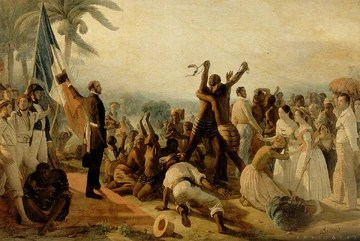
WAS JOHN BROWN INFLUENCED BY THE HAITIAN REVOLUTION
The life of radical abolitionist John Brown (1800-1859) John Brown reveals a profound influence from the event, which he saw as a model for militant resistance against slavery. Brown’s embrace of the revolution marked a shift from his earlier pacifist leanings toward a belief in armed insurrection as the only path to emancipation. Wes Trueblood in his 2013 dissertation on John Brown cited Brown’s abandonment of pacifism in 1842 after reflecting on Haitian violence. This era of personal shift would define the rest of his life’s work and efforts. Brown’s words framed the Haitian revolution as divine proof that enslaved people could and must seize freedom through force, protecting America from “God’s wrath.” David Walker’s view adds to this, in that Walker thought that the divine fire in the revolutionary in action will be God’s wrath. The fire brought out through resistance itself is God’s wrath.
Brown’s family shared this admiration with his eldest son, John Brown Jr. In correspondence to abolitionist circles as in an 1859 letter to The Liberator, Brown’s son stated, that Louverture’s “soul visits the cabins of the slaves of the South,” inspiring resistance. Brown’s family reflected family-wide admiration and Brown’s oral storytelling of Haitian tactics during Bleeding Kansas. Haitian intellectuals, in turn, mourned Brown’s execution as a parallel to their own revolutionary heroes, with newspapers like Le Progrès calling him a “martyr for the cause of the Blacks.” Scholars like Wes Trueblood argued, that this Haitian model “significantly shortened the life of American slavery” by radicalizing abolitionism.
Harriet Martineau’s The Hour and the Man (1841) was a biography of Louverture, which Brown read and annotated. This is historically seen as a major source that influenced his view of Haiti as a model for armed emancipation. Brown referenced it in prison notes equating his martyrdom to Louverture’s.
Brown’s tactics are very similar to those of Toussaint Louverture and Giuseppi Mazzini on guerilla warfare tactic, self-determination and anti-imperial republicanism. In 1847, he confided to Frederick Douglass his plan to use “guerrilla warfare and slave insurrection” drawn directly from Haiti’s example. During his imprisonment after the 1859 Harpers Ferry raid, Brown read a biography of Louverture and reportedly equated his own impending execution with Louverture’s death in a French prison, viewing both as martyrdoms for liberty. One of his jailers, William Fellows, later recalled Brown saying he “patterned his life after the San Domingan and that he viewed his own death on the scaffold in the same light as the execution of L’Ouverture.” This account was a post-execution interview published in The New York Tribune, December 1859.
Brown argued that the Haitian Revolution proved “blood, not peace, broke the chains of slavery” demonstrating that the constant proposal of gradual means through quiet, “civilized” and good-mannered processes of legislature served directly or indirectly established institutions of power. Brown hoped his Harpers Ferry raid would spark a “second Haitian Revolution” by arming enslaved people, leading them in guerrilla warfare across the South. In a speech to Black abolitionists in Chatham, Canada West (1858), recorded in The North Star (Douglass’s newspaper), Brown dismissed doubts about enslaved Americans rising up, insisting they were “no different from those of the West India island of San Domingo.”
In Frederick Douglass’s Life and Times of Frederick Douglass (1881), he detailed that 1847 Springfield, Massachusetts meeting where Brown outlined his plan for “guerrilla warfare and slave insurrection” explicitly inspired by Haiti’s “bloody lessons.” Douglass quotes Brown as saying enslaved Americans were “no different from those of the West India island of San Domingo” in their potential for revolt.
Brown praised Louverture as a “Christian, a statesman, and a general” whose career surpassed that of the American Cincinnatus George Washington’s, emphasizing Black military prowess as proof that enslaved people could lead a successful uprising.
Bibliography
- Richard H. Abbott, Courage and Conscience: Black & White Abolitionists in Concert, Indiana University Press, 1990.
- Kellie Carter Jackson, Force and Freedom: Black Abolitionists and the Politics of Violence, University of Pennsylvania Press, 2019.
- Matthew J. Clavin, Toussaint Louverture and the American Civil War, University of Pennsylvania Press, 2010.
- Julia Gaffield, Haitian Connections in the Atlantic World, University of North Carolina Press, 2015.
- C.L.R. James, The Black Jacobins. Vintage Books, ed. 1989.
- David S. Reynolds, John Brown, Abolitionist: The Man Who Killed Slavery, Sparked the Civil War, and Seeded Civil Rights, Knopf, 2005.
- Manisha Sinha, The Slave’s Cause, Yale University Press, 2016.
- John Brown, Martyr for the Cause of the Blacks: John Brown, the Haitian Revolution, and the Death of American Slavery, University of Mississippi, 2013.
 The American Minervan
Leave a comment