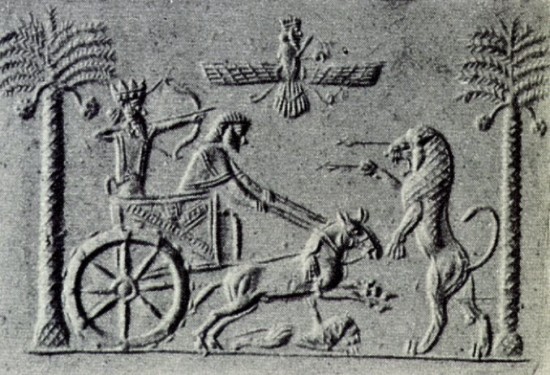
Blavatsky here in her article from her Lucifer magazine, explains the philosophy of the dual principles of Good and Evil of Mazdaism and brilliantly critiques modernity through it, and I specifically extracted these lines.
INTRODUCTION
First things first, I am not a scholar of pre-Islamic Iranian religions and do not fully understand the extent and origin of the legacy of Zarathushtra, but it has always interested me. Pre-Islamic Iranian religions usually and mistakenly get thrown into one word, “Zoroastrianism” implying that pre-Islamic Iranian religion began and ended with Zarathustra. It is perhaps, due to my attempts to trace Mani’s Gnostic Mesopotamian and Hellenic influences, that led me to want to understand these complex roots beyond the conventional stories presented by Christianity and Islam, where the world is a highly contentious arena of religions battling for converts. Once upon a time, when I was always backed into a corner to describe my religious view, I simply defaulted to “Gnostic.” I do not, now, though I am quite gnostic on the religious ideas I write about. I do not write them as a distant scholar but reflect on all these subjects and ideas.
It is important to note, that I nor Theosophy argue for or against the idea of the Christians that uses the magoi or magi that appear in the New Testament story of Jesus’ nativity as a sign of one of the prophesied Saoshyant (or Saoshyants) in Zoroastrian eschatology. The Christians also do not accept the ancient notion of multiple Saoshyants, as this conflicts with their Antichrist prophecies, which they use to demonize other religions as having false prophets, or mere precursors to Jesus, the Son of God, therefore subordinating ancient traditions. One can also argue that there has been no Saoshyant in that period. Just as the Jews defend their concept of their prophesied Mashiach as never come yet, so it is the same for the Kalki of Vishnu as final avatar. The teachings or sayings attributed to Jesus in the New Testament are reflections of the tradition of the magi, and in a sense, Jesus becomes a missionary to his people and others of the Good Wisdom. Within this context as explained, Jesus is respected and so are the sages and the Wisdom-traditions that preceded the Christians who use his name and character.
✷
H.P. Blavatsky, The Devil’s Own Thoughts on Ormuzd and Ahriman, H.P. Blavatsky Collected Writings, Vol. 13, pp. 124-127, p. 133; published in Lucifer, Vol. VIII, No. 43, March, 1891, pp. 1-9.
“No more philosophically profound, no grander or more graphic and suggestive type exists among the allegories of the World-religions than that of the two Brother-Powers of the Mazdean religion, called Ahura Mazda and Angra Mainyu, better known in their modernized form of Ormuzd and Ahriman. Of these two emanations, “Sons of Boundless Time”—Zeruana-Akarana—itself issued from the Supreme and Unknowable Principle, the one is the embodiment of “Good Thought” (Vohû-Manô), the other of “Evil Thought” (Âkô-Manô). The “King of Light” or Ahura Mazda emanates from Primordial Light and forms or creates by means of the “Word,” Honover (Ahuna-Vairya), a pure and holy world. But Angra Mainyu, though born as pure as his elder brother, becomes jealous of him, and mars everything in the Universe, as on the earth, creating Sin and Evil wherever he goes.
The two Powers are inseparable on our present plane and at this stage of evolution, and would be meaningless, one without the other. They are, therefore, the two opposite poles of the One Manifested Creative Power, whether the latter is viewed as a Universal Cosmic Force which builds worlds, or under its anthropomorphic aspect, when its vehicle is thinking man. For Ormuzd and Ahriman are the respective representatives of Good and Evil, of Light and Darkness, of the spiritual and the material elements in man, and also in the Universe and everything contained in it. Hence the world and man are called the Macrocosm and the Microcosm, the great and the small universe, the latter being the reflection of the former. Even exoterically, the God of Light and the God of Darkness are, both spiritually and physically, the two ever-contending Forces, whether in Heaven or on Earth.” (Blavatsky 124-125)
“The Parsis may have lost most of the keys that unlock the true interpretations of their sacred and poetical allegories, but the symbolism of Ormuzd and Ahriman is so self-evident, that even the Orientalists have ended by interpreting it, in its broad features, almost correctly. As the translator of the Vendidad writes, “Long before the Parsis had heard of Europe and Christianity, commentators, explaining the myth of Tahmurath, who rode for thirty years on Ahriman as a horse, interpreted the feat of the old legendary king as the curbing of evil passions and restraining Ahriman in the heart of man.” (Blavatsky 125)
“The same writer broadly sums up Magism in this wise:—
The world, such as it is now, is twofold, being the work of two hostile beings, Ahura Mazda, the good principle, and Angra Mainyu, the evil principle; all that is good in the world comes from the former, all that is bad in it comes from the latter. The history of the world is the history of their conflict, how Angra Mainyu invaded the world of Ahura Mazda and marred it, and how he shall be expelled from it at last. Man is active in the conflict, his duty in it being laid before him in the law revealed by Ahura Mazda to Zarathustra. When the appointed time is come a son of the lawgiver, still unborn, named Saoshyant (Sosiosh) will appear, Angra Mainyu and hell will be destroyed, men will rise from the dead, and everlasting happiness will reign over all the world.
Attention is drawn to the sentences italicised by the writer, as they are esoteric. For the Sacred Books of the Mazdeans as all the other sacred Scriptures of the East (the Bible included), have to be read esoterically. The Mazdeans had practically two religions, as almost all the other ancient nations—one for the people and the other for the initiated priests. Esoterically, then, the underlined sentences have a special significance, the whole meaning of which can be obtained only by the study of occult philosophy. Thus, Angra Mainyu, being confessedly, in one of its aspects, the embodiment of man’s lowest nature, with its fierce passions and unholy desires, “his hell” must be sought for and located on earth. In occult philosophy there is no other hell—nor can any state be comparable to that of a specially unhappy human wretch. No “asbestos” soul, inextinguishable fires, or “worm that never dies,” can be worse than a life of hopeless misery upon this earth. But it must, as it has once had a beginning, have also an end. Ahura Mazda alone, being the divine, and therefore the immortal and eternal symbol of “Boundless Time,” is the secure refuge the spiritual haven of man. And as Time is twofold, there being a measured and finite time within the Boundless, Angra Mainyu is only a periodical and temporary Evil. He is Heterogeneity as developed from Homogeneity. Descending along the scale of differentiating nature on the cosmic planes, both Ahura Mazda and Angra Mainyu become, at the appointed time, the representatives and the dual type of man, the inner or divine Individuality, and the outer personality, a compound of visible and invisible elements and principles. As in heaven, so on earth; as above, so below.
During our life cycle, the good Yazatas, the 99,999 Fravashi (or Ferouers) and even the “Holy Seven”, the Ameshâspends themselves, are almost powerless against the Host of wicked Devs—the symbols of cosmic opposing powers and of human passions and sins. Fiends of evil, their presence radiates and fills the world with moral and physical ills: with disease, poverty, envy and pride, with despair, drunkenness, treachery, injustice, and cruelty, with anger and bloody-handed murder. Under the advice of Ahriman, man from the first made his fellow-man to weep and suffer. This state of things will cease only on the day when Ahura Mazda, the sevenfold deity, assumes his seventh name or aspect. Then, will he send his “Holy Word” Mathra Spenta (or the “Soul of Ahura”) to incarnate in Saoshyant (Sosiosh), and the latter will conquer Angra Mainyu. Sosiosh is the prototype of “the faithful and the true” of the Revelation, and the same as Vishnu in the Kalki-avatara. Both are expected to appear as the Saviour of the World, seated on a white horse and followed by a host of spirits or genii, mounted likewise on milk-white steeds. And then, men will arise from the dead and immortality come. (Blavatsky 125-127)
“Great is the power of Ahriman! Time rolls on, leaving with every day the ages of ignorance and superstition further behind, but bringing us in their stead only centuries of ever-increasing selfishness and pride. Mankind grows and multiplies, waxes in strength and (book-)wisdom; it claims to have penetrated into the deepest mysteries of physical nature; it builds railroads and honeycombs the globe with tunnels; it erects gigantic towers and bridges, minimizes distances, unites the oceans and divides whole continents. Cables and telephones, canals and railways more and more with every hour unite mankind into one “happy” family, but only to furnish the selfish and wily with every means of stealing a better march on the less selfish and improvident.” (Blavatsky 133)
 The American Minervan
Leave a comment