INTRODUCTION
The common narrative and claims of the three Abrahamic religions are becoming increasingly problematic in our world today, and the religious within Judaism, Christianity and Islam respectively try to mitigate this through various interpretations of the relation of these religions to each other. Then, you have more claims of a continued chain of prophecy from Adam to the revelations of the Báb and Baháʼu’lláh. I would like to take a shot at it.
There are factors that are not considered from the theoretical side of Occultism that attempts to explain the effect of conditioning mechanisms in PHYSIS, that reframes prophetic noetic experiences naturalistically, rather than as “pure divine revelation” of an entified “Supreme Monarch of the Universe,” to which world structures should conform to. I am approaching this from a particular perspective, rather than using it to diagnose the constantly recurring issues between Religion and Politics in the Middle East as a different side of reflection on the very class of that title I am taking this quarter.
THE UNLETTERED MERCHANT: INTERPRETATIONS ABOUT MUHAMMAD
There is an understanding that differs from the typical way we view the claims of revelation in Abrahamic religion, and particularly in this case, Muhammad’s gnosis. In surah 7 verse 157, Muhammad is described as al‑nabī al‑ummī, commonly translated “the unlettered prophet.” This term ummī is debated among scholars, but mainly the point is, understanding of Muhammad as illiterate, unlettered, unscriptured, etc, according to whatever interpretation, lends argument to the Qur’an’s literary quality as miraculous.
In my understanding however, “revelation” is never “pure.” It is always filtered in some way, whether it is social or from a metaphysical explanation. Social, societal, psychological and linguistic conditioning is always at play in the noetic and psychic experience. Always, in some way. The interpretations of Muhammad’s experiences are entirely built to refute the factor of these conditions, which no human of flesh, brain and bone can escape. There is a precise philosophical lens for reframing noetic (gnosis, illumination) prophetic experiences like Muhammad’s reception of revelation in the cave of Hira; or concerning both direct noetic apprehension (gnosis of unchanging truth) and psychic sensory opinion (doxa or deceptive flux-bound perception). No external deities or supernatural interventions are required in the explanation, except unfolding processes.
In this view, there is a principle separate from the material flux yet permeating and governing it without contamination, and considered the eternal, hidden rational principle underlying all change that most humans fail to grasp because they rely on senses and opinion (doxa). This describes the higher, illuminating faculty known in the Greek as the nous, contrasted with the lower, terrestrial psyche that operates through sensory and passional mechanisms. Noetic action (true gnosis or illumination) occurs when the individual psyche, purified and stilled, achieves direct, non-sensory apprehension of the NOUS-LOGOS that structures LIFE. The psyche temporarily suspends its ordinary commerce with the sensory flux, allowing the underlying order to mirror through the psyche. This is not passive reception but an active alignment: the psyche becomes a clear mirror for the cosmic intellect, yielding coherent, lawful insight that feels overwhelming and external yet arises from the natural order itself.
By contrast, psychic action is the default state of the unpurified psyche: impressions arise from the lower sensory and elemental layers of chaotic mixtures, deceptive appearances, or elemental forces in the cosmic medium, producing fragmented, often distorted doxa that can masquerade as and blend with (or be confused as or deliberately incorporated into claims of) so-called “revelation,” but in fact leads to inconsistency or fanaticism. True gnosis requires the psyche to be disciplined through ascetic preparation so that nous dominates without distortion; otherwise, the experience collapses into psychic mediumship.
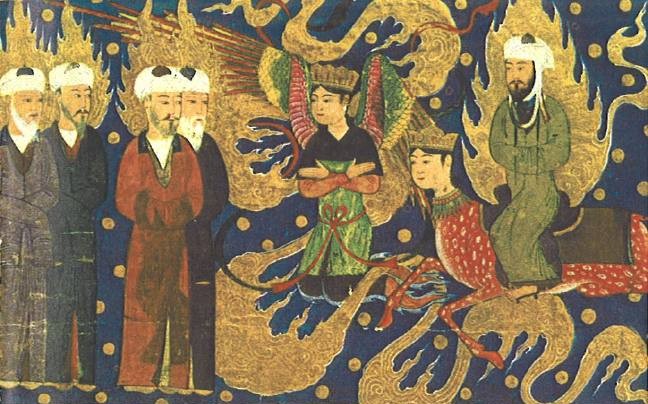
GABRIEL AND THE NOETIC ILLUMINATION OF MUHAMMAD ﷺ
Muhammad’s case, viewed through this lens, exemplifies noetic illumination arising lawfully within physis. Tradition records an illiterate but ethically inclined man who withdrew repeatedly to the cave of Hira for solitary meditation, precisely the practice of stilling the psyche from sensory doxa and elemental flux taught by Heraclitus 1,100-1,200 years before Muhammad. In 610 CE, during one such withdrawal, an overwhelming presence commanded him to recite (iqra’), initiating twenty-three years of intermittent revelations.
The “angel” (Jibril or Gabriel) is not viewed literally from this view, but is seen as a symbolic, culturally adapted projection. From my understanding, Gabriel is similar to the Zoroastrian Amesha Spentas, especially Vohu Manah (Good Mind). Gabriel is a recurring archetype appearing under different names in different religions and has been seen as a national guardian in antiquity, equated with the Logos, the Demiurgic Spirit, Hermes (or Mercury), and the Spirit of Revelation. Gabriel is the symbol of DIVINE INTELLECT or cosmic mediation, e.g., Gabriel in Daniel and Luke is read as a symbolic figure of divine communication, not just a literal angel, corresponding to earlier Near Eastern and Hellenistic ideas of a mediating spirit, or bridge between God and humans. This depicts Gabriel as a node in a process of mythic dramatization of the might and power of the Logos or divine spirit entering history. Gabriel represents the spirit of enlightenment and is repeatedly used as a symbolic way of talking about divine mind acting in the world, brought over when post‑exilic Judaism absorbed Persian angelology.
MUHAMMAD ﷺ OVERCOMES LOWER PSYCHIC NATURE
The physical and emotional intensity (sweating, fear, conviction confirmed by his wife Khadija) reflects the natural struggle of the psyche integrating noetic influx — a process when the higher faculty temporarily paralyzes lower sensory mechanisms. Thus, the Qur’an exhibits as a result, a coherent, ethically transformative poeticism that expresses the perennial LOGOS of unity, justice and cosmic order, rather than fragmented hallucination. This is gnosis of the Parmenidean philosophy on Truth apprehended through the NOUS, filtered naturally through Muhammad’s Arabian physis and cultural symbols, producing a reforming ecumenical community of monotheists in its early phases, that preserved the philosophy of hidden cosmic harmony.
The story of Muhammad depicts a genuine and active seer of noetic gnosis and action whose psyche, prepared by ascetic discipline, interacts with the cosmic intellect, allowing him to overcome passive psychic impressions from the lower elemental medium of his constitution.
GNOSIS IN ISLAMIC TRADITION
Ismaili Gnosis in Shi’a tradition, e.g., interprets Muhammad’s prophethood and the Night of Power (Laylat al-Qadr) as the descent of divine guidance into human language and history: the Qur’an as the outer expression of an inner, eternal reality revealed through the Prophet as “Possessor of Divine Guidance.” The cave experience symbolizes stages of spiritual ascent and the nous-like intellect ordering chaos into harmonious law — allegorical, not literal dictation. This is direct experiential knowledge (gnosis) of the divine PLEROMA over blind faith or demiurgic exotericism, which Allah (the divine UNITY or ONE) represents. Some argue whether Muhammad’s angelic intermediary came from the true transcendent source or lower archonic forces, but the traditional Ismaili view is that Muhammad’s experience is an authentic transmission of the same universal light that Gnostics sought in their own revelations.
Qur’anic narratives (e.g., Jesus forming birds from clay or speaking in the cradle) and Gnostic-influenced apocrypha circulating in pre-Islamic Arabia (Infancy Gospel of Thomas and Arabic Infancy Gospel), suggesting cultural transmission within physis.
This is not plagiarism but convergent expressions of the same logos manifesting across traditions with the universal intellect impressing archetypal truths through whatever symbolic medium the local psyche and historical flux provide. Gnostic texts and early Islamic esotericism both prioritize inner illumination over literalism, reinforcing that Muhammad’s experience was noetic interaction with the cosmic ordering underlying principle of physis rather than psychic deception or external supernaturalism. It demystifies but does not deny Muhammad’s experiences: a gradually purified psyche achieving gnosis through direct apprehension of the NOUS-LOGOS. This is the occult process behind all genuine prophetic illumination, when distinct from psychic mediumship. This is the overlooked theoretical side of OCCULT PHILOSOPHY, which is revelation as science of the NOUS operating through PHYSIS, accessible to the sufficiently prepared psyche.
However, the noetic experience or apprehension of the nous-logos (the cosmic intellect as the self-ordering rational principle within physis) by a purified individual psyche is never transmitted or expressed in a vacuum.
While the gnosis itself is unmediated contact with the unchanging ordering principle its output, or the specific form, symbols, language, ethical content, and cultural expression that reaches the world — is always filtered, colored, and concretized by layers of conditioning operating within the lower psyche and the flux-bound strata of PHYSIS. This conditioning does not corrupt the Universal NOUS (which remains pure and unmixed) but determines the particular “seeds” and harmonic patterns through which the LOGOS manifests in human history. GNOSIS appears here as a culturally intelligible “revelation.” This term, revelation is a means to political authority in the ancient world.
SOCIAL, PSYCHOLOGICAL AND LINGUISTIC CONDITIONING
Firstly, we must consider the social conditioning. Social conditioning comprises the shared expectations, norms, and collective memory of the community; societal conditioning adds the structural pressures of power, economy, and historical moment.
In seventh-century Arabia, the psyche of any sensitive individual was steeped in the vibrant crossroads of monotheistic currents — Jewish tribes in Medina with their scriptures and prophetic traditions, Christian communities (Nestorian, Monophysite, and Gnostic-influenced) bringing Syriac hymns and apocryphal narratives, Zoroastrian dualism through Persian trade routes, and indigenous hanif seekers already invoking a single high god called “Allah” in inscriptions centuries before Muhammad. Epigraphic evidence shows monotheism was not an innovation but a widespread substrate.
Societally, Arabia’s tribal fragmentation, caravan-trade economics, and the need for moral unification amid Byzantine-Sasanian proxy conflicts created a collective demand for a unifying logos of ethical monotheism. A noetic impression of cosmic unity and moral order would therefore be received and expressed as a call to tribal reform, anti-idolatry, and social justice — precisely the Qur’an’s emphasis on charity, justice, and ummah. The output is not arbitrary. The societal “seeds” such as pre-existing prophetic models, rival claimants like Musaylima or al-Aswad led to a coherent new synthesis that met the historical flux. Without this conditioning, the same gnosis might have manifested as a different reform movement. This is merely pre‑reflective mental impression (a raw, initial “take” before it becomes a fully formed belief, judgment, or concept) shaped by the recipient’s social environment.
Psychological conditioning includes personal biography, habitual mental patterns, emotional states, and preparatory practices. Muhammad’s documented retreats to the cave of Hira reflect a cultivated psyche trained in solitary stillness to allow nous to impress directly. Muhammad’s illiteracy, ethical integrity, and rejection of pagan excess prepared a psyche relatively free of gross passional distortion, yet still carrying the psychological imprint of Arabian storytelling, dream-visions common among kahins (soothsayers), and the emotional intensity of merchant life despite his period’s social upheaval.
The overwhelming physical and affective phenomena (sweating, fear, the need for Khadija’s reassurance) illustrate the natural struggle of the personal psyche integrating noetic influx. The higher ordering principle temporarily dominates lower faculties, but the output is clothed in the individual’s psychological symbols like an “angel” (a culturally expected intermediary) delivering rhythmic, poetic speech. The nous impresses truth, while the conditioned psyche translates it into visionary narrative. I understand that this interpretation takes away from the belief in the invisible worlds as populated with angelic intermediaries, but one cannot get away from the personal and collective psychological archetypes that shape the imagination.
The linguistic conditioning is perhaps the most precise filter that factors into this. Language is not a neutral container but the very structure through which the psyche thinks, and the logos becomes articulate within physis. Classical Arabic whether poetic, oral, or rhythmic is rich in loanwords from Syriac, Hebrew and Ethiopic, which provided the medium. Christoph Luxenberg’s scholarship demonstrates that many Qur’anic phrases, when read through Syriac Christian liturgical and hymnic vocabulary yield meanings connected with pre-existing Abrahamic motifs (e.g., “white grapes” of paradise as Syrian Christian symbols of bliss rather than literal virgins). The Qur’an’s inimitability claim itself reflects the poetic contests of Arabian soothsayers, while its legal-ethical content repurposes Mishnaic parallels (e.g., Quran 5:32 on saving a life) and Gnostic motifs already linguistically available in the milieu. The conditioned psyche renders logos in the only linguistic “seeds” present, resulting in Arabic suras that sound like heightened poetry, referencing local geography and customs, and resolving contemporary theological tensions (e.g., reworking crucifixion narratives).
CONCLUDING THOUGHTS
Parmenides’ distinction between Truth (noetic) and Opinion (linguistic doxa) is operative here: the gnosis is perceptiveness of ineffable BEING, but its output is the harmonious arrangement of the flux-bound words and idioms ready-to-hand. Without Arabic’s specific phonetic, syntactic and semantic elements in the culture, the same illumination would have produced a different scripture.
The traditional “pure divine revelation from Gabriel” narrative emerged from a richly conditioned seventh-century milieu. Archaeological and epigraphic data prove monotheism (including the term “Allah”) was already dominant across Arabia from the third century onward. Textual semblances demonstrate the Qur’an’s intimate dialogue with Jewish, Christian, Zoroastrian and Syriac sources, reshaping them through human creativity and cultural exchange rather than isolated dictation. The time period reveals rival prophets, the Sana’a Palimpsest reveals textual evolution, and Luxenberg’s Syriac-Christian substratum illustrate how societal intermingling, psychological expectations of prophetic speech and linguistic borrowing produced the specific Qur’anic output.
Gnosis is thus not an end of knowledge, and it is not culturally sterile. Every human has to work through the social, psychological and linguistic material of their race, tribe, cultural environment, world, etc, even to generate an adaptive system and philosophy of harmony to affect or reform that world; and through this, Muhammad and the “Believers” (muʾminūn) as Muhammad called them early on rose to produce and give life to a religion born of dynamic synthesis.
This man declared after his work was done, that the disbelievers have given up all hope of undermining your faith and to not fear them:
“Today I have perfected for you your religion, completed my favor upon you, and chosen Islam as your way.”
Qur’an 5:3 Surah al‑Mā’idah, verse 3.
 The American Minervan
Leave a comment