Category: Cultural History
-

Riding the Tiger of Modernity | Shaykh Abdal Hakim Murad on Julius Evola
SHAYKH ABDAL HAKIM MURAD ON JULIUS EVOLA COUNTER-CULTURE “…so Evola is a point of reference for people who are seeking an alternative, but unfortunately because of his possibly xenophobic blindspot when it came to Europe’s “third heritage”. . . .the Heritage of Islam — Gaudí’s move was definitely in the direction of the underestimated Ishmaelite…
-

Alighieri’s vision: Giovinezza – 1922 (First Version)
“Salve o popolo d’eroi (Hail, people of heroes), Salve o patria immortale (Hail, immortal Fatherland), Son rinati i figli tuoi (Your sons were born again), Con la fede e l’ideale (With the faith and the Ideal) Il valor dei tuoi guerrieri (Your warriors’ valour), La virtù dei pioniero (Your pioneers virtue), La vision dell’Alighieri (Alighieri’s…
-

Why the Statue of Lucius Quinctius Cincinnatus carries a Fasces?
the Founding of a City and its Character Lucius Quinctius Cincinnatus, the legendary Roman who defeated the Aequians and rescued the trapped Roan Army. With one hand he returns the fasces, symbol of power and fraternity to the Dictator of Rome. In the other, a plow, which represents his life as citizen and farmer. Cincinnati…
-

H.P. Blavatsky involvement in Italian Politics with Garibaldi and Mazzini, and the Carbonari’s Role in the Republican Revolutions
H.P. Blavatsky’s interest in Italian politics has been very scanty in the historical record of her life. H.P.B. herself had claimed and proven to H.S. Olcott, as detailed in his Diary Leaves, that she had joined the Garibaldians (see Garibaldi and the Red Shirts) at the bloody Battle of Mentana, where she was stabbed with a…
-

A Critical Look at Hayward’s Review of the Liberal Republicanism of Gordon Wood
Late to the party Wood’s body of work will remain preeminent for some time in the historiography of the American Founding. But it begs to be superseded by an equally large-scale treatment that does not shy away from treating the founders as thinkers and statesmen, rather than as 18th-century ideologues.” “Unlike today’s liberals who quote…
-

Behind the Visual Propaganda of the ‘New Italian Woman’ in Fascism | Victoria de Grazia’s ‘How Fascism Ruled Women’
INTRODUCTION Victoria de Grazia explains in her book, “How Fascism Ruled Women: Italy, 1922-1945,” that the New Italian Woman (Nuova Italiana) in the Fascist Ideal was not as one might imagine as displayed in Italian and German pictures, or in the propaganda of marching, busty and fit, militant and disciplined Athena-esque women. There was really…
-

The Influence of Theosophy on Russian Culture in the Russian Silver Age
Maria Carlson and other Collected Writings In September 1990, the Soviet Union officially ended its policy of state-sponsored atheism, approving a tolerant law on freedom of conscience as people were entering the Church in record numbers. The fall of Communism in Russia in 1991 also led to the end of long years of a ban and suppression…
-

Gordon S. Wood on Republicanism and Monarchy in the Eighteenth-Century
“Educated people of varying political persuasions celebrated republicanism for its spirit, its morality, its freedom, its sense of friendship and duty, and its vision of society. Republicanism as a set of values and a form of life was much too pervasive, comprehensive, and involved with being liberal and enlightened to be seen as subversive or…
-

Adolf Hitler’s Religion and Ideological Influences in National Socialism
National Socialism in Germany arose partially out of a folk movement in Germany connected to Romanticism and politically existed nearly two decades prior to Hitler. In its manifestation as a matured aesthetic and political force under Hitler, we find that by 1934, economists reported that the Germans look on Hitlerism as a Religion with “no…
-

The Spanish Alumbrados: Origin of the Term ‘Illuminati’
The ALUMBRADOS, Perfectibilists and TheosophiCAL REFERENCES Illuminati. the past participle of illuminare, meaning to “light up,” or “illuminate.” The plural term, “Illuminati” (Lat. illuminatus; Ital. Illuminato). The term has earlier religious uses, with no historical connection between the use of the term by the Spanish Alumbrados Catholic mystics and the later Illuminati Order in Bavaria. LINGUISTIC HISTORICAL…
-
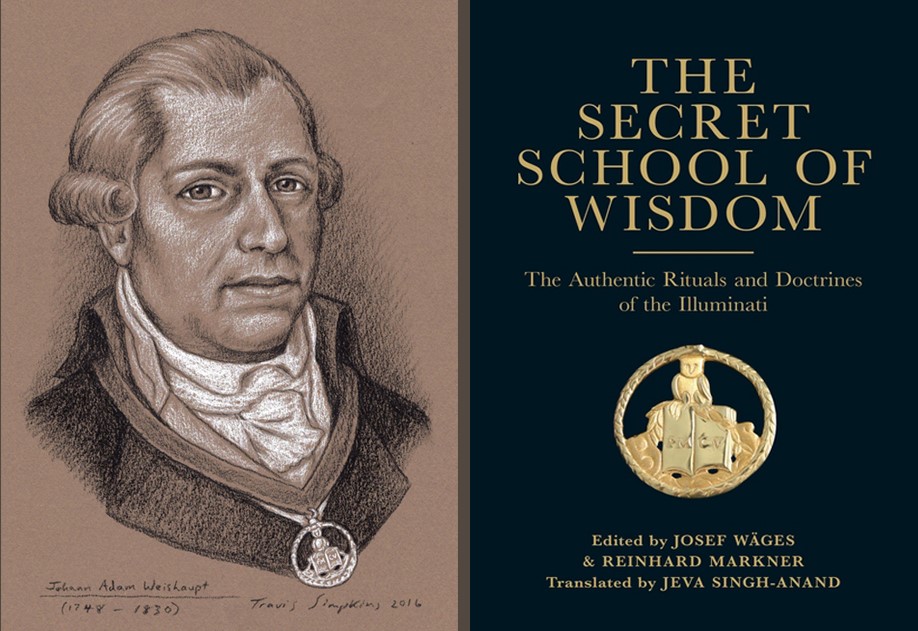
Zain Khan interviews Josef Wages on the Truth about the Bavarian Illuminati
Josef Wäges is making breakthroughs in historical research about the Bavarian Illuminati and Johann Adam Weishaupt. Zain Khan interviews Josef Wages a 32° degree Freemason, and also a best selling author of the book ‘The Secret School of Wisdom: The Authentic Ritual and Doctrines of the Illuminati.’
-

Kumari Jayawardena: “The White Woman’s Other Burden.” Blavatsky and Emancipation in South Asia
From the outset, Kumari Jayawardena’s “The White Woman’s Other Burden” (1995) demonstrates, theosophy emphasized the absence of any distinction of race, creed, sex, caste or color in its theory and practice; and gender equality was therefore, one of its distinctive features. The 1995 work of Jayawardena details the roles and activities of foreign women in…
 The American Minervan