Tag: Theosophy
-

Sir Malcolm Murray “Night Work” Script: Season 1
“Come Join Me,” says Sir Malcolm Sir Malcolm Murray: “You seem to be a free thinker, able to imagine a world not bound by such what we consider ‘truth’.” Dr. Victor Frankenstein: “You mean the supernatural?” Sir Malcolm Murray: “I mean the place where science and superstition go hand in hand. An anatomist of your calibre would…
-
What are the Principles of a Theosophical Group?
The principles of a group called Theosophical would be: [1] “Brotherhood [camaraderie] of man, without distinction of race, color, religion, or social position. [2] The serious study of the ancient world-religions for purposes of comparison and the selection therefrom of universal ethics; [3] the study and development of the latent divine powers in man (…)” —Theosophical…
-

Hermetic Undertone of the Theosophical Society’s Foundations
K.H., The Mahatma Letters, Letter no. 85, December 7, 1883 “(…) As the lady has rightly observed, the Western public should understand the Theosophical Society to be “a Philosophical School constituted on the ancient Hermetic basis” — that public having never heard of the Tibetan, and entertaining very perverted notions of the Esoteric Buddhist System.…
-

Pico della Mirandola Oration on the Secret of Gnosis and the Dignity of Man
Pico della Mirandola on the secret of Gnosis
-

James M. Pryse On The Delphian Key-Note of Esotericism: Plato’s Four Degrees of Knowledge
Theosophist, James Morgan Pryse describes the true meaning of the Delphian axiom, “Man, Known Thyself,” in his highly interesting work, Apocalypse Unsealed: Being an Esoteric Interpretation of Initiation (1910). Pryse argued, that the “Book of the Revelation” of Iaonnes (John) is not a book detailing the past, nor the future; but was a book designed to…
-

Limitations of Christian Cabalists and Bible Challenge Authority of Western Esotericism
Does the limitations of Kabbalah and the Christian Bible in the Studies of Esotericism blind Western Philosophers? Helena P. Blavatsky challenged the esotericists of her time, who saw in the Bible, the final authority, even in the area of esoteric study. “And now it has come to this: The student interested in the Secret Sciences…
-
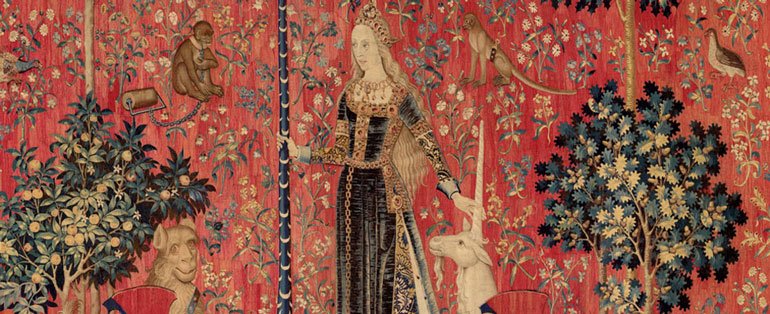
Goetia and Witchcraft: Origin of the “Witch” and Magic
The term “Witch” in old Anglo-Saxon glossaries is tied to wicce, meaning “pythoness, divinatricem.” As in this, and in early forms, it referred to specific kinds of magical craft. In the Laws of Ælfred (c.890), wicce is seen as the craft of women — “wise (skilled) women in the art of magic”; and in the old German, wiccan…
-

Alexander Wilder on Pagans and the Value of the Classical Religions
Limited Knowledge of Religion in Antiquity The term Pagan, or paganus originally meant, an inhabitant of the village, or a peasant, but came to refer to perverted heretical and heterodox beliefs outside of the theology of the Catholic Church. Therefore, what is considered perverted must come from the devil, hence, idolatrous and pagan. The Jews, Christians,…
-

Gottfried De Purucker defines Religion in “Occult Glossary”
What does it mean, when we use the broad term religion? Gottfried de Purucker† (1874-1942), who was head of the Pasadena Theosophical Society from 1929-1942, had a good definition in his Occult Glossary (1933). It follows on pages 148-9: “Religion. An operation of the human spiritual mind in its endeavor to understand not only the how and the why of…
-
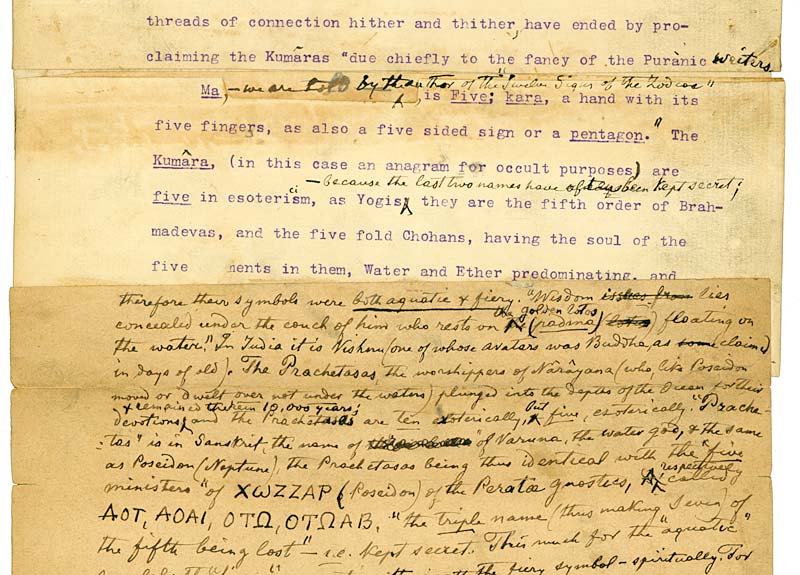
Analysis of the ‘Würzburg Manuscript’ of The Secret Doctrine (1888)
Officially published in 1888, The Secret Doctrine was a project began by HPB. From as early as 1885-86, we find a partial or portion of the manuscript when she stayed in Germany and Belgium this time, called the “Würzburg Manuscript.” In studying how The Secret Doctrine was written, we see the modern example of a work…
-

“Use the Eyes of the Spiritual Intelligence” | H.P. Blavatsky
“First let the student clearly realize that he cannot see things spiritual with the eyes of the flesh, and that in studying, he must use the eyes of the Spiritual Intelligence, else will he fail and his study will be fruitless.” HELENA BLAVATSKY, COLLECTED WRITINGS, VOL. 12, P. 691
-
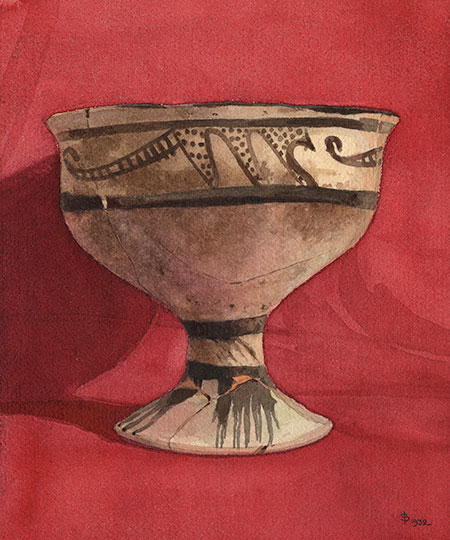
“The Religion of the Future”
‘No human-born doctrine, no creed, however sanctified by custom and antiquity, can compare in sacredness with the religion of Nature.’ (Helena P. Blavatsky, The Secret Doctrine, Vol. 2, pg. 797) The Religion of the Future [Helena Blavatsky, The Theosophist, Vol. IV., No. 8, May, 1883.] “Occultism teaches us that ideas based upon fundamental truths move…
 The American Minervan