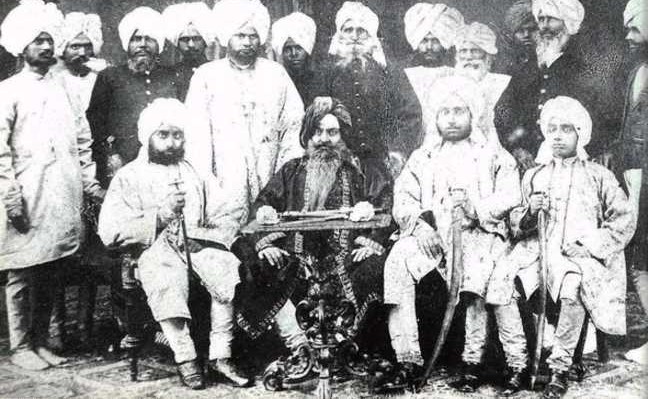
K Paul Johnson claimed to provide a “suggestion” and “persuasive case” of his findings. Beginning with K.H. (Koot Hoomi or Kuthumi). K. Paul Johnson suggests K.H. was Sardar Thakur Singh Sandhawalia, the chief and founder of the Sikh Singh Sabha Movement in India who was involved in patriotic efforts in the freedom movement from the British, along with his exiled cousin, prince Maharaja Daleep Singh.
Thakur Singh masterminded the campaign for the restoration of Maharaja Duleep Singh to the throne of the Punjab. Thakur Singh was well versed in Arabic, Persian and Sanskrit languages, and appointed to the administrative board of the Golden Temple at Amritsar. Thakur Singh was only 12 years old when his cousin, Maharaja Daleep Singh lost his empire to the British, and he was witness to the “First War of Independence in 1857, in which his father-in-law Raja Nahar Singh of Ballabhgarh was hanged to death” (Sardar Thakur Singh Sandhawalia – Chief of Singh Sabha Movement).
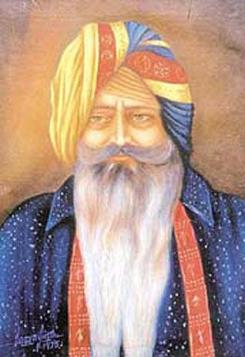
The British Government hated Thakur Singh, and he left Amritsar. There was a prophecy spoken of in which the Maharaja was to return to India through Russia:
“However, he [Thakur Singh] left Amritsar on September 28, 1884. He went to England accompanied by his sons Narinder Singh and Gurdit Singh and a granthi called Partap Singh. He wanted the granthi to recite the Guru Granth Sahib to the Maharaja. In England, Thakur Singh would talk of the lost riches of the Punjab and Talbot’s report. “But, Thakur Singh Sandhawalia had carried with him to England something much more potent than a list of lost property. He bore the keys to the whole kingdom in the form of a prophecy,” says Christy Campbell, a researcher.
According to the “prophecy”, the Maharaja was to return to India through Russia and regain his lost empire after extensive bloodshed. The Maharaja did not believe the prophecy earlier but Thakur Singh Sandhawalia wrote to his eldest son Gurbachan Singh in India to obtain written statements from principal Sikh priests verifying the prophecy. These were then signed and sealed and sent to Elvedon Hall. After that there were no doubts in the gullible Maharaja’s mind. A year later, the impolitic Maharaja committed one of the most tragic mistakes of his life by mentioning that prophecy in a letter to Lord Randolph Churchill, Secretary of State for India.” (Ibid.)
Jean Overton Fuller in his biography Blavatsky and her Teachers, refers to K.H. and Morya as “the Sikhs.” K. Paul Johnson wrote about Olcott’s supposed impression of Koot Hoomi (Kuthumi) acting in a priestly manner at the Golden Temple in Amritsar. K. Paul Johnson calls K.H. a Punjabi or Kashmiri Sikh. H.P. Blavatsky described Koot Hoomi as Kashmiri by birth, a Punjabi whose family was settled for years in Kashmir (Collected Writings, Vol. VI, p. 277). Mohini Chatterji (a pupil of K.H.) said, that he was a “Kashmiri Brahmin.”
However, Olcott never says K.H. specifically was officiating at the Golden Temple, a function reserved for Sikh priests, but instead says, “one of the masters…for the moment…was figuring as one of the guardians.” Jean Overton Fuller speculated that this master was “officiating” at the Golden Temple, and further that this master was K.H. In Was Koot Hoomi a Sikh, Daniel H. Caldwell shows that this is not possible, given the minutes of K.H. travels in the week of October 26, 1880 when Olcott was in Amritsar.
Olcott notes on that day they went to the Golden Temple again in the afternoon, and a brother gave them a rose. They would have known if this brother handing them a rose was K.H. or not. Between October 27-29, 1880, K.H. notes that he is on a journey down the Karakorum mountains, where he had emerged out of seclusion to spend some time with H.P.B. October 27, 2:05 pm, K.H. is thirty miles beyond Rawalpindi. K.H., two hours later sends a telegram from Jhelum, and on October 29th, he goes to Amritsar.
This is part of a series that provides a better understanding of the role and history involving “the Masters.” that were said to be secret sponsors behind the Theosophical Movement and its operations. These circles of adepts, including their disciples and associates were said to have activities in South Asia, the Middle East, North Africa, the Americas and Europe.
- Speculations About Thakar Singh Sandhawalia: Were the Mahatmas Sikh/Sant Mat
- Tamil Swami Ramalingam Pillai’s Prophecy
- Was Morya the Maharajah Ranbir Singh
- Hilarion Smerdis, Serapis Bey and the Legend of the “Brotherhood of Light” and Luxor
- Political Operations in Cairo and War Treaty in Cyprus involving Hilarion and Ooton Liatto
- Thakur Singh Connection and Damodar meets the Mahatmas
- Olcott meets His Master in Lahore: K. Paul Johnson versus Olcott’s Testimony
- Olcott’s Strained Relationship with Blavatsky and the Judge Case
- Witnesses of Morya, Identity of Koot Hoomi and Connections to Tibet and the Panchen Lama
- Sarat Chandra Das The Bengali Spy, Sengchen Tulku and the Maha-Chohan Connection
 The American Minervan
Leave a comment