
The term Prayāg (or Prayaga) is an ancient term for the city of Allāhābād. In January 1, 1881, an early branch of the parent or original Theosophical Society was formed in Allahabad. G.N. Chakravarti was a notable member of this lodge, who represented Brahmanism at the 1893 World’s Parliament of Religions in Chicago. So, the Prayag Letter is a correspondence from November 4th, 1881, which includes a message from Morya. Babu Benemadhab Bhattachārya (President of the Prayag TS) was mentioned in the letter by Morya,
“What has Benemadhab or any other of the many claimants done to have a right to such a claim? Nothing whatever. They join the Society, and though remaining as stubborn as ever in their old beliefs and superstitions, and having never given up caste or one single of their customs, they, in their selfish exclusiveness, expect to see and converse with us and have our help in all and everything.”
Following this letter, two days later on November 6, the name was suddenly changed to “Prayāg Psychic Theosophical Society.” Bhattacharya later denounced the Theosophical Society as a Buddhist propaganda. The letter, in which M. states they are the “disciples of the true Arhats, of esoteric Buddhism,”1 denounces some superstitions of Hinduism. It also criticizes Hindus for persecuting and driving Buddhism out of India.
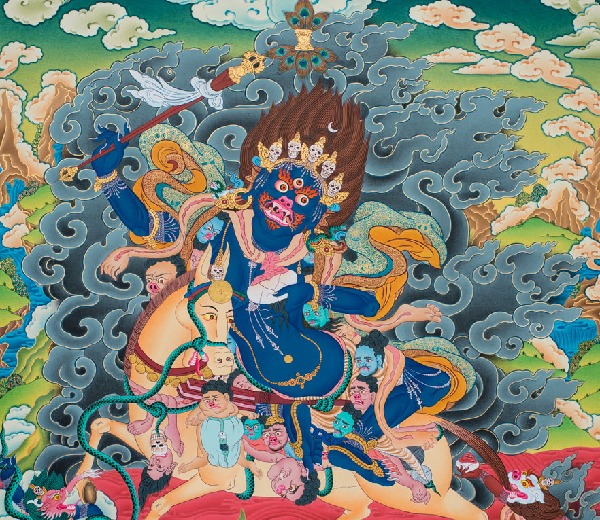
In the letter, Morya equates Yahweh to a high class of sentient demons in the Tibetan tradition called a mamo (Tib མ་མོ):
“Faith in the Gods and God, and other superstitions attracts millions of foreign influences, living entities and powerful agents around them, with which we would have to use more than ordinary exercise of power to drive them away. We do not choose to do so. We do not find it either necessary or profitable to lose our time waging war to the unprogressed Planetaries who delight in personating gods and sometimes well known characters who have lived on earth. There are Dhyan-Chohans and “Chohans of Darkness,” not what they term devils but imperfect “Intelligences” who have never been born on this or any other earth or sphere no more than the “Dhyan Chohans” have and who will never belong to the “builders of the Universe,” the pure Planetary Intelligences, who preside at every Manvantara while the Dark Chohans preside at the Pralayas. Explain this to Mr. Sinnett (…) let him remember that as all in this universe is contrast (…) so the light of the Dhyan Chohans and their pure intelligence is contrasted by the “Ma-Mo Chohans” — and their destructive intelligence. These are the gods the Hindus and Christians and Mahomed and all others of bigoted religions and sects worship; and so long as their influence is upon their devotees we would no more think of associating with or counteracting them in their work than we do the Red-Caps on earth whose evil results we try to palliate but whose work we have no right to meddle with so long as they do not cross our path. (You will not understand this, I suppose. But think well over it and you will. M. means here, that they have no right or even power to go against the natural or that work which is prescribed to each class of beings or existing things by the law of nature. The Brothers, for instance could prolong life but they could not destroy death, not even for themselves. They can to a degree palliate evil and relieve suffering; they could not destroy evil. No more can the Dhyan Chohans impede the work of the Mamo Chohans, for their Law is darkness, ignorance, destruction etc., as that of the former is Light, knowledge and creation. The Dhyan Chohans answer to Buddh, Divine Wisdom and Life in blissful knowledge, and the Ma-mos are the personification in nature of Shiva, Jehovah and other invented monsters…)” (Morya, The Prayag Letter, The Mahatma Letters to A.P. Sinnett in Barker ed., Letter No. 134, Dehra Dun. Friday. 4th)
This had been again explained to A.O. Hume in a letter on God (dated Simla, Sept. 28, 1882 see God versus Svabhava and its Importance: Cosmological Notes in Theosophy), by K.H., that “…He who reads our Buddhist scriptures written for the superstitious masses will fail to find in them a demon so vindictive, unjust, so cruel and so stupid as the celestial tyrant upon whom the Christians prodigally lavish their servile worship and on whom their theologians heap those perfections that are contradicted on every page of their Bible.”
So, this point is very important, since from this view and its understanding of religious metaphysics and its esoteric teaching, it does not support the notion, that there are men called prophets that speak to (or hear) the “word of God.” According to this position, it is not only a fabrication, or a mental delusion, the very belief attracts illusion (moha, Sanskrit मोह, Tibetan གཏི་མུག) and sentient spirits that cause trickery, destruction or havoc.
“The radical unity of the ultimate essence of each constituent part of compounds in Nature…” refers to the imponderable substance, or living substance, which is not the same as a creator God, or any God that is prayed to. Even then, it is explained, esoterically, that the so-called creative principle is a compound unity in Nature, and not a particular, singular entity such as the nationalistic storm god, Yahweh. The theosophists like Sinnett and Hume in correspondence with the masters are going back and forth in these letters, because it demonstrates, they’re not quite willing to let go their Spiritualist and theistic leanings to understand the non-theistic teaching they are demanding and asking themselves to be taught. Instead, they are trying to argue, and reconcile their beliefs, and want to make it suitable to an especially Christian public.
- “What have we, the disciples of the true Arhats, of esoteric Buddhism and of Sang-gyas to do with the Shasters and Orthodox Brahmanism? (…) Their forefathers have driven away the followers of the only true philosophy upon earth away from India and now, it is not for the latter to come to them but to them to come to us if they want us. Which of them is ready to become a Buddhist, a Nastika [*i.e., Atheist, does not rely on the Vedas] as they call us? None. Those who have believed and followed us have had their reward.” (Morya, The Prayag Letter, The Mahatma Letters to A.P. Sinnett, Barker ed., Letter No. 134, Dehra Dun. Friday. 4th) ↩︎

 The American Minervan
Leave a comment