INTRODUCTION
I have presented in some recent articles a philosophical and historical argument that ancient Greek and Roman thought, particularly through REPUBLICANISM and Stoicism, undermines any notion of inherent racial or biological hierarchies. It emphasizes universal reason (LOGOS), cultural malleability, civic virtue, and cosmopolitanism as the core of its classical ideals, and I use Aristotle, Plato, Cicero, Seneca, Epictetus, and others to demonstrate its distinction from race realism or fixed biological differences in human potential.
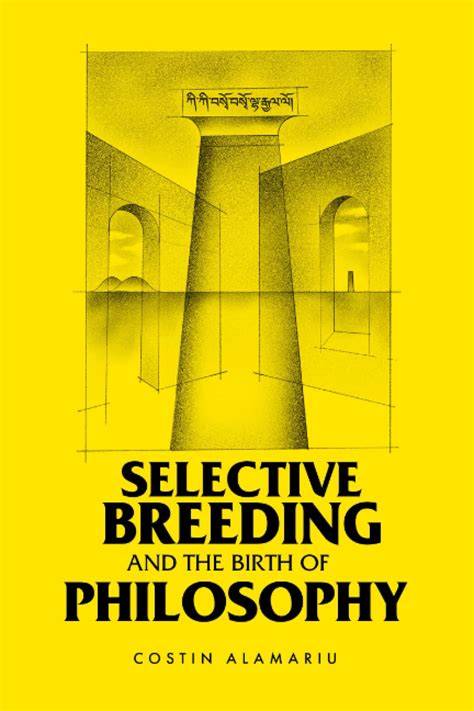
In contrast, Costin Alamariu’s Selective Breeding and the Birth of Philosophy (self-published in 2023, based on his 2015 Yale dissertation1) is a Nietzschean reinterpretation of ancient philosophy. I wanted to purchase it physically, but it has been in my Scribd library for some time. Books and individuals like this annoy scholars, who seem to get a chance to indulge a little in theories considered less politically correct. I came across theories from scholars about the origins of totalitarianism from Plato as a way to critique Western Liberal Democracy and its world imposition in a unipolar order. I do not subscribe to the theory in the manner it is used negatively; nevertheless, this idea that the “origins of Fascism” lie in certain scary ideas of ancient philosophers like Plato’s philosopher-king is to me a suicidal position, but a different side to Costin Alamariu’s thesis.
Alamariu argues that philosophy emerged from aristocratic perceptions of nature (PHYSIS) rooted in biological heredity and selective breeding practices. He posits that ancient aristocracies, formed through conquest, discovered that hierarchies are natural through animal husbandry and human eugenics; and he connects this to the birth of philosophy and tyranny as related phenomena. He uses Nietzsche’s readings of Plato, Pindar, Homer, and anthropological sources like James George Frazer to claim that breeding is central to morality, legislation, and political philosophy. We both intersect thematically around classical antiquity, philosophy’s origins, and the role of nature in human society but diverge sharply in our interpretations and conclusions. I use classical sources to promote ethical universalism distinct from biological determinism, while Alamariu’s book embraces biological essentialism as the foundation of philosophy.
CONCEPTION OF NATURE (PHYSIS) AND ITS ROLE IN PHILOSOPHY
Alamariu centers his thesis on PHYSIS (Nature) as biological reality, interestingly as the hereditary transmission of physical and behavioral traits observed in breeding. He argues that philosophy was born with and dependent on the idea of nature, first manifested in aristocratic societies’ management of reproduction through sexual selection and marriage laws. This awareness arose from pastoralist conquerors such as Indo-European steppe nomads subjugating sedentary farmers, who applied animal-breeding principles to humans, creating a “pathos of distance” between rulers and the ruled. Philosophy therefore emerges as a radicalization of this aristocratic insight during societal decline, abstracting breeding into a standard for evaluating conventions (nomos). For Alamariu, this makes breeding “the most important part of morality, legislation, or of the ‘lawgiver’s art,’” while utilizing Nietzsche’s interpretation of Plato’s eugenics in The Republic. So, he also cites Pindar’s odes2 celebrating inherited excellence (e.g., “become what you are” as a call to fulfill genetic potential) and Homer’s depictions of heroic bloodlines.
TWO INTERPRETATIONS BETWEEN SELECTIVE BREEDING AND MY VIEW
This history is interesting, because it is similar to Julius Evola’s critique of Western readings of Buddhism as passive (Jean Varenne on the Reactions to Julius Evola on Buddhism), when Siddhartha as a royal Prince was trained as a martial artist; and this martialism imbues his philosophy, particularly in his fight against the qualities of Mara, or what Mara represents. I think if we look at it, it is not a mere polemic to state, that American civilization embodies the qualities of Mara and defines these qualities as a superior form of culture, which it tries to impose on other countries as “Democracy.”
We are both grappling with physis as a disruptive force against nomos, but Alamariu celebrates it as biological hierarchy enabling philosophy and tyranny, while in my view physis is subordinate to universal logos, and it is historically and conceptually the basis of equality. Alamariu’s eugenic physis is a claim of inherent racial differences, but there is a sense of cultural fluidity I explain that challenges Alamariu’s claim that philosophy stems from fixed hereditary insights, e.g., the examples I provided of the Scythian philosopher, Anacharsis3 considered a barbarian (see Introduction to the Pre-Socratic Sages: All the Wise Sages) or Epictetus (a former slave) achieving wisdom, which undermine Alamariu’s aristocratic breeding origins. If Alamariu’s Selective Breeding implies racial hierarchies through master races (like conquering pastoralists), it can be countered with the history of Roman expansions, e.g., Caracalla’s Edict of 212 CE granting universal citizenship, as evidence of inclusive REPUBLICANISM. However, my views on inclusivity are not grounded in modern liberal democracy. There are crucial elements I find necessary for the success and development of inclusive REPUBLICANISM.
The theories of Hippocrates’ in Airs, Waters, Places4 provides a classical argument for environmental determinism, which is malleable, not fixed by biology. Distinctions like “Greek vs. barbarian” are cultural and linguistic, not racial, since barbarians were able to assimilate through education or relocation. I deemphasize inherent racial differences by pointing to the Stoic concept of logos as universal reason pervading all humans, transcending blood and physical origin. Cicero’s De Legibus and Seneca’s De Vita Beata both extend kindness to “all mankind,” teaching that there is no difference between man and man, regardless of status; and LOGOS is common to all. This is because CLASSICAL REPUBLICANISM prioritizes ethical and institutional factors over biology. Aristotle critiqued natural slavery as conventional, not innate.
ARISTOCRACY, HIERARCHIES AND BREEDING
Alamariu’s view is that the aristocracy is the cradle of philosophy, born from conquest where virile pastoralists impose selective breeding to preserve superior traits. This creates natural hierarchies, with philosophy as a fossil preserving aristocratic blood and breeding within an age of decay. Alamariu interprets Plato’s ideal city (Republic) as a eugenic project to breed guardians, radicalizing aristocracy into philosopher-tyrants who surpass conventions. He draws on Nietzsche’s scorn for Christianity’s dysgenic unions, which misbred humanity into egalitarian “last men.” “Breeding” is esoteric in Plato5 but unveiled by Nietzsche for modern revival.
While I acknowledge ancient prejudices like Aristotle’s view of some barbarians lacking deliberation in his Politics (1252b5-9), these were cultural, contested, and not biologically fixed. Plato and Aristotle show slavery as contingent on war, not innate traits in his Politics (see Classical Republicanism and Stoicism refutes Racial Hierarchies). There is republican balance as in Polybius’ mixed constitution and Stoic equality, where virtue stems from reason, not birth. Chrysippus’6 theories on “true kinship in shared rationality” rejects blood-based ties, explaining using the analogy of a herd grazing together being nurtured by a common law.
The glorification of aristocratic breeding in Alamariu’s work contrasts with this refutation of hierarchies or shift to more distributive power among institutions and citizens. The Stoic cosmopolitanism of Diogenes as “citizen of the world”7 differs from the conquest model that is based on ethnocentric bias. The connection made between breeding and philosophy reconfigures ancient philosophy, ignoring inclusive examples like Rome’s citizenship expansions or idealized “barbarians” like Cyrus the Great in Xenophon’s Cyropaedia8. Yet we do both recognize aristocracy’s role in classical thought with Alamariu describing it as origin of the philosophers, with my position of aristocracy as a framework challenged by and yet to degrees still imbuing universalism. I want us to take our proper roles in the development of civilization, just as Alamariu is concerned for human potential, except I maintain a strong emphasis on ethical cultivation without regard to heredities.
Is this ethical cultivation imposition from a priestly caste, or aristocratic elite? No. It must emerge from within and among the people, which includes those considered “elite” in an act of humility and civic submission to communal welfare.
CLASSICAL REPUBLICANISM AND PHILOSOPHY’S CONNECTION TO TYRANNY
For Alamariu, philosophy and tyranny are closely related, emerging in declining aristocracies. The philosopher-tyrant is a nomos-independent man of superior physis, using knowledge of breeding to impose his will as active philosophy, preserving nature unbound by historical classes. Alamariu justifies ancient prejudices when associating philosophers with tyrants using Plato’s cave allegory as rebarbarization.
Republicanism is defined as the pursuit of the common good9 through civic virtue and balanced governance in Cicero’s De Re Publica. Polybius’10 adaptable Roman constitution incorporated diverse peoples, countering exclusion. Stoicism, intertwined with Republicanism teaches an ethical and ontological universalism on citizens as “sons of Zeus” in Epictetus’ Discourses11, and views tyranny as contrary to logos.
This is the core opposition in that republican inclusivity refutes tyrannical philosophies. The philosopher-tyrant is the dangerous figure and pretender among citizens I warn against. Philosophy, as we understand it should foster shared humanity, not hierarchical imposition.
MODERN OBSESSIONS WITH RACIAL BIOLOGICAL HIERARCHIES
I understand that Alamariu critiques modernity’s egalitarianism as dysgenic lending support to arguments for hereditary superiority, but this is his philosophy. A politics of shared humanity is consistent with the republican view. Alamariu’s breeding-centric morality focuses on ancient prejudices as foundational. If Alamariu wants to flirt with racial hierarchies with Herrenrasse conquerors, then I am at liberty to evoke Seneca’s emphasis on kindness to all12, preferring reason’s invariance over biology.
For Alamariu, on physis (nature), biological heredity from breeding is the foundation of philosophy and hierarchies, and specifically, conquerors breeding superior traits. Philosophy’s role in this history radicalizes aristocracy into tyranny, preserving natural breeding. In this view, hierarchies are natural through biological heredities. This differs with my readings on Classical Republicanism and Stoicism: Nature (PHYSIS) is relational to LOGOS. Aristocracy is a framework for our notions of virtue, but I critique prejudices, and yield to universalism as the reality of physis itself. The role of philosophy is to promote civic virtue, and this is not dependent on biological heredity and the biology of race. Selective Breeding leads to the idea of the Philosopher King, which was embodied (to give a modern political example) in the Iranian philosophy of Ruhollah Khomeini. Mario Palmieri had this idea in mind, in his Fascist Philosophy, in his ideal of the HERO.
It is not the intention to sanitize the thoughts of ancient philosophers, but viewing ancient philosophers as connected to tyranny has historicity but is not the foundations of philosophy. This is what I got from doing the brief reports on Introduction to the Pre-Socratic Sages: All the Wise Sages. There is a change in the emphasis in Greek education in antiquity from defining tyrants once considered among the great philosopher-sages and the martial knowledge of war strategy as WISDOM. I explained in that article, that this was itself a conscious choice and reconstruction of Greek history in Plato’s writings, but then I still kept to the original lists that included those tyrants.
Selective Breeding and the Birth of Philosophy provides a provocative, biology-driven origin story for philosophy that is interesting but is not my focus. It is also not my intent to refute anything like Roger Morrison, Tyler Cowen and others have when it first came out, but provide simple contrasts, and what provocative things other philosophers are attempting to achieve in breaking through present limitations with unique theses. In some sense, I propose Stoicism and Republicanism as antidotes to breeding-based hierarchies, though in my own view, I am highly observant and aware that biological hierarchical beliefs or sexual selection exist among the most ordinary citizen of any race when it comes to choice and place of dating, marriage and raising children.
This use of the term “vitalism” is in Occult Philosophy and Neo-Idealism also, but it is not limited to the physical sexual organs, semen or to levels of testosterone. This is just typical of ongoing tensions in interpreting antiquity: between essentialist vitalism and ethical cosmopolitanism and reveals the true stakes of our classical inheritance. We can endlessly debate ancient ethnocentrism or selective readings of Plato’s eugenics (e.g., Greek barbarian distinctions as quasi-racial)13, but the coherent legacy aligns unmistakably with Cicero and Seneca: a cosmopolitanism grounded in shared logos, extending kindness and civic equality to all mankind, transcending blood, birth, or conquest. This is no mere abstraction. It finds its fullest political expression in the REPUBLIC, our Republic, as a mixed government deliberately blending elements of monarchy, aristocracy, and democracy to prevent domination and corruption. As Cicero and later Machiavelli emphasized, this balanced constitution upholds rule of law, separation of powers, and popular sovereignty not to enthrone a philosopher-tyrant or preserve hereditary “superiority,” but to safeguard the common good through institutional humility and non-domination.
Hierarchies imposed by physis alone breed only despotism, while the mixed republic elevates ethical cultivation from within the demos, ensuring the school of liberty endures against any claim of innate mastery by one race, tribe or ethnic group. In reclaiming these roots, we do not sanitize the ancients, but we fulfill their highest ideal: a civilization where reason, not blood, governs human potential. Such a civilization requires reformed teachers of the ideal who live, express (or embody), exhibit and propagate it through the power of logos, so that the philosophy lives with us and through us as a shield to bind against stasis and degeneration.
HELP YOURSELVES AND THEN BECOME AS TEACHERS AMONG THE PEOPLE.
DO NOT LOSE FAITH IN YOUR FELLOW HUMANKIND AND IN THEIR HUMANITY.
FOOTNOTES
- Costin Alamariu (2023). Selective breeding and the Birth of Philosophy was self-published (Original dissertation published 2015 as “The Problem of Tyranny and Philosophy in the Thought of Plato and Nietzsche,” Yale University.). ↩︎
- Pindar, Odes, Pythian 2: line 72 (γένοι᾽ οἷος ἐσσὶ μαθών) ↩︎
- Herodotus, Histories 4.76 (visit to Greece); Diogenes Laertius, Lives 1.101-105 (sayings) ↩︎
- Hippocrates, Airs, Waters, Places, Chapters 12-24 (effects of environment on peoples); e.g., 12 (Asiatics vs. Europeans) ↩︎
- Plato, Republic, Book 5: 458c-461e (eugenics and breeding); 459a-c (analogy to animal breeding); Book 7: 540a-541a (philosopher-kings/tyrants). ↩︎
- Chrysippus, Fragments, Fragment 67F (on cosmic kinship and rationality); also, 57W (on the herd analogy) ↩︎
- Diogenes the Cynic sayings in Lives of Eminent Philosophers, Book 6: 6.63 ↩︎
- Xenophon, Cyropaedia, Book 1: 1.1-1.6 (Cyrus as ideal ruler); and Book 8: 8.1-8.7 on institutions. ↩︎
- Cicero, De Re Publica, Book 1: 1.39-1.41 (definition of res publica); Book 3: 3.43 (common good) ↩︎
- Polybius, Histories, Book 6: 6.3-6.18 (analysis of mixed constitution) ↩︎
- Epictetus, Discourses, Book 1, Chapter 3: 1.3.1-3 (sons of Zeus); Book 2, Chapter 1: 2.1.11-15 (tyranny vs. reason) ↩︎
- Seneca, De Vita Beata, Chapter 15: 15.3-15.5 (the happiness and equality of souls); 24.3 (no distinction in virtue) ↩︎
- Listen to Mika Ojakangas on Biopolitics, Eugenics, and State Racism in Ancient Philosophy ↩︎
ARTICLES MENTIONED
- Cowen, T. (2023, September 24). Selective Breeding and the Birth of Philosophy. Marginal Revolution.
- Morrison, R. (2023, September 26). A Historical Criticism of Costin Alamariu’s “Selective Breeding and the Birth of Philosophy.” Substack.
- Evola, J. (1996). The Doctrine of Awakening: The attainment of Self-Mastery according to the earliest Buddhist Texts (H. E. Musson, Trans.; J. Varenne, Pref.). Inner Traditions. (Original work was published 1943.)
 The American Minervan
Leave a comment