Influenced by the pious Italian Catholic, Giambattista Vico, Gentile in his philosophy of Actual Idealism or Actualism (Attualismo) attempts to preserve Christian heritage. Palmieri’s work outlining Fascist Philosophy absorbs Vico’s philosophy and his “Ages” as a bridge between Catholic social teaching and Italian historical philosophy on the place of the Roman Catholic Church in Italy to form this idea of the Organic State, or CORPORATIVISMO. Fascism sought to position itself as the modern realization of an “eternal” Italian-Catholic spirit against modernity’s ills, where Fascism recognizes the authority of the Church, but subordinates the Church to the totalitarian ethical State.
- FIRST SECTION: VICO’S CYCLES OF HISTORY, HEROES AND INTERPRETATION OF HISTORY
- SECOND SECTION: GENTILE’S ACTUALISM AND RADICAL HUMANISM
INTRODUCTION
The political history of Italy pre-unification is far richer and older than the United States, but we must also consider the political landscape in North America before the establishment of the modern U.S. Republic. This political landscape has also gone through several distinct phases that were monarchic, corporate, proprietary, or imperial in structure, operating on land already governed by diverse Indigenous nations with their own political systems and 20,000 years of rich history. We can argue whether the U.S. American’ has experienced a sufficient number of sequences of political cycles or regimes to warrant a comparison to Italians, but it is true, that the modern U.S. Republic represents merely the current phase in the history of American Civilizations — understanding, that no nation is eternal.
The long history of the indigenous Americas is criminally excluded from the national historical narrative, as perhaps goes the same slightly for the history of the Indigenous peoples of ancient Italy before Rome that reveal its rich linguistic diversity. These Indigenous peoples and cultures were Etruscans in central Italy; the Samnites, Lucanians, Bruttians Italic tribes in the central and southern Apennines; Greeks (Magna Graecia) from flourishing colonies in the south; Celts (Gauls) in the north; and the Ligures, Veneti and Messapians (Uncovering Italy’s Hidden Cultures: The True Indigenous Peoples). The pre-Roman Etruscan goddess Menvra is the foundational inspiration for my work, as is the indigenous of the Americas, African ancestors and the history of the Europeans, connecting to a consistent theme of reclamation, revival and love of antiquity. Simply, one cannot love antiquity while disregarding the history of the indigenous and the global human story of migration.
THE TWO LEGACIES OF ROME
With this recognition, turn to the period of Fascist Italy. Fascism and the Republic represent two different legacies of ancient Rome. U.S. REPUBLICANISM is a unique synthesis itself, which includes elements of democracy, aristocracy and monarchy — all the structures mentioned above. It is implicitly not meant to be a perfect system. Perfect and utopian systems are the systems of the totalitarian. What does not seem understood is that our system does not depend on strict determinism but is founded on spiritual and metaphysical notions about the nature of the cosmos and human agency that have become through historical and philosophical processes, secularized. Intelligence is essential to Democracy, but we have gone through the Age of Enlightenment where the modern root of Scientific Racism emerges in ugly forms distinct from prejudices in classical antiquity.
Essential to our system is the classical democratic heritage. Democracy necessitates a faith in the potential of the People. Fascism on the other hand suspends this faith as a fantasy not possible at this time in history, according to Mario Palmieri. The masses need an elite, and they need and want to be led — and led by a hero. These ideas evoke the Hero in Thomas Carlyle’s works and the Caesarist strongman. This is Palmieri’s view of things.
What exactly is the potential of the people? Well, inherent in REPUBLICANISM, from ancient Stoicism and even before is the belief in man’s inner divine potential. There is this belief in the potential of every citizen, and it is their connection to the divine logos, and their potential for good. A Republic, by function therefore should be nurturing not hindering this in the People.
In the two competing legacies of Rome, our civic republican tradition represents classical Humanism (incompatible with capitalist transhumanism*), and this is the crux of the argument of Fascism against philosophies of individualism occurring during the Italian Renaissance era. Fascist thinkers, utilizing Mazzini, Dante, Vico and others sought to provide a critique of what they saw as a civilizational problem in a world increasingly becoming dominated by individualism leading to social dissolution.
FORERUNNER OF FASCIST PHILOSOPHY IN THE LAST RENAISSANCE MAN
Fascism is a very particular spiritual philosophy and martial discipline grounded in a collective of history and theology in Italy. The Fascist philosophers themselves wrote exactly what is and what is not a Fascist, whereas any authoritarian is called a Fascist by contemporaries. This enables people to associate anything with Fascism.
The early thinkers of Fascism find the beginning of the continuation of Rome’s lineage (which was to be embodied by Fascism) in the last Renaissance Man, Vico. Fascism is, above all, a metaphysics and “way of life.” Palmieri’s emphasis on Vico and Renaissance aligns with Gentile, who saw his attualismo philosophy as a radical transformation of humanism, or “radical humanism.” Gentile appears to be in heavy dialogue with Renaissance thinkers, at the root of neo-classical Republicanism. This is the root of the divergence from liberal modernity via individualism (from Petrarch, Pico and Burkhardt), because Gentile argues against autonomous individuality. There are several factors that transitioned Fascism or pushed out Gentile’s immanentistic state-spiritual humanism in the very late half of the 1930s, and this was due to Mussolini’s decisions and alliance with the German National Socialists, along with Mussolini’s eventual adoption of previously and adamantly rejected biological theories of the Nazis and German scientists.
When Mussolini began adopting more of the Judeo-Masonic conspiracy from Russia in Maurice Joly: Origins of the Protocols of Zion and its Impact on Theosophy, this immediately affected anti-Zionist Jewish Italian Fascists. Jews had been instrumental during the Risorgimento (or Reunification of Italy). Mussolini claimed to be a reincarnation in spirit of Mazzinianism, even adopting Mazzini’s all-black attire, and Gentile and Mussolini made Mazzinianism central to the doctrine of Fascism. The early anti-Zionist Jewish Italian Fascists therefore saw Mussolini as a protector, and this however changes with the adoption of the official Racial Laws promulgated between 1938-44.
Early on, Mussolini admitted admiration for the anarchist, as superior to the socialists. He was interested in action and came to detest the flailing liberal theorists of his time who do nothing. He romanticized violence like it was drama and poetry, carrying about as if Mars had possessed him. Sorel, D’Annunzio and many others he read and met along the way satisfied what he described as apart of his wish to understand the depths of the history of the then Post-Risorgimento Young Italy, the poor and shattered of Europe, to bring them up to their former glory. While Fascism is indeed a discipline, a martial philosophy, it becomes later merely a reflection of Mussolini’s psychology.
This is important context for the history I have so far elaborated on and will explain in this and the next section on Giovanni Gentile’s concept of “radical humanism.”
In his 1936 book The Philosophy of Fascism (published in English by the Dante Alighieri Society in Chicago, with a preface by Dr. Guido Corni and implicit approval from Mussolini), Palmieri, an Italian Fascist intellectual writing to explain Fascism’s spiritual and philosophical foundations to an American audience, explicitly positions Giambattista Vico (1668-1744) as one of the foundational prophets of Fascism along with Dante Alighieri as I explained in The Romaness of Fascism: Palmieri on the Prophets, Philosophy and Mission of Fascism. Palmieri frames history as cyclical alternations between individualistic (disintegrative) and anti-individualistic (integrative) forces, listing Vico alongside Schlegel, Herder, Marx and Hegel as thinkers who reveal this pattern. However, he specifically singles out Vico as the starting point of the anti-individualistic reaction at the basis of Fascism and Gentilian thought against Renaissance-era individualism.
VICO’S NEW SCIENCE, PHILOSOPHY OF CYCLES AND INTERPRETATION OF HISTORY
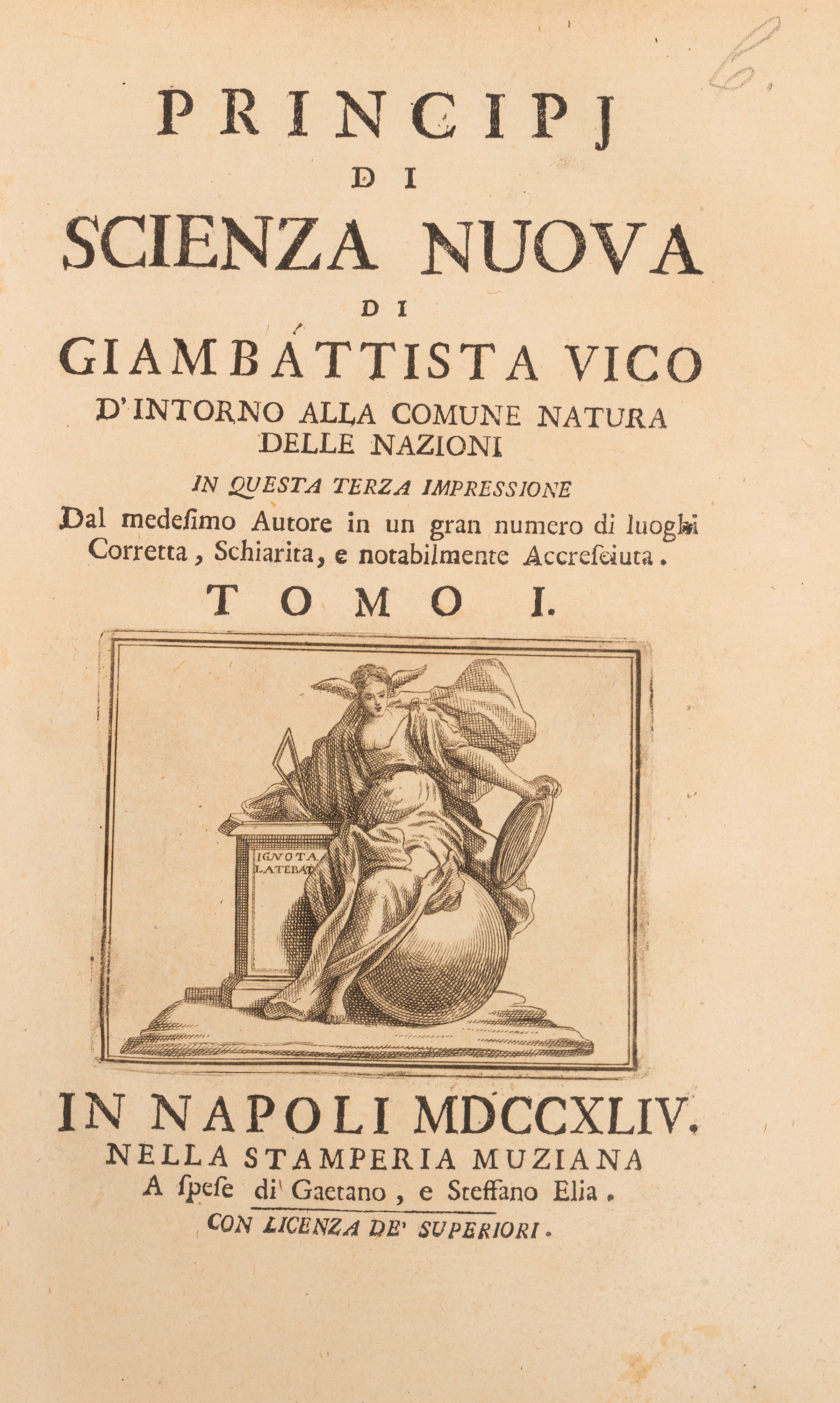
In his chapter “Two Forerunners of Fascism,” e.g., Palmieri devotes significant space to Vico’s Scienza Nuova (The New Science). The first draft of this book dates to 1725, and I had found this book at The Old Book Inc. down in Grayslake, IL.
What did I think of Vico? He certainly believed in the supremacy of the Church of Rome and its established place in the World, and he teaches a rational civil theology of divine providence. I immediately thought of Mario Palmieri, but I also thought of Theosophy. There is a shared convergence of notable thematic and structural similarities in Vico and Blavatsky’s philosophies of history, human development, myth, and the interplay of divine forces with human affairs. Analogies can be drawn within macrohistorical frameworks, where both Theosophy and Vico emphasize integrative inquiry bridging physics and metaphysics. Both focus on cycles over linear progress, and symbolic (or mythic) knowledge over materialist reductionism. There is this cyclical macrohistory that prioritizes imaginative and symbolic insight over Enlightenment rationalism.
His New Science is basically a holistic rational civil theology of divine providence, integrating philosophy, history, myth, law and language. His ideas and theories are referred to as the Vichian concepts. Vico, like Theosophy proposes a “new science” that transcends narrow rationalism and materialism by reuniting reason with imagination, history with myth, and the physical with the metaphysical and spiritual. The difference is that Vico focuses on historical institutions and mentality, that can appear more pessimistic. Vico’s poetic etymologies stress that etymology and symbolism are keys to origins of religious thinking and man.
For Vico, human societies (specifically “gentile” nations, excluding the Hebrews with their revealed religion) follow an ideal eternal history (storia ideale eterna) traversed in time by every nation. There is one “ideal eternal history” that all nations follow according to a common human nature. In this view, history is not chaotic but law-governed; and studying myths, language, and institutions reveals this pattern. Myths are thus understood not as lies but encoded “true” history of the civil world, e.g., through etymology, because words preserve origins in sensory experience.
This unfolds in three recurring ages (corsi), followed by a ricorso (return or ricorso to a new barbarism, restarting the cycle, often with some accumulated refinement). It follows from the Age of Gods, Heroes and Men. The characteristic of the Age of Gods is sensory, poetic, theocratic. Humans live in fear (awe) of natural forces personified as deities; institutions arise from divination and oracles. In the Age of Heroes, it is imaginative, aristocratic, forceful. There is rule by might, feudal structures, and epic poetry. Primitive humans possessed “poetic wisdom” (sapienza poetica) or a fantasia-driven, metaphorical mode of thought. Early people were “theological poets” who created myths, fables, and “poetic characters” (universal imaginative archetypes) to explain and found institutions. In the Age of Men, the dominant qualities are rational, democratic, individualistic, which culminates in skepticism, abstraction, and “civilized” barbarism (e.g., excessive reflection leading to social dissolution), triggering ricorso. The cycle is providential and reflects evolving human mentality or consciousness, not mere external events.
PROVIDENCE works immanently, not through miracles but by directing human passions, vices (e.g., ferocity leading to laws, greed to commerce), and institutions toward social order and eventual rationality. Dio for Vico makes history intelligible because humans, made in the image of Dio create the civil world. Vico wrote much on the “Ancient Wisdom of the Italian people,” which became important in the early ideas of Fascism.
PALMIERI ON VICO
“. . . the philosophy of his [Giambattista Vico’s] age tended to dissolve society, to dissociate men, to lose sight of humanity, nations and families in the contemplation of isolated individuals. . . .” (Mario Palmieri)
Palmieri explicitly frames Italian philosophy (including Vico) as always having been Catholic. Catholicism, for Palmieri has been the inspiration from Bruno and Campanella, to Vico, Rosmini and Gioberti. Here, Vico is tied to the unbroken tradition of Catholicism as Italy’s precious spiritual heritage.
Essential to Vico’s view, is that he considered the philosophy of the Stoics and Skeptics of Greece to tend toward the isolation he describes occurs in the Age of Men. Here it is admitted, Palmieri says, the philosophy of Vico gives “an account of men not as solitary, but as social beings; which would promote social union, strength and progress. It is with Vico, then, that we must begin our study of the two greatest forerunners of Fascism.” Vico also influenced Karl Marx, and Gentile was influenced by Marx.
In Palmieri’s chapter, he argues that Vico reacted against the “solitary,” materialistic, and dissolving spirit of Renaissance individualism by emphasizing humans as inherently social beings bound by an “invisible” collective affinity. Vico’s ideas of historical cycles (corsi e ricorsi) as the “Divine Mind” manifesting in nations and civilizations reveals the limits of abstract science (which is merely an “anatomy of nature”), and the need for spiritual renewal through authority, conscience, and heroism. These are all ideas early Fascism would incorporate or articulate as its philosophy. Palmieri states that Fascism fulfills and realizes Vico’s vision in practice, that the State as the higher ethical entity that subordinates the individual, restores moral unity, and averts barbarism through a new cycle of heroic, anti-individualistic order.
Palmieri states, that with Vico, Fascism is born and Individualism begins to die. He also notes that Mussolini (as “il Duce” or hero-leader) fulfills the prophecies of all the forerunners of Fascism, from Vico to Mazzini.
Palmieri presents Vico as the philosophical origin of the anti-individualistic current that culminates in Fascism’s rejection of liberal democracy, rights-based individualism, materialism and unchecked liberty. Instead, Fascism revives duty, hierarchy, the Nation-State as a “super-human entity,” and the spiritual unity of the people under authority. Vico supplies the historicist and idealist tools, where history is the unfolding of the Spirit (Divine Idea) through nations, not abstract individuals. Law and Authority are expressions of divine (or eternal) justice rather than popular will; and Fascism recognizes the need for periodic heroic renewal.
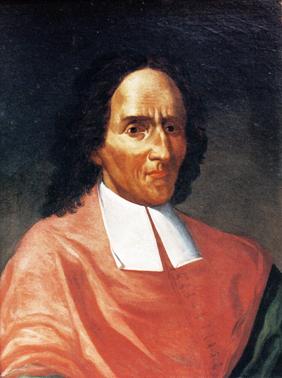
This is the basis of Palmieri’s philosophy of Fascism, as a philosophical and martial “way of life” and thinking, not a mere political movement. The aim of Fascism is recognition of historical process as force restoring spiritual order against the decadence of the liberal era. While Giovanni Gentile (the official philosopher of Fascism) and others in the Actualist (Neo-Idealist) tradition also engaged with Vico, Palmieri’s book remains one of the clearest and most explicit popularizations of the Catholic Vico as a spiritual and intellectual ancestor of Italian Fascism. I reject the modern interpretations or common conjectural habits in academia that posits, the Fascists selectively interpreted or “reclaimed” earlier Italian thinkers (Vico, Dante, Mazzini, Machiavelli, etc.) in a game of roulette to “construct” a continuous “Roman” or Italian philosophical lineage for their regime. According to Mario Palmieri, Vico is not just influential but essentially where “Fascism is born” as the decisive turn against individualism and therefore the liberal tradition.
This contextual history undoubtedly settles certain questions readers have about the study of Fascism as a philosophy, not a verb to be hurled indiscriminately. The Fascists do not get their understanding of Time or Ages from the nineteenth-century Theosophists nor ridiculous theories about the root of their ideas originating in sci-fi novels. It was inspired by the cultural influence that Giambattista Vico still had in Italy as a reaction against materialist reductionism and spiritual decadence.
LIBERAL LIMITATIONS AND THE PSYCHIC DROSS OF WORLD WAR II ERA POLITICAL IDEOLOGIES
The origins of every element of Fascism are dissectible. There are persons that find my approach better than typical scholarship on this topic, and others that believe my approach “encourages.” The approach I take is different, because it centers philosophy as way of life and force in the world. I am rooted in the Idealist and Republican tradition itself as a spiritual mission against materialism in modernity, so I recognize where Fascists are working from metaphysically, as not merely attempting to “reclaim” thinkers within the lineage of Republicanism but finding them or anybody else justified in their inclusions.
In my view, the Fascist readings or interpretations of Mazzini, Vico and others create a partial tradition, because their analysis and interpretations are not actually that good, whereas (1) better analysis can be distilled from the prophets they choose, and (2) the prestige of republican tradition is already established as Aegean Origins and History of the Fasces demonstrates. If I were to ask, what modern so-called Fascist today reads Vico, not a soul could answer. Republicanism need not be replaced with, adopt or adapt Fascism in any manner, just like it does not need to be replaced by, adopt or adapt Marxism. These factors give my analysis and observation a depth that others fail and will continuously do, because the common motive on the big stage for discussing Fascism is to merely contextualize it within Post-War preferential analysis in recognition of actual Fascist Philosophy as viable competitor to Liberalism. However, actual Fascist Philosophy does not exist as a collective in the United States. There are merely Neo-Fascists, Third Positionists and those who reduce Fascism to what appeals to them aesthetically.
For the early Italian Fascists, LIBERALISM pre-war was already seeming obsolete and dead on-arrival. It was only by winning the War, that the life of Liberalism was extended and thus saved, but this victory is a short-lived victory.
Fascism was the next evolution from Liberalism, i.e., Il liberalismo ora si chiama fascismo (“Liberalism now is called fascism”), Gentile declared. I do not affirm the Fascists positively, but I recognize the early arguments, because within civic republicanism itself as a communalist vision of society, also lies a strong and valid critique against individualism that can be utilized today against the prevailing superficialisms, capitalist greed and domination. So, no soul could lie and say I preference Fascism. I preference Republicanism, therefore I must teach you Fascism properly; and not as a liberal polemicist, but to educate each other how to diagnose the political poisons identified in classical republican theory. Therefore, one does not need to be Fascist, a Conservative or a Traditionalist to critique individualism.
We want reinvigoration of philosophy and theology (social teaching), not to be constantly on the wall fighting against the tyrannical ideologies of the War. There is in our democratic political tradition the recognition of the dignity of every human being, and this is a classical humanist legacy that does not depend on adherence to any political party. It must be understood in its fullness as historical heritage, as lineage, not through a particular lens, figure or hierarchical group of a select few political prophets. For us to understand this, we need people to get unhooked from the Post-War mythology and their fascinations with the political visions from the Wars (which are just smokescreens) and also defeat false equivalencies to these political ideologies whenever solutions not liberal or leftist are conceived, which actually allow party factionalism, extreme political polarity, oligarchy and feudal technocracy to proliferate. For the Republic to be safe, every citizen, of every class and every party must be shields to the vulnerabilities of the Republic, rather than its exploiters.
This article is a continuation from The Romaness of Fascism: Palmieri on the Prophets, Philosophy and Mission of Fascism.
 The American Minervan
Leave a comment