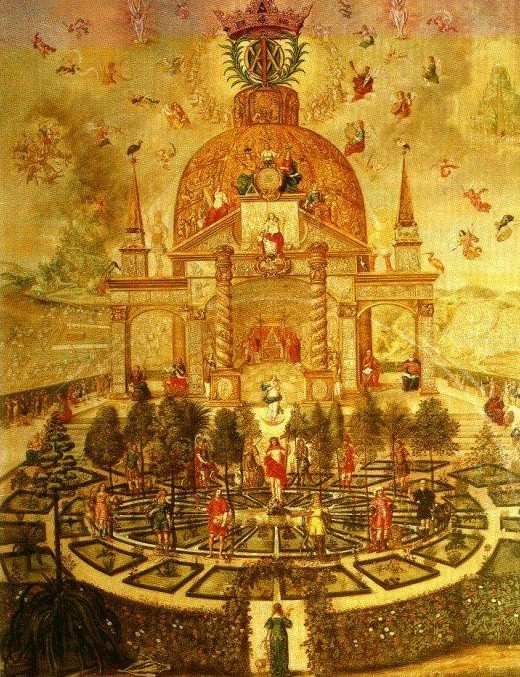
HELENA BLAVATSKY IS CERTAIN THAT A GREAT BODY OR FEDERATION OF “spiritual Illuminati” does exist in her time, but their locations will never be known. What was being formed and taking place in that time between all these networks is a question K. Paul Johnson put forth, and it made me think of the history and manner in which conspiracies and fabricated hoaxes have been built upon misuse of this narrative of esoteric currents. These things are not foreign or distant in my view within my past study of Islam, but the history and writings of H.P. Blavatsky and others detail cooperation between centers of brotherhoods in her time in possession of valuable and inaccessible knowledge to the public, revealing a web of trans-cultural spiritual and philosophical lineages converging in that time period, which has not occurred again. Furthermore, these efforts and the ideas circulated in these efforts challenge power structures.
The fact, that such efforts have dwindled is a problem, and the propounding evil in our time is, in my view, a consequence of both the absence and unfortunate failure of such efforts. To get things back on track would necessitate similar efforts as a challenge to the times, and to get in that mindset that has become lost, there are some things we need to consider.
To detach this conversation from its vague popular discourse, this idea that a federation of adepts and initiates with their disciples and agents, of individuals working known and anonymously to give birth to eclectic philosophical movements between esotericists of various or similar tradition has some long and detailed history behind the myths. Our generations should be encouraged to get into the world and bring about such efforts, outside of digital spaces/limitations, which is a controlled game.
ETHICAL AND FUNCTIONAL REASON FOR THE RULE OF SECRECY
The criticism of secrecy became popularized by conspiratorial integration of assassinated U.S. President John F. Kennedy, in his speech against secrets and secret societies, but now we live in a globally surveilled and policed system, and there is no privacy. There is nowhere to hide from tyranny, from drones, from intelligence. There is not a cave or mountain to hide. For these persons in the history of the Theosophical Movement to have kept their identities secret and under alias in the present-day, it would require more knowledge, than simply living as a local farmer in a marshland, or among a band along obscure mountains. Governments and agencies have a different sense of omniscience than the nineteenth-century; and also who could say, that secrecy means evil is being perpetrated, considering the history of infiltration through social activist movements?
When it comes to the scorned side of the History of Religion in the study of the History of Esotericism, we are told that until the masses had greatly sought to get rid of its ignorance and aspired to learn of (or receive) the body of knowledge associated with those institutions and schools well, such individuals would not feel it wise to engage. The rule of secrecy serves two purposes, (1) ethical, (2) functional, or i.e., to safeguard (ethical) and as a method for maintaining doctrinal continuity and practical efficacy (functional).
These two main ethical and pedagogical reasons for the secrecy of esotericism throughout human history were given in H.P. Blavatsky’s book, The Key to Theosophy (see page 12):
- Most people lack the moral, intellectual, and spiritual preparation to receive them, and premature exposure may blind them, and lead to spiritual harm. It is the human traits of selfishness, personal desire, and ambition, which can easily result in such revelatory teachings and potent information being misused and misdirected to evil effect.
- The inability and unreliability of the masses to prevent that which is sacred and divine from being desecrated and distorted. The rule of secrecy is a responsible pedagogy, because the real occult knowledge is powerful, and must be transmitted only when the student can integrate it without causing harm to self or others. Institutions, methods and strategy for these means have been developed for long periods with systems in place.
- In explaining the structures of religions, if people think that the esoteric is separated from the tradition — the inner doctrine is preserved within an initiated circle to keep it from being diluted, trivialized, or turned into mere curiosities by public exposure. Public forms (rituals, myths, exoteric doctrines) serve the masses, but the inner teaching are for genuinely serious and tested aspirants or initiates.
- The rule of secrecy protects the integrity of the tradition and ensures that transmission remains effective — rituals, methods, and ethical disciplines must be learned gradually under training or guidance by a Master (see The Reluctant Messiah: Truth about Jiddu Krishnamurti and Theosophy).
Now, instead of delving into conspiracy theories, others might go to search out what was this body of knowledge, this perennial body of esotericism that these various persons covet. To do this, I have to put things into perspective outside of conspiracy theory within European and American history. There are many movements and associates in various spaces of the world between the seventeenth and nineteenth-century prior to the Theosophical Movement and during its early periods that provide examples of what is being attempted here outside of academic skepticism of internal motives.
LISTS OF PERSONAGES TO RESEARCH
Here are historical persons featured in the Dabistān (e.g. Azar Kayvan circle with later commentators), to the nineteenth-century leading into the formative periods of the Theosophical Movement then with similarly technical and esoteric Zoroastrian Ilme Kṣnum (often also spelled Ilm-e-Khshnoom) within the culture of the Parsi/Mazdayasnan:
THE DABISTAN
The Dabistān was a seventeenth-century Persian comparative survey of religions compiled in Mughal India. Its chapter on the Sipasiyan/Āzar Kayvānī sect records a small eclectic Zoroastrian‑Illuminationist circle whose features of (i.) secretive lineage and (ii.) claim to preserve esoteric doctrine resemble the Theosophical idea of hidden “Masters,” despite the two arising in different historical and cultural contexts. Its ethnographic‑like chapters describe beliefs, rites, and local sects, and might give a clue or ethnographical and occult explanatory template for what Helena P. Blavatsky had in mind for “The Secret Doctrine Vol III,” the authentic completion of her proposed tetralogy that she could not finish, though she indicates they were almost finished. The Third Volume was going to be a digest of the History of the Adepts. There is no authentic Third Volume published.
- Mir Ẓū al‑Fiqār ʿAlī al‑Ḥusaynī (pen name Mubād Shāh), identified as the author of the Dabistān‑i Mazāhib, which records and describes the Azar Kayvānian sect among many others.
- Āzar Kayvān, founder of the Zoroastrian Ishrāqī (Illuminationist/Abadi) school; active priest-mystic in 16th-early 17th century, emigrated to Patna under the Mughals and became the focal figure for a distinct Zoroastrian sect.
- Kay Khosrow, named successor/leader in the Azar Kayvanian lineage
- Shaykh Bahaʾi (Bahaʾ al‑Dīn al‑ʿĀmilī), a major Safavid polymath (late 16th-early 17th c.)
- The Sepāsīān/Sipasiyan community, a named Zoroastrian group associated with the Azar Kayvān school.
- Emphasizing doctrinal transmission, the Dabistān includes many other composite sectal categories and unnamed local Zoroastrian priests and mystic mobads (clerics), Sufi‑influenced gnostics and “Illuminationist” philosophers (Ishrāqī‑style thinkers), regional patrons and Mughal‑era rulers.
HISTORICAL PERSONAGES IN THE THEOSOPHICAL MOVEMENT
- Prince Aleksandr Golitsyn
- Prince Pavel Dolgorukii
- Giuseppe Mazzini
- Yaʿqūb Ṣanūʿ (or James Sanua)
- Mohini Chatterji
- Ranbir Singh, Maharajah of Kashmir
- Thakar Singh Sandhawalia
- Yashwant Rao Holkar II, Maharaja of Indore
- Bhai Gurmukh Singh
- Baba Khem Singh Bedi
- Surendranath Banerjea
- Dayal Singh Majithia
- Sumangala Unnanse
- Sarat Chandra Das
- Lama Ugyen Gyatso
- Rinzin Namgyal
- Abd al-Qadir al-Hassani al-Jaza’iri (Abdelkader), an Algerian Sufi sheikh
- Norendro Nath Sen
- Agardi Metrovitch, possible alias of opera singer Giovanni Metrovitch
- Richard Francis Burton
- Maria, Duchese de Pomar and Countess of Caithness
- Lydia Pashkov
- Raphael Borg
- Charles Sotheran
- Emma Harding Britten
- Charles-Ernest Renan
- Henri Rochefort
- Jamal ad-Din al-Afghani
- Alma and Max Theon (born Louis M. Bimstein)
- Albert L. Rawson
- Mikhail Katkov
- Alfred Percy Sinnett
- Allan O. Hume
- James Martin Peebles
- Swami Dayananda Sarasvati
- Shyamaji Krishnavarma
Ilme Kṣnum — AFTER THE THEOSOPHICAL MOVEMENT
Ilme Kṣnum and Behramshah, the mystic of Mount Damavand personages.
- Behramshah Naoroji Shroff
- Khurshedji Cama
- Jehangirji Vimadalal
- Manchershah Kekobad
- Phiroz Nasarvanji Tavaria
- Hormusji Jeejeebhoy Suntoke
- Jehangirji’s circle and local Surat/Bombay devotees
After the 1979 Islamic Revolution and the establishment of the Islamic Republic, Iranian Zoroastrians faced increased social pressure, legal and civic disadvantages, and a marked emigration that reduced community numbers. These changes disrupted transnational ties that had previously connected Iranian Zoroastrians (and any Behramshah sympathizers in Iran) to Parsi/Kṣnum networks in India and the diaspora, but Ilme Kṣnum as now a primarily Parsi and Indian movement remains centered in India and the West, rather than inside post‑revolutionary Iran under Ayatollah Mojtaba Khamanei, currently. After 1979 non‑Muslim minorities, including Zoroastrians, lost many of the secular protections they had under the Pahlavi state and experienced greater social and institutional pressure, therefore esoteric currents lost institutional backing. Any small groups in Iran sympathetic to Illuminationist or neo‑Zoroastrian esotericism definitely found fewer safe public venues and weaker scholarly exchange with Indian Parsis after 1979. This history could have negatively affected Khshnoom where they relied on manuscripts, visiting scholars, or exchanges with Iranian Zoroastrians, disrupting those channels by immigration, travel restrictions and political risk, slowing their textual transmission and scholarly collaboration between Iranian Zoroastrians, Bombay and Surat disciples and the Parsi diaspora.
SECRECY AND STRATEGY FOR SURVIVAL IN AN OPPRESSIVE WORLD
In such context, secrecy becomes a strategy for survival, which is the other missing element to this conversation. As to the spread of the remnants of a collective body of esoteric Wisdom, I do not see attitudes about this kind of narrative of transmission of knowledge understood well on a mass-scale, and the situation is quite the opposite. These thinkers in the Theosophical Movement, e.g., were very critical of institutional abuses, the mechanisms of political and religious exploitation, materialism and the cultural superficialities of that era, and we are not able to say that much has changed.
Blavatsky claims that a living, initiatory, perennial wisdom preserved by a small circle of initiated teachers as a custodial, pedagogical secrecy was intended to prevent misuse. In A Few Questions to Hiraf, it is stated that “. . .the real, the complete Cabala. . .is in possession, as I said before, of but a few Oriental philosophers. . .The only thing I can say is that such a body exists, and that the location of their Brotherhoods will never be revealed to other countries, until the day when Humanity shall awake in a mass from its spiritual lethargy, and open its blind eyes to the dazzling light of Truth. A too premature discovery might blind them, perhaps forever.”
It is from reading texts like that, one is able to find how occultist tropes provide narrative utility for conspiracy theories, that propagandists and fabricators adapt and misuse, and I have observed this tactic work well throughout the digital age. The term Cabal comes from Cabala (or Kabbalah) referring to the history of oral transmission of esoteric teachings and methods of transmission, like ciphers. I wrote about some of this history of transmission in Medieval Kabbalah and the Transmission of Jewish Mysticism. Mass propaganda deliberately blurs the distinction between the two terms.
Some have said, that like the first German Rosicrucians, who learned their ideas and imagery from Moors and mystics of Islamic esoteric origin, Theosophy owes its concepts of Cyclical Time to them, but these concepts do not originate in Islam. The story is bigger than Christianity and Islam and will remain so.
It is said that the ancient academies from Egypt and all over Asia and Europe once bloomed with great minds. Initiates, as said before were surely to come into “the company of the gods,” but most importantly, as time has also shown us, the Europeans had lost their Mysteries. Some buried its remnants in the new religion Christianity as a means of adaptation and survival from persecution and death.
The pedagogical reasons for secrecy greatly frustrated someone like Egyptologist Gerald Massey, and though H.P. Blavatsky had explained the various reasons, like the dangers in this period in history, Armenian Christian mystic G.I. Gurdjieff provided the best answers to this reason. If the mass of humanity scoffs at such knowledge and doubts, it has been because they have been taught to. G.I. Gurdjieff offered a somber reality about the human condition and the masses as controlled machines (G.I. Gurdjieff on Esoteric Christianity and the Slavery of the Masses). Gurdjieff advises us to remember the famous words inscribed on the Temple of Apollo GNOTHI SEAUTON.

 The American Minervan
Leave a comment