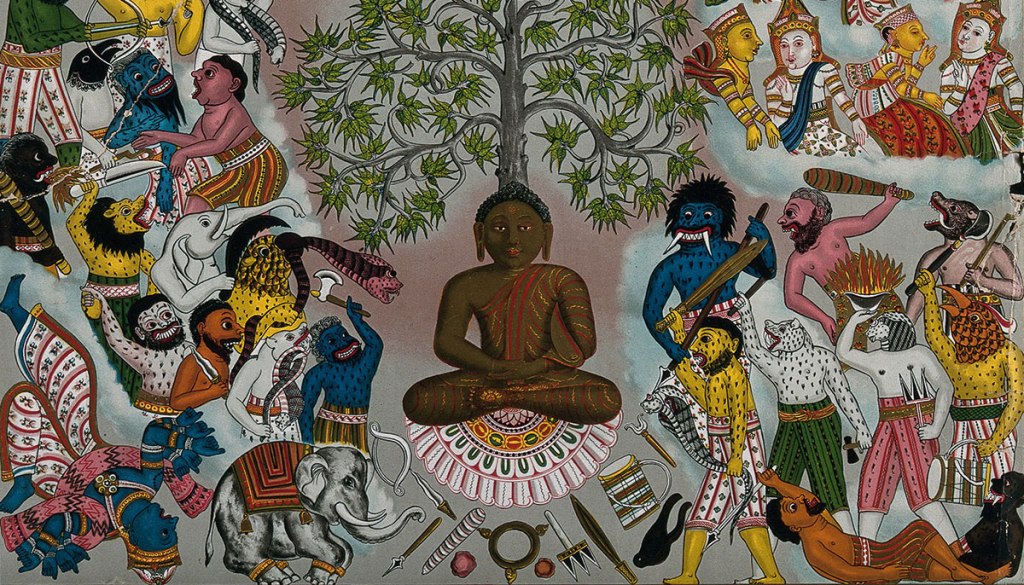
There is a profound moral framework underlying true OCCULT PHILOSOPHY. Genuine occultism is not a shortcut to power, libertinism, or moral relativism (antinomianism), but a demanding path of ethical purification, self-mastery, and alignment with universal law. Adepts are the “rare efflorescence of a generation of enquirers” who obey the soul’s impulse through rigorous self-development. The real adept is latent potential realized through moral conquest, not an inherent or easily accessible state.
The concept of “ADEPT” in occult philosophy describes a transformed human being. The adept is actually the daimon, an inner spiritual principle that emerges when occult faculties are activated. Hence, it is brought out by the sovereign will and can act only when the outer personality is partially or fully subdued; otherwise, the person is an ordinary mortal. Using adept abilities is compared to an athlete preparing to lift a weight, because it requires inner exertion and cannot be constant. So, the “real adept” as taught in occultism, is the latent dynamic power within every person, but only emerges through will, discipline, and occult development. Accusations or tying the term “occult” to immorality misunderstand the structure, because adeptship is the opposite of antinomianism.
From the Mahatma Letters’ point of view, the very requirements for occult development directly refute the idea that OCCULT PHILOSOPHY is amoral, antinomian, evil, or sexually perverse. True occultism demands ethical purification, self‑mastery, and moral discipline. Occult training explicitly requires probationary discipline. Aspirants face tests of character, fixity of purpose, and physical-mental purity meaning absolute chastity and abstemiousness during key phases. This is not optional; and attempting powers without it invites backlash from natural law. Therefore, occult development is impossible without rigorous moral discipline, so accusations of immorality misunderstand the entire structure of occult training. The “adept” can only emerge in a person who has already conquered selfishness, sensuality, and moral weakness.
Aspirants must eliminate selfish motives, sensual desires, emotional turbulence and personal ambition. This is not merely a philosophical demand. This is the opposite of antinomianism. A path that requires the destruction of egoistic impulses cannot be “immoral” in the conventional sense.
SELF-MASTERY is the foundation of occult power, and the system and nature of what is at stake demands absolute control over one’s lower nature, and such a person cannot be “sexually perverse” or libertine.
The occultist must act from compassion, duty, universal law and sense of impersonality. This is not antinomianism, but is a higher, stricter law than social convention. Also, occult progress is impossible for someone who is sexually undisciplined or indulgent. There are no exceptions to this. These are not rules merely set by humans but is natural law.
Anyone who tries to awaken occult faculties without moral purification risks psychic disintegration, obsession, madness and life ruin. If occultism were “evil,” it would not require virtue as a precondition for safety.
The path of adeptship, different from a lay practitioner, is a practical expression of the Bodhisattva path: one of renunciation, self-mastery, ethical purification, and dedication to humanity’s upliftment. Theosophy emphasized in its occult philosophy that every new Bodhisattva or initiated great adept is called the “liberator of mankind” in Northern Buddhist traditions. The Vatican and many Christian authorities demonized (or formally condemned) this path of adeptship and esoteric occult philosophy primarily because it was seen as fundamentally incompatible with core Christian doctrines, a direct challenge to the Church’s spiritual authority, and a potential gateway to dangerous spiritual errors. This opposition often stemmed from sincere theological convictions, institutional self-preservation, and historical patterns of responding to rival spiritual movements.
Critics of Occultism in general, like the Vatican with its libraries and history constantly and often intentionally confuse popular occulture (mediumship, sensationalism, spiritualism) with esoteric occultism (self‑discipline, ethics, inner development). As a powerful institution that has existed for so long, it constantly peddles the most infantile view under its maternalism and paternalism.
The adept is not a libertine or rebel. The adept is the inner man, awakened only when the lower nature is silenced, the personal self is purified, and the will is aligned with universal law.
What man has not felt a little of their potential, or light shine through and step into the stead in moments in their life it demanded it! Remember this, when you talk, breathe and act in the world.
Let us speak honestly, in saying that occult philosophy challenges the faith or traditions (Christianity, Islam, Brahmanism) by revealing their symbolic or distorted origins, but it preserves and strengthens true moral foundations. This isn’t nihilism but a call for religion to become a science, as William Judge noted. This counters Vatican critiques of Occultism by showing that serious occultism opposes the very sensationalism or moral laxity sometimes associated with “occult” fringes.
Catholic critiques, such as those from the Holy Office (which condemned Theosophy in 1919 as incompatible with doctrine), often portray occultism as pantheistic, denying a personal God and personal immortality, or as a dangerous mix of mysticism, charlatanism, and hidden forces that undermines Christian revelation. They associate it with superstition, moral relativism, or even demonic influences, while warning the faithful against participation. Popular occulture —meaning mediumship, sensational phenomena, and spiritualism is frequently conflated with the deeper esoteric path of self-discipline and inner development. This conflation misses (or sidesteps) the fact, that occult philosophy does not destroy morality but supplies higher rules of right and wrong, with sanctions rooted in universal principles rather than theological distortions.
This threatens established Christian (and other religious) power structures, because occult philosophy is terribly iconoclastic. When fully revealed and understood by earnest students, it sweeps away conventional religious beliefs, including the foundational conceptions of ordinary faith. It reveals exoteric doctrines as symbolic or partial, often distorted over time by priesthoods. While it preserves and elevates true moral foundations, the transition creates danger: old sanctions for morality weaken before new, higher ones fully take hold, potentially dividing society into camps of intellect and culture versus ignorance and fanaticism. Religions resist because their authority, built on churches, hierarchies, clergy, and mass adherence, relies on maintaining the conventionalist framework. Occultism shifts the ground by making religion a science of verifiable inner laws, accessible through personal development rather than mediated solely through institutional sacraments or dogma. This erodes the exclusive interpretive power of the Church and appeals directly to your latent divine potential.
It is cautioned, that abruptly destroying cherished beliefs without guidance could leave a moral vacuum. Occultists among the Theosophical Movement advocated gradual dissemination of knowledge to avoid past mistakes of priesthoods, while preparing humanity.
This emphasis on discipline finds echoes even within Christianity. Knowing Christ deeply has always required more than nominal belief or external ritual, as it demands rigorous moral purification, self-denial, conquest of the lower nature (flesh, passions, ego), prayer, and surrender to divine will. Mystics and saints describe a transformed inner life: dying to the old self so the higher Christ-principle can emerge. Ascetic practices, chastity in certain vocations, humility, and charity mirror the self-mastery of occult training. The Sermon on the Mount and Pauline calls to “crucify the flesh” set a high bar of ethical purity and inner exertion.
The key difference lies in framework and authority. Occult philosophy universalizes this process as a natural law open to all sincere aspirants across traditions, independent of any single revelation or institution. It frames the adept as the evolutionary fruition of human potential through self-induced effort, not solely through grace mediated by the Church. This democratizes and scientizes the transformative path, challenging claims of exclusive salvific power. Both paths recognize that undisciplined sensuality or selfishness blocks higher realization, whether union with Christ or awakening the inner adept. Yet occultism’s iconoclastic edge, revealing symbolic layers beneath dogma, naturally unsettles institutional strongholds that position themselves as indispensable intermediaries.
True occultism is the antithesis of evil, perversity, or license. It is a demanding ascent, or emergence and rebirth, requiring the subjugation of the lower self by the deeper essence within. By threatening to replace fading exoteric sanctions with a higher, impersonal morality grounded in universal law and inner science, it challenges religious power structures built on maintained ignorance or partial truths. This does not negate the value of Christian discipline but reframes the quest for transformation as humanity’s shared heritage; and one that religions may guide but cannot ultimately monopolize without risking stagnation. The path remains strict, ethical, and inward: only the purified can safely wield the latent powers within.
The adept path involves a profound surrender of the lower personal self (ego, desires, separateness) so that the higher inner essence, the purified spiritual principle, can emerge and guide. This mirrors the Christian mystical emphasis on “dying to self” so that Christ (or the divine life) may live within. Both traditions describe a transformative surrender that subdues selfishness, sensuality, and personal willfulness in favor of alignment with a deeper reality. Different vocabularies point to a similar process of silencing the outer personality to allow the inner divine spark or presence to dominate.
Many traditions including Christianity have produced profound transformations through surrender to a higher inner reality, but they have also generated cases of self-deification, delusion, spiritual abuse, or ego inflation when discipline and discernment falters. This is a human vulnerability across systems, not unique to one.
Christian mystics (e.g., some accused of Quietism or pantheism like Meister Eckhart) faced heresy charges for language bordering on identity with God. Extreme asceticism or ungrounded visions have led to fanaticism and mental ruin. Theosophy and related occult currents have seen inflated egos, charismatic abuse, and claimants to adeptship who lacked the required moral conquest. No tradition is immune, meaning that rigorous self-mastery and ethical safeguards are simply essential.
Perhaps, this little write-up is unsatisfactory, and perhaps it is not, but the point is to establish the basis, as those Letters purported to do, lay out of the foundations of OCCULT PHILOSOPHY, as opposed to what is popularly regarded as occultism in relation to fears of possession, ritualists in caves performing blood sacrifices and Ouija boards. This indulgence in fantasy is a remarkable example of how institutions of power that claim to be the gate of all sacred Truth and the adolescent condition of humanity bound to primitive fears or authority depend upon one another. We should not have to always stand and hold hands to affirm that these ideas do not upset your cherished faiths, as they will wane of their own accord. But ideas and causes have been set in motion, and this teaching of the sovereign will is not a mere idea, it is a gift. It carries the realities and potentialities inherent in nature, and it is within man’s natural right to know it, and to know that no god, king, government, machine or institution has sway over it. It is your strength in this life and the next.
 The American Minervan
Leave a comment