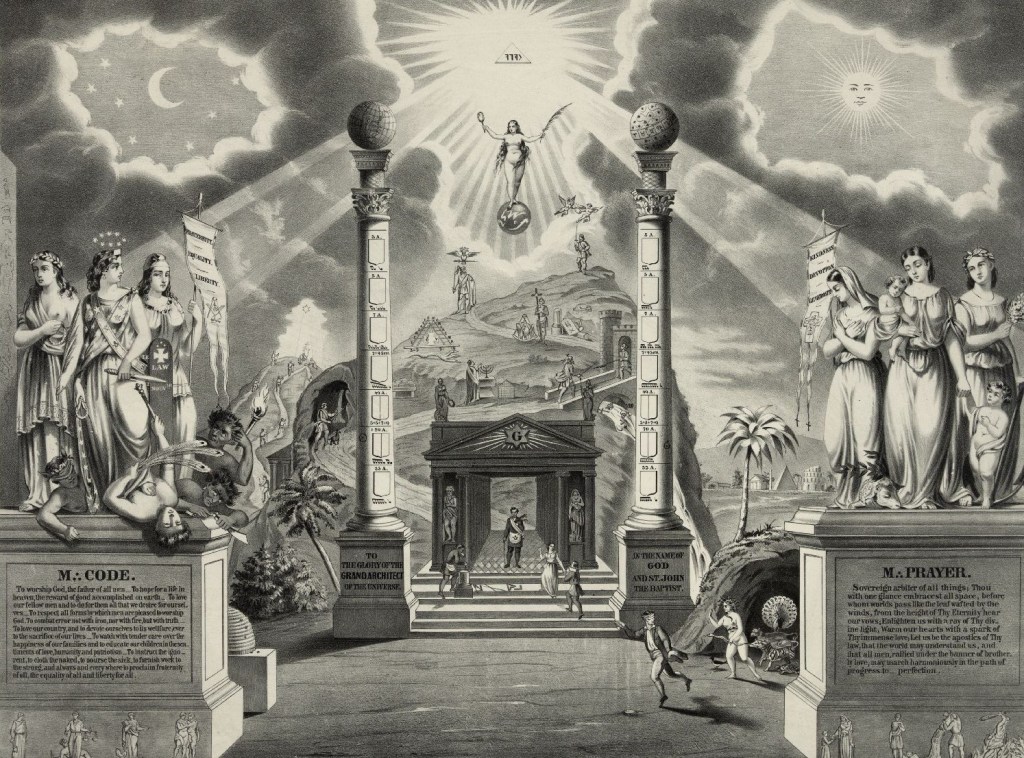
PART II: Blavatsky Buries BARRUEL’S ANTI-REVOLUTIONARY CONSPIRACY – Jesuit INSTIGATIONS, Illuminati Panic, KABBALISM and the Eastern Secret Doctrine
The 1790s panic (Barruel’s Mémoires pour servir à l’histoire du Jacobinisme, 1797) claimed the French Revolution was the work of a Templar-Illuminati-Masonic conspiracy. Blavatsky traces the very idea of a Templar-Masonic connection back to Barruel himself who treats it as a historical curiosity, and not a living plot. Blavatsky notes that modern Masonic Templarism “was hatched in a Jesuit College” in her work, Roots of Ritualism and on secret societies in Isis Unveiled. The real danger, in her view, is not an Illuminati cabal but materialism, dogmatic Christianity, and the suppression of esoteric knowledge. The “Illuminati” of the East are the Masters of Wisdom themselves, i.e., light-bringers, not world-controllers. Any political secret society that claims the name has simply hijacked the symbol. The Judeo-Masonic “Protocols” conspiracy post-dates Blavatsky by over a decade, but she anticipates the ideological groundwork, refuting it in advance. The Protocols of the Learned Elders of Zion (fabricated c. 1903) alleged a Jewish-Masonic cabal seeking global domination. Blavatsky’s entire corpus is the antithesis to this political myth.
Theosophy being universal, rejects racial or religious supremacy. Blavatsky elaborates on the Jewish Kabbalah but treats it as one ancient esoteric current among many (Chaldean, Egyptian, Hindu, Buddhist), instead of a Jewish conspiracy used as a weapon, explicitly separating Eastern esoteric Masonry (non-political, wisdom-based) from any modern Western lodge that might have been politically active. Any attempt to rope Theosophy into a “Judeo-Masonic” narrative collapses, because she repeatedly states Theosophists “have nothing to do with modern Masonry” and she never joined a regular Western lodge. The Protocols appeared after her death, and every premise they rest upon is demolished in Isis Unveiled, The Secret Doctrine, and Roots of Ritualism.
As to the Bavarian Illuminati, Blavatsky does not directly address or equate herself with Adam Weishaupt or endorse his Bavarian Illuminati in relation to Templarism. She never mentions Weishaupt by name in her writings on Masonry and ritualism. However, there is a clear parallel in their shared anti-Jesuit, anti-Vatican stance. Weishaupt (a former Jesuit seminarian and canon-law professor at Ingolstadt, a Jesuit stronghold) founded the short-lived Bavarian Illuminati (1776-1785) explicitly to combat Jesuit influence in education, promote Enlightenment rationalism, and undermine clerical power in Bavaria. Blavatsky, writing a century later, repeatedly portrays the Jesuits as the primary corruptors of both Church and Masonry — using infiltration, forged rites, and political machination for Vatican control. Blavatsky clearly laments the Church’s reform and absorption of the Society of Jesus. Her critique of “Jesuitry” mirrors Weishaupt’s anti-clerical motive, but she rejects any political secret society as a chimera of true esoteric “Illumination.” For her, the genuine “Illuminati” are the Eastern Masters of Wisdom (i.e., the Khwajagan) — light-bringers of primeval knowledge.
Her views on the Rosicrucians fit as a positive counterpoint to the Illuminati panic. Blavatsky treats the original Rosicrucians as authentic esoteric preservers of ancient wisdom—linked to alchemy, the “lost word,” and the same Mystery-tradition as true Masonry and her “Eastern Masons of the Orient.” She notes approvingly that Elias Ashmole (a key 17th century figure) was “the first operative Mason of any consequence, and the last of the Rosicrucians and Alchemists,” and that “no one could ever lay hands on the Rosicrucians; their true aims are to this day a mystery” (Blavatsky, Jesuitry in Masonry, pp. 8, 41).
By contrast, if she would have written on them, she would likely see the Bavarian Illuminati (and the 1790s panic around it) as a fleeting, politically motivated group whose name was later mythologized, which is the unfortunate case. Historically, Rosicrucians and early Illuminati had tensions (the latter sometimes viewed as too rationalist and secular by mystic Rosicrucians), but Blavatsky collapses any conflation: true Rosicrucianism is esoteric and wisdom-preserving, while the Illuminati panic is a Jesuit-instigated distraction. She does not call Rosicrucians “anti-Illuminati” in a modern conspiratorial sense; rather, she positions genuine Rosicrucian and Masonic esotericism against the proposed corrupted, Jesuit-influenced “modern” branches and against materialist political cabals.
These distinctions utterly collapse the modern Illuminati myth of a continuous “Illuminati-Masonic-Templar-Jewish” world-control cabal from the Middle Ages to today. Blavatsky demonstrates that the Templar-Masonic connection itself was invented by the Jesuit priest Abbé Augustin Barruel in his 1797 Mémoires pour servir à l’histoire du Jacobinisme as anti-revolutionary propaganda (see Thomas Jefferson’s Enlightenment Republicanism against Illuminati Panic: Letter on Weishaupt’s Perfectibilist Ideal). Hence, “modern Masonic Templarism” was deliberately fabricated by Jesuits in the College of Clermont (Paris, 1735-1740) to infiltrate the Craft.
Blavatsky’s own chapters from Isis Unveiled (Vol. II, ch. VIII, “Jesuitry and Masonry,” 1877) and the standalone compilation argues, that modern Masonic Templarism was hatched in a Jesuit College. Higher specious degrees were constructed, and she believed, that no Masonic rite was free from the influence of the Jesuit College of Clermont at Paris in her time. The Jesuits, she stated, e.g., had accomplished but one of their designs, which was in denaturalizing and bringing into disrepute the Masonic Institution.
“Having succeeded, as they believed, in destroying it in one form, they were determined to use it in another. … we see these pseudo-Templars, under the guidance of the worthy Father Jesuits, forging in Paris, 1806, the famous charter of Larmenius.” (Jesuitry in Masonry, p. 45, Philaletheians UK)
“That bastard foundling of Freemasonry, the ‘Ancient and Accepted Scottish Rite,’ … was the enunciation, primarily, of the brain of the Jesuit Chevalier Ramsay.” (ibid, p. 51)
On spurious Templar claims, she stated:
“All these asseverations, unsupported by history, were fabricated in the High Chapter of Clermont [Jesuits] … preserved by the Parisian Templars as a legacy left them by those political revolutionists, the Stuarts and the Jesuits.” (ibid, p. 42)
“The frantic denunciations of the Craft by Catholic and Protestant writers appear simply ridiculous, as also the affirmation of the Abbé Barruel that everything ‘betrays our Freemasons as the descendants of those proscribed Knights Templars’ of 1314.” (ibid, p. 32)
She never once attributes Masonry’s degeneration to any “Jewish” source, but to Jesuits introducing “ecclesiastical rites,” “anthropomorphic theology,” and political tools (regicide, high treason). She cites Jesuit authors approving murder of kings and statesmen. Keep in mind, these eras of Christendom, and the history of the revolutions, which we are a product of.
The primary-sources quoted are unassailable, and conspiracists citing Blavatsky to “prove” an Illuminati-Judeo-Masonic plot are directly contradicted by her own words in the very texts they cherry-pick. The Jesuit fabrication of the panic, the Jesuit hatching of modern Templarism, and her elevation of Eastern and Rosicrucian esotericism over any political cabal rejects the modern myth.
The “Sod” (Jewish Mysteries) and Its Transmission
The core thesis of Blavatsky’s writings is that the primeval Secret Doctrine originated in the East and was transmitted westward in increasingly distorted forms. The Jews are not the originators or custodians of this primordial Wisdom-Religion but late, secondary transmitters. The true “Sod” (סוד, Mysteries) of the Jews is not original, but identical with the universal Mysteries of the pagans, ultimately traceable to the East. Her focus remains uncompromisingly Eastern, in stating that “the Kabala is derived directly from the primeval Secret Doctrine of the East; through the Vedas, the Upanishads, Orpheus and Thales, Pythagoras and the Egyptians.” (Blavatsky, Theosophical Glossary, s.v. “Kabalist.” In Isis Unveiled, Vol. I, p. 135, she explains that their kabalistic ‘secret doctrine’ may be traced in each detail to its primeval source — to Upper India, or Turkestan.
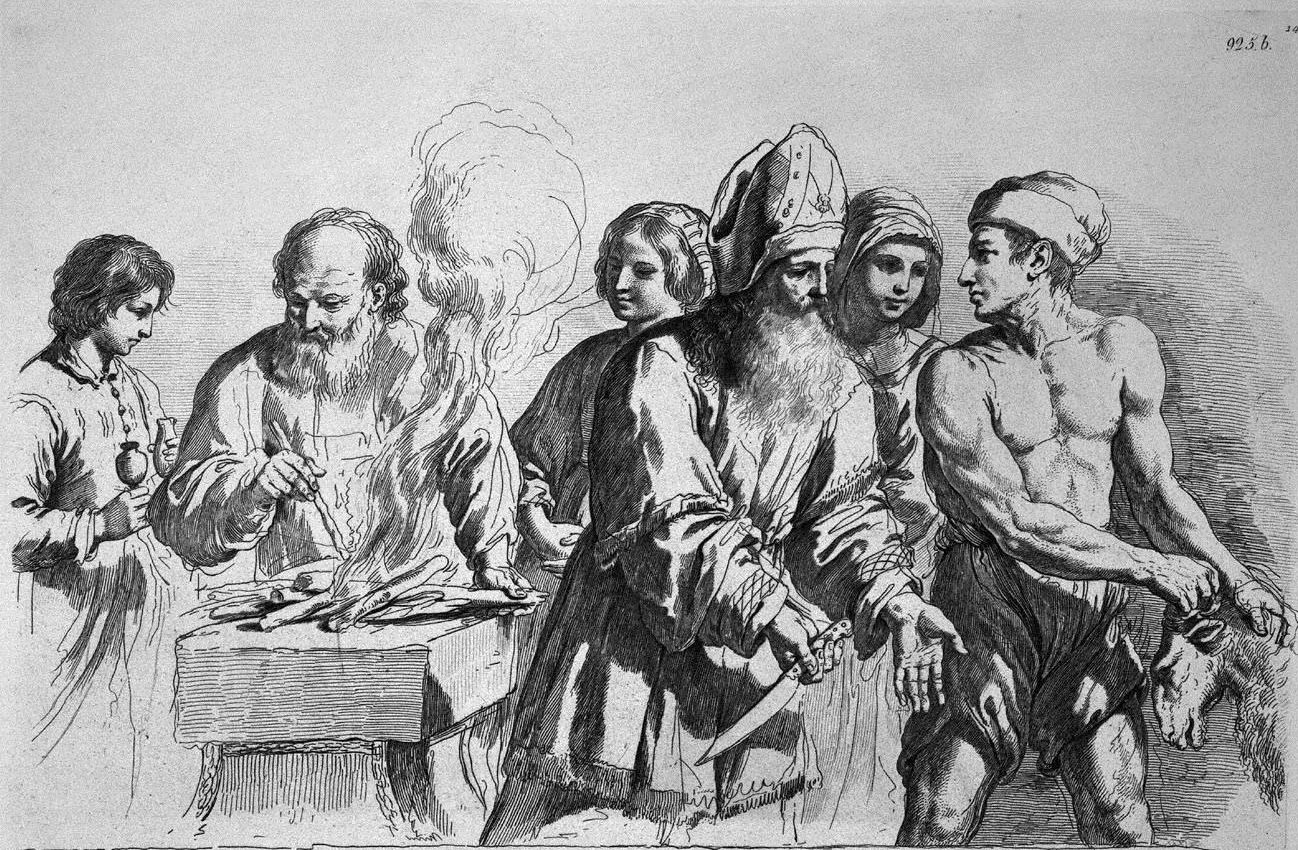
“Now in the original, the words ‘their secret’ really are ‘their SOD.’ And Sod was the name for the great mysteries of Baal, Adonis and Bacchus… [It] was the name given to the tribe of Levi… and Moses was the chief of the Sodales.” (Blavatsky, The Secret Doctrine, Vol. II, p. 202, fn.)
The Jewish Sod is thus the esoteric Mysteries — identical to those of the Pagan Greeks (who took them from Egyptians, who borrowed from Chaldeans, who got them from the Indo-Aryans and so on (see Blavatsky, The Secrecy of Initiates).
“There was at all times a Kabbalistic literature among the Jews, though historically it can be traced only from the time of the Captivity. Yet, from the Pentateuch down to the Talmud, the documents of that literature were ever written in a kind of Mystery-language, a series of symbolical records which the Jews had copied from the Egyptian and the Chaldæan Sanctuaries, only adapting them to their own national history.” (Blavatsky, Collected Writings, XIV, pp. 192-205, in her writings on Zohar, p. 8).
“It is now becoming apparent that the Kabbalah of the Jews is but the distorted echo of the Secret Doctrine of the Chaldæans, and that the real Kabbalah is found only in the Chaldean Book of Numbers, now in the possession of certain Persian Sufis.” (Ibid., p. 12). The Tanaim (early Jewish kabalists, c. 3rd cent. BCE) preserved a doctrine “identical with that of the Chaldeans, and includes at the same time much of the Persian wisdom.” (Isis Unveiled, Vol. I, p. xxxiv; Theosophical Glossary, s.v. “Kabalist”).
The Jewish religion “never had more than three keys out of the seven” (astronomical, numerical, anthropological or physiological, resulting in what Blavatsky calls “the most phallic religion of all,” but modern “Kabbalistic speculation is on a par with modern ‘speculative Masonry’” (vainly claiming archaic origins).
THE LESSON IN BLAVATSKY’S CRITIQUE OF JUDAISM AND CHRISTIANITY
Blavatsky sharply distinguishes esoteric (universal, noble) from exoteric (tribal, degraded) Judaism.
Blavatsky’s critique of Judaism operates through a precise ontological scalpel, where she severs the living esoteric core from its exoteric shell, treating the latter not as an ethnic failing, but as a degenerative historical process that turns universal wisdom into tribal enclosure. At its heart lies the figure of Jehovah, whom she reframes as a localized, anthropomorphic potency alternately passive in the primordial chaos or aggressively phallic when masculinized, rather than the boundless Ain-Soph (the Hebrew Parabrahman) that Theosophy equates with the impersonal Absolute.
The Pentateuch, under this reading, dissolves into a layered astronomical-physiological allegory whose surface narrative glorifies national exclusivity while its hidden grammar celebrates the union of sexes. Exoteric Judaism thus becomes the paradigmatic case of a once-noble tradition collapsing into literalism, jealousy, and territorial deity-worship, mirroring the very degradations Blavatsky elsewhere diagnoses in institutional Christianity or late Brahmanism.
This demotion of the exoteric directly undermines its truth claims. The doctrine of a “chosen people,” the assertion of an unmediated divine revelation, and the messianic exclusivity tied to a single historical lineage are exposed as late rhetorical inventions designed to sacralize tribal cohesion. Historical and linguistic scrutiny reinforces the verdict: the twelve tribes lack any independent corroboration in ancient historiography; the scriptures themselves betray repeated editorial layers reaching into the post-exilic period; and the Hebrew tongue, far from primordial, shows no monumental trace before its relatively late emergence.
The Kabbalistic keys retained by Jewish initiates, Blavatsky argues, were only those three in number — sufficient to preserve fragments of phallic symbolism, but insufficient to recover the full septenary system of the primeval tradition. The promised Messiah is therefore reinterpreted as a collective emergence or epiphany of divine wisdom in the far future, not a partisan deliverer for any single ethnicity who reigns under a divine-right kingship under the full imperial glory of Israel. Crucially, these strictures are never permitted to slide into ethnic animus. Blavatsky’s own biography show that she studied under initiated Palestinian rabbis, held a lifelong friendship with a “first and dearest” Hebrew mentor, and highlighted the visible presence of Jewish members in the Theosophical Society (see Blavatsky articles titled “Doomed” and “Tetragrammaton”). Her target is the exoteric distortion, the same phenomenon she indicts when it appears in any tradition: the hardening of symbol into dogma, the contraction of universal light into national boundary. The critique is therefore symmetrical and non-hierarchical in its moral application.
The primeval secret doctrine, being Eastern (Indo-Aryan/Indo-Iranian, Chinese, etc) predates and supplies the archetypes later refracted westward, revealing that Jewish esotericism appears as a secondary, partial transmission rather than an origin as was explained in African Traditional Religion: From Nabta Playa to Dynastic Egyptian Mysteries.
Kabbalah and Masonry preserve authentic fragments, yet they remain derivative; any claim of Hebrew primacy is historically untenable. I will repeat that: Any claim of Hebrew originality, or Abrahamic supremacy is “untenable.” This placement collapses attempts to conscript Blavatsky into conspiratorial narratives of “Judeo-Masonic” dominance. Instead, her system universalizes the Wisdom-Religion, demotes every exoteric tribalism (Jewish or otherwise) to a transient cultural artifact, and insists that the “light of the Eastern Sun” remains the sole legitimate source. In this light, her critique is neither antisemitic nor philo-Semitic but rigorously metaphysical. It measures every historical religion against the yardstick of an impersonal, pre-ethnic primordial tradition and finds the exoteric forms wanting precisely to the degree they forget their older, universal origin.
Therefore, in this view, the concept of chosen people, exclusive monotheism and literal revelation are exoteric inventions. The Jews borrowed but never had more than three keys. Jewish messianic exclusivity is also rejected.
This directly refutes any conspiratorial “Judeo-Masonic” primacy, because true Masonry and Mysteries predate and transcend Jewish transmission.
These positions collapse any attempt to co-opt Blavatsky into “Judeo-Masonic” or antisemitic narratives, as she universalizes ancient wisdom, and exposes exoteric tribalism as a distortion.
PATH BACK TO DAVIDIC DIVINE-RIGHT IDEOLOGY
When it comes to Christianity and the Jewish concept of the Messiah, the Jewish Messiah is purely an adaptation of Near Eastern royalist-monarchic (divine-right) ideology. The New Testament writers re-use the model of the Jews and reformulates it. The Mashiach concept at its basis derives from Canaanite royal fire-cult — a stolen throne of Baal. The Mashiach was the storm-king heir, Baal which was to be restored after exile from Canaanite royalism but was transferred to Jerusalem’s Davidic kings. This is the death knell to theocratic revivalism. To challenge this requires a development in secular republicanism. This concept of the Jewish Mashiach is a path back to the Davidic divine kingship of Israel and can be wielded therefore as a political tool for worldly power, even using the Christians who feel obligation to future prophecies. There never was a unique prophesied Messiah in the past nor for future prophecy.
Christian polemics (John 1:41; Acts 2:36; creeds) however insist Jesus alone fulfills every Torah prophecy as the exclusive divine Messiah, rendering all prior gods “demons,” “types,” even non-existent. This edifice is nothing more than an ancient royalist construct, or reconfigured Jewish monarchism.
The Mesopotamian adopted god-king was first embodied in Israelite monarchy, then projected eschatologically then finally, it was reconfigured onto the character Jesus to claim the throne. These royalist origins are unavoidable in the historical record. The concept is meant to legitimize kingship, just as it did across Northwest Semitic cultures in antiquity. The concept solely exists to legitimize pure monarchic continuity or imperial-expansionist ambitions, and this long before any New Testament, or John’s Revelations, which arguably is not a book about future prophecy. The concept is a purely royal and political tool from its inception.
Blavatsky does not defend herself. She attacks the lies with primary sources. Every conspiracy theorist who cites her while ignoring these passages is committing intellectual fraud. Theosophy’s message remains what it always was: universal brotherhood through recovery of the ancient Eastern Wisdom-Religion. Read her. The “Epstein network” is not “the Illuminati.” The Israel Zionists are not “the Illuminati.” There are absolutely no signs of the presence of an “Illuminati” in political affairs, anywhere.
The truths about the origins of the three Abrahamic religions and their transmission, omissions and erasure of religion in the Near East is key it seems to our future and the future of religion. The three main Abrahamic religions rewrite over that history, and they are left to spin the tale and play one against the other or fight. Modern scholarship shows how the ancient Israelites trampled over and erased the cult-worships and high places of others to assert their dominance, and lead history to preference their interpretations and polemics against other tribes and nations. This process of erasure, committed by all three religions on each other or upon others has not changed.
COUNTER-PRODUCTIVE POLITICAL MYTH
In relation to the issues in my own country, the United States Founders were anti-Papist, anti-clerical, anti-divine right monarchy, and anti-Christocracy. So, why has more than half the country elected a bunch of Christian nationalists to power? It seems, a great part of the problem comes down to the serious degeneration of civics education. You have to by all means defeat those who distort this fact and drag us into wars for the ambitions of other nations, because they govern you. If the citizens were truly educated and cared about this country, they’d take my words seriously. To those who think the points I make are too esoteric and weird, I have nothing to say. There should not be an ounce, or degree of Messianism, Christocratic, theocratic, royalist monarchic or clerical sentiment in any American politician when it comes to their duty of representation and policymaking. If you do not understand this, then the country is lost.
Those who rule the spiritual world are different from those who rule the financial and political world, despite any financial philosophy the latter may espouse. If one studied, e.g., what is required of one to become holy, according to Zarathustrian wisdom, for one, or just use simple judgement, you would not think those who “control the world” could be illuminated, nor do our political leaders consider themselves such. It is the many among the masses who do. The political myth creates targets of the masses’ fury and becomes counter-productive the minute it is mixed with the old, instigated conspiracies of Barruel, Robison, the tsarist intelligence and others; and the clarity is lost, being that those who directly affect policy and our lives are open and publicly explain their political schemes, not in hiding.
Secularism in American republicanism is not an atheistic idea, nor is it a Christocratic idea. I tell you, the concept cannot be understood without properly understanding the long struggle against religious dogmatic belief and divine kingship, which has become compromised.
 The American Minervan
Leave a comment