Tag: Helena Blavatsky
-

Alexander Wilder on Pagans and the Value of the Classical Religions
Limited Knowledge of Religion in Antiquity The term Pagan, or paganus originally meant, an inhabitant of the village, or a peasant, but came to refer to perverted heretical and heterodox beliefs outside of the theology of the Catholic Church. Therefore, what is considered perverted must come from the devil, hence, idolatrous and pagan. The Jews, Christians,…
-

Gottfried De Purucker defines Religion in “Occult Glossary”
What does it mean, when we use the broad term religion? Gottfried de Purucker† (1874-1942), who was head of the Pasadena Theosophical Society from 1929-1942, had a good definition in his Occult Glossary (1933). It follows on pages 148-9: “Religion. An operation of the human spiritual mind in its endeavor to understand not only the how and the why of…
-
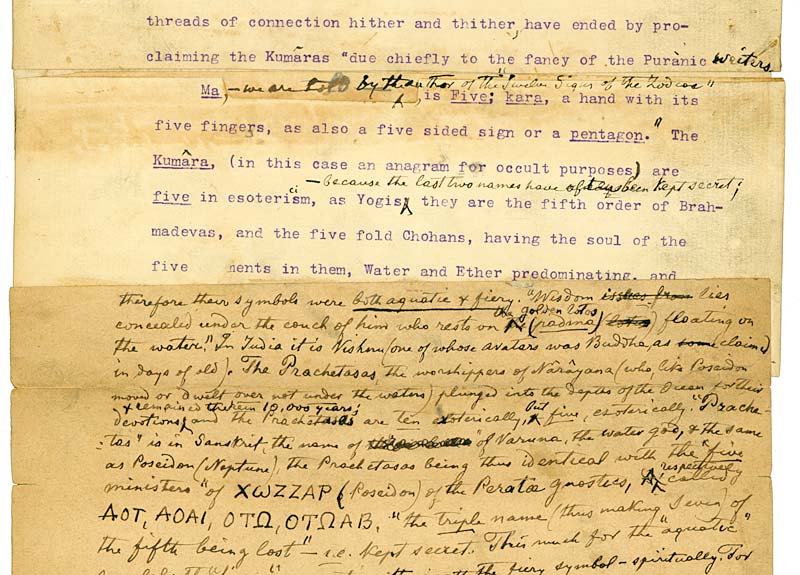
Analysis of the ‘Würzburg Manuscript’ of The Secret Doctrine (1888)
Officially published in 1888, The Secret Doctrine was a project began by HPB. From as early as 1885-86, we find a partial or portion of the manuscript when she stayed in Germany and Belgium this time, called the “Würzburg Manuscript.” In studying how The Secret Doctrine was written, we see the modern example of a work…
-
“The Religion of the Future”
‘No human-born doctrine, no creed, however sanctified by custom and antiquity, can compare in sacredness with the religion of Nature.’ (Helena P. Blavatsky, The Secret Doctrine, Vol. 2, pg. 797) The Religion of the Future [Helena Blavatsky, The Theosophist, Vol. IV., No. 8, May, 1883.] “Occultism teaches us that ideas based upon fundamental truths move…
-

The Seven Numerations of Nature in the Egyptian Hieroglyphs and Trans-Himalayan Occult Tenet
The Secret Doctrine defends the doctrine on the Seven Numerations of Man and Nature, held by the Trans-Himalayan Occultists’ School taught in the Theosophical system. Helena Blavatsky did not invent Theosophy, nor this concept, but explains it in no way others have hitherto done. She further tied this to Greek Esotericism (Theosophy and Platonism: The Seven…
-

The God of Plato
It is not that Deity geometrizes with numbers, but in relation to numbers—and the numerical phases of cosmogenesis. “Thus, on the very showing of the defenders of this system the Jewish Deity is proved to be, at best, only the manifested duad, never the One absolute ALL. Geometrically demonstrated, he is a number; symbolically, an…
-

Pro and Con Sources on Controversies about the Theosophical Society
Pro and Con Sources Dr. James Santucci, a scholar of comparative religion, and editor of Theosophical History wrote: “All too often, this subject [Theosophy & Blavatsky], when it is discussed in scholarly circles, is presented in a most unscholarly fashion. Falsehoods are perpetuated and original research is not actively pursued.” Why Take Blavatsky Seriously? by…
-

The Truth about the Future Maitreya Buddha in Theosophical Writings
H.P. Blavatsky was a Theosophist and Buddhist, and held to the traditional and Theravada Position regarding Maitreya, which is in conflict with contemporary beliefs originating from later Neo-Theosophical influences of a Christo-Buddhist Theosophical innovation, and reinterpretation of Christology as held by Annie Besant. H.P.B. did not advocate or emphasize any millenarian element, or messianism in Theosophy,…
-

Sam Harris dishonesty about Helena Blavatsky in “Waking Up”
Sam Harris mentions Helena P. Blavatsky in the first chapter of Waking Up: Guide on Spirituality without Religion (2014), and he committed a poor mistake, with a very inaccurate, and incompetent account. It is rare for such an author to even mention Blavatsky, but it is unfortunate again, as always, that it is a slight,…
-
Anagarika Dharmapala and Gandhi Distrusted Charles Leadbeater and Besant
Anagarika Dharmapala was a Buddhist revivalist from Sri Lanka, who founded the Maha Bodhi Society May, 31, 1891. He was also an active member of the Theosophical Society. Dharmapala provides his insight into the controversies in the history of the organization known as the Theosophical Society. Upon reading about the Masters from Alfred P. Sinnet’s…
-
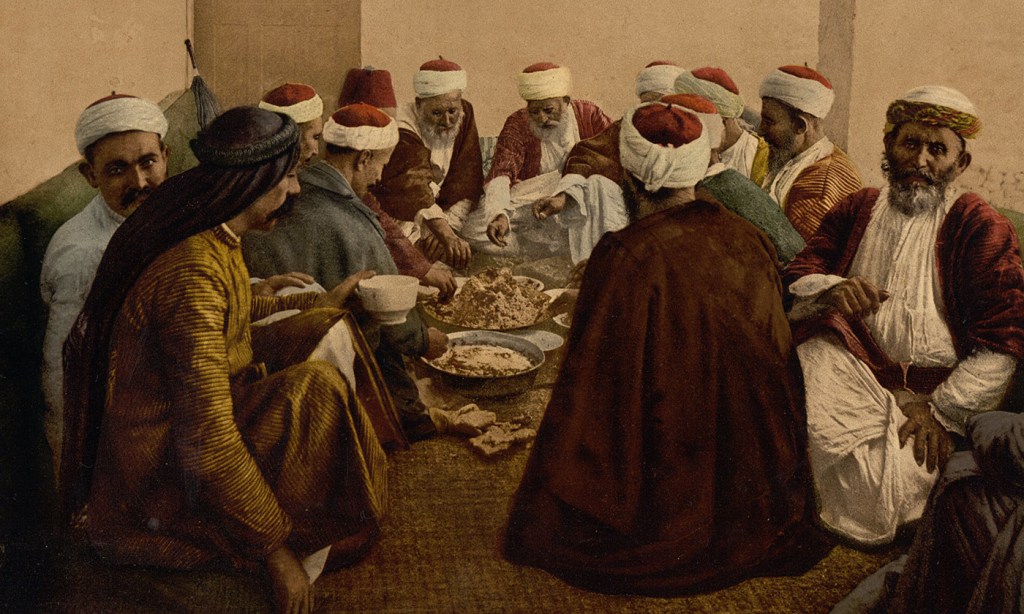
Did Helena Blavatsky Study with the Druze of Lebanon?
“The religion of the Druses is said to be a compound of Judaism, Mahomedanism and Christianity, strongly tinged with Gnosticism and the Magian system of Persia. Were people to call things by their right names, sacrificing all self-conceit to truth, they might confess things otherwise. They could say, for instance, that Mahomedanism being a compound…
 The American Minervan