
(Heavily revised, 3-16-2026)
This article provides some insights about the involvement of this clandestine esoteric network underlying the Theosophical Movement and operations of the Society in its early periods, and theories about them. The main purpose is to demonstrate how unsatisfactory the search for the actual identities of these individuals has been for many researchers, and also why Blavatsky did not write The Mahatma Letters, invent Buddhist ideas, nor can a definitive conclusion be drawn about their identities.
THE MULTIPLE WITNESSES OF MORYA AND WHY MORYA WASN’T THE MAHARAJAH RANBIR SINGH
The master known as Morya had visited the Theosophical Society Headquarters at Bombay, and a joint statement of seven Theosophists (including Olcott) was given as quoted in Hints on Esoteric Theosophy (No. 1, 1882, pp. 75-76):
“We were sitting together in the moonlight about 9 o’clock upon the balcony which projects from the front of the bungalow. Mr. Scott was sitting facing the house, so as to look through the intervening verandah and the library, and into the room at the further side. This latter apartment was brilliantly lighted. The library was in partial darkness, thus rendering objects in the farther room more distinct. Mr. Scott suddenly saw the figure of a man step into the space, opposite the door of the library; he was clad in the white dress of a Rajput, and wore a white turban. Mr. Scott at once recognized him from his resemblance to a portrait [or Morya] in Col. Olcott’s possession. Our attention was then drawn to him, and we all saw him most distinctly. He walked back out of our sight…when we reached the room he was gone….Upon the table, at the spot where he had been standing, lay a letter addressed to one of our number. The handwriting was identical with that of sundry notes and letters previously received from him….” The statement is signed by: “Ross Scott, Minnie J.B. Scott, H.S. Olcott, H.P. Blavatsky, M. Moorad Ali Beg, Damodar K. Mavalankar, and Bhavani Shankar Ganesh Mullapoorkar.”
Olcott is clearly able to distinguish between Morya and Ranbir Singh, the Maharaja of Kashmir whom he met and gave a detailed description of; because again, concerning this event, Olcott mentions in a Jan. 5, 1882 entry in his diary, M’s face:
“Jan. 5, 1882, “Evening. Moonlight. On balcony, HPB, Self, Scott & wife, Damodar (…) M appeared in my office. First seen by Scott, then me (…) Scott clearly saw M’s face (…) M left note for me on table in office by which he stood….”
Morya in a letter (Letter no. 29, chron.) refers to another visit with Olcott:
“O’s memo…was written on the 27th [of Sep. 1881].…K.H. thought of asking me to go and tell O to do so….At the same time as I delivered my message to O, I satisfied his curiosity as to your Society [Sinnett’s Simla T,S.] and told what I thought of it. O asked my permission to send to you these notes which I accorded….”
And Olcott recounted this same meeting with M. three days before Sept. 27th 1881 in Colombo, Sri Lanka:
“…on the night of that day I was awakened from sleep by my Chohan (or Guru, the Brother whose immediate pupil I am) (…) He made me rise, sit at my table and write from his dictation for an hour or more. There was an expression of anxiety mingled with sternness on his noble face, as there always is when the matter concerns H.P.B., to whom for many years he has been at once a father a devoted guardian….” (Hints on Esoteric Theosophy, No. 1, 1882, pp. 82-83).
So, how can it be accepted on such accounts, that Morya is fictitious, and was really Ranbir Singh? A fictitious man in Tibetan garb could not be walking and interacting with Olcott, and why would Ranbir amidst all his important duties be traveling so free of guards at all possible times of the day in Bombay and Colombo on those exact dates Olcott was meeting Morya?
A clerk from Tirunelveli in South India on leave in 1882 by the name of S. Ramabadra Ramaswamier had given an account of meeting Morya.
“…I suddenly saw a solitary horseman galloping towards me from the opposite direction. From his tall stature and the expert way he managed the animal, I thought he was some military officer of the Sikkim Raja…But as he approached me, he reined the steed. I looked at and recognized him instantly….I was in the ….presence of…my own revered Guru….The very same instant saw me prostrated on the ground at his feet. I arose at his command….He wear a short black beard, and long black hair hanging down to his breast…He wore a yellow mantle lined with fur, and on his head…a yellow Tibetan felt cap…I had a long talk with him. He told me to go no further, for I would come to grief. He said I should wait patiently if I wanted to become an accepted Chela…Before he left, two more men came on horseback, his attendants I suppose, probably Chelas, for they were dressed…like himself, with long hair streaming down their backs. They followed the Mahatma, as he left, at a gentle trot….” (Damodar and the Pioneers of the Theosophical Movement, 1965, pp. 295-297)
Here, we are supposed to believe that Morya is Ranbir Singh, and Ranbir Singh is going all the way to Sikkim without any guards or attentions to his duties at home, to go around fooling his countrymen by dressing in the garb of a Yellow-cap gelugpa.
These are some of the questions and contradictions that were strongly put forth by Daniel H. Caldwell, John Algeo and others throughout the years. This is information that does not often inform persons who speak on the subject, having become just acquainted with the history, or concluding the case on the basis of very limited source material. There are no proofs for the accusations that K.H. and Morya were the aspects of H.P.B.’s proposed “multiple personalities,” besides simply being skeptical. Where is the time to construct such an elaborate hoax and consistent philosophy as exhibited in The Mahatma Letters?
KOOT HOOMI’S TRAVELS IN EUROPE AS A DISCIPLE IN TRAINING
When it was previously mentioned that Morya says of himself, that he is not as fine a scholar like K.H., in that letter, Morya speaks to A.P. Sinnett about him not being used to their “Indo-Tibetan ways” saying of himself in relation to K.H.:
“I am not a fine scholar, Sahibs, like my blessed Brother” (…) We of the Indo-Tibetan hovels never quarrel (…) Owing to complicated politics, to debates and what you term, if I mistake not, — social talk and drawing-room controversies and discussions, sophistry has now become in Europe (hence among the Anglo-Indians) “the logical exercise of the intellectual faculties,” while with us it has never outgrown its pristine stage of “fallacious reasoning,” the shaky, insecure premises from which most of the conclusions and opinions are drawn, formed and forthwith jumped at. Again, we ignorant Asiatics of Tibet, accustomed to rather follow the thought of our interlocutor or correspondent than the words he clothes it in — concern ourselves generally but little with the accuracy of his expressions.” (The Mahatma Letters to A. P. Sinnett, Letter No. 29)
Of K.H. during his three-month absence, Morya says again:
“A few days before leaving us, Koot’hoomi speaking of you said to me as follows: “I feel tired and weary of these never ending disputations. The more I try to explain to both of them the circumstances that control us and that interpose between us so many obstacles to free intercourse, the less they understand me! Under the most favourable aspects this correspondence must always be unsatisfactory, even exasperatingly so, at times; for nothing short of personal interviews, at which there could be discussion and the instant solution of intellectual difficulties as they arise, would satisfy them fully. It is as though we were hallooing to each other across an impassable ravine and only one of us seeing his interlocutor. In point of fact, there is nowhere in physical nature a mountain abyss so hopelessly impassable and obstructive to the traveller as that spiritual one, which keeps them back from me.”
Two days later when his “retreat” was decided upon in parting he asked me: “Will you watch over my work, will you see it falls not into ruins?” I promised. What is there I would not have promised him at that hour!
At a certain spot not to be mentioned to outsiders, there is a chasm spanned by a frail bridge of woven grasses and with a raging torrent beneath. The bravest member of your Alpine clubs would scarcely dare to venture the passage, for it hangs like a spider’s web and seems to be rotten and impassable. Yet it is not; and he who dares the trial and succeeds — as he will if it is right that he should be permitted — comes into a gorge of surpassing beauty of scenery — to one of our places and to some of our people, of which and whom there is no note or minute among European geographers. At a stone’s throw from the old Lamasery stands the old tower, within whose bosom have gestated generations of Bodhisatwas. It is there, where now rests your lifeless friend — my brother, the light of my soul, to whom I made a faithful promise to watch during his absence over his work.” (ibid.)
Koot Hoomi had gone on a spiritual retreat, the letter shows, marking a period of initiation for three months between Oct 1881-Dec 1881. Morya, referring to K.H.’s lifeless body, describes a cataleptic state of sleep, as if entering stong-pa nyid or empty awareness, according to Blavatsky. During this time, the Chohan occasionally visited and took care of his body. K.H. reemerged from this samadhi December 24th of 1881 and resumed teaching A.P. Sinnett January 1, 1882.
Mary K. Neff outlined K.H.’s travels, which he said were difficult for him. Koot Hoomi (or Koot Humi Lal Singh) traveled widely, as documented by Mary K. Neff in The “Brothers” of Madame Blavatsky, 1932, 63-79:
- 1870s – student in Europe – Leipzig, Zurich, Wurzburg
- 1880 – Toling, in western Tibet; Kashmir; Karakorum, in Mongolia
- 1881 – Tirich Mir, a mountain in the Hindu Kush range; Sakkya-Jung, Ghalaring-Tho Lamasery, and Horpa Pa La, in unknown territory
- 1882 – Unknown location of KH’s retreat; Himalayan lamasery near Darjeeling
- 1883 – extended tour of Asia; Lake Manasarovara in the Himalayas; Lahore; Kashmir; Madras; Singapore; Ceylon; Burma; Mysore; Sanangerri (unknown location); China; Cambodia.
Mary K. Neff mentions, that K.H. was a student in Europe, in Germany and Zürich, which was undergoing modernization at the time, and expanded on related themes in earlier work (e.g., her 1929 article Echoes of the Past: Master Koot Hoomi in The Theosophist).
K.H. briefly mentions this also in a letter to A.O. Hume, and gives an insight into his thinking:
“For instance, I, because I had received a bit of Western education — must needs be fancied as the type of a “gentleman” who strictly conforms his action to the laws of etiquette and regulates his intercourse with Europeans, after the regulations of your world and Society! (. . .) That if, to a certain extent, I may be familiar with your (to me) peculiar notions about the propriety of this thing or another, and the obligations of a Western gentleman, so are you, to a degree, acquainted with the manners and customs of China and Tibet. For all that, as you would decline to conform yourself to our habits and live according to our customs — so do I, preferring our modes of life to yours, and our ideas to those of the West.” (K.H., The Mahatma Letters to A.P. Sinnett, Letter no. 65, 1884, Second & Revised edition)
H.P. Blavatsky said that: “The personage known to the public under the pseudonym of ‘Koot Hoomi’ is called by a totally different name among his acquaintances. . . .The real names of Master Adepts and Occult Schools are never, under any circumstances, revealed to the profane.” (“Lodges of Magic,” Lucifer, 1888)
K.H.’s pupils included Bhavani Shankar, Mohini Chatterji, Damodar K. Mavalankar, Djual Kul (later falsely adapted by Alice Bailey), Gwala Krishna Deb and R. Casava Pillai.
Koot Hoomi (the name he went by in the letters) was said to be a Northern Brahmin of Kashmir, very learned in European ways. This article from Prajna Quest, The Orthography and Pronunciation of “Koot Hoomi,” went further into the generally used English spelling “Koot Hoomi.” K.H. spoke French and English fluently, and a letter (no. 26) describes him as being “Frenchified.” K.H. was said to at the time live in a house in a ravine in Tibet along the Karakoram Range near Ladakh.
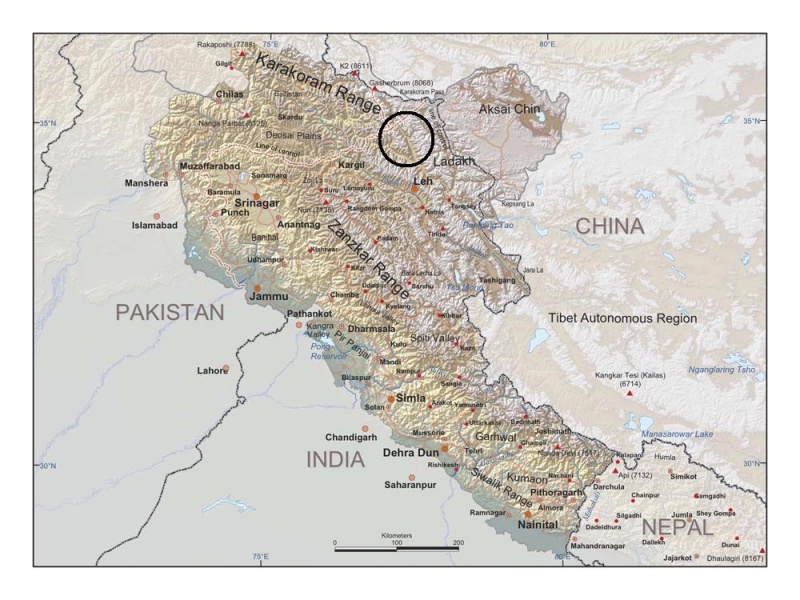
Colonel Henry S. Olcott wrote to A. O. Hume in 1881:
“I have also personally known [Master Koot Hoomi] since 1875. He is of quite a different, a gentler, type, yet the bosom friend of the other [Master Morya]. They live near each other with a small Buddhist Temple about midway between their houses. In New York, I had . . . and a colored sketch on China silk of the landscape near [Koot Hoomi]’s and my Chohan’s residences with a glimpse of the latter’s house and of part of the little temple.” (A.O. Hume, Hints on Esoteric Theosophy, Vol. 1. Bombay, India: The Theosophical Society, 1882, 83)
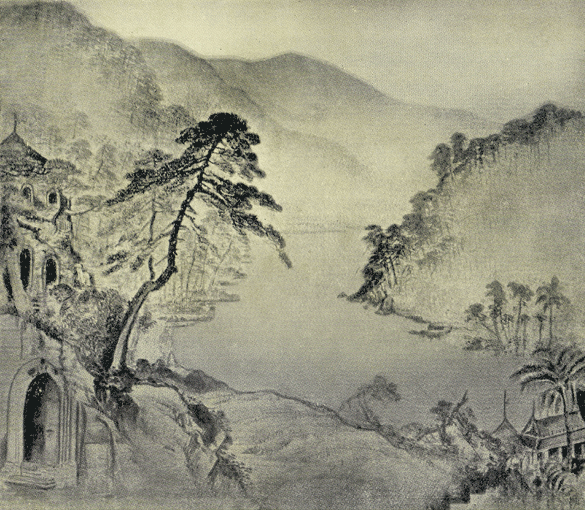
This house was near Morya’s house, and is confirmed when K.H. mentions to A.P. Sinnett:
“I was coming down the defiles of Kouenlun — Karakorum you call them . . . and was crossing over to Lhadak on my way home.” (The Mahatma Letters to A.P. Sinnett, Letter no. 5)
Helena Blavatsky wrote to Mrs. Hollis Billings in a letter, Oct. 1881:
“Now Morya lives generally with Koot-Hoomi who has his house in the direction of the Kara Korum [Karakoram] Mountains, beyond Ladak, which is in Little Tibet and belongs now to Kashmire. It is a large wooden building in the Chinese fashion pagoda-like, between a lake and a beautiful mountain (…)”
THE FECHNER CONTROVERSY
The Fechner controversy exists because K.H. presented the exchange as his own (on panpsychist soul-hierarchy ideas from Fechner’s work, rejecting spirit-communication with the living), prompting Massey’s verification attempt. Fechner confirmed the substance but attributed it to the Leipzig visitor Nisi Kanta.
K.H. is said to be a Kashmiri Brahmin by birth, who traveled and studied in Europe in the 1870s as a disciple in training (chela under the protection of Morya), seemed fond of French culture and the overtly French atheist philosopher, Paul-Henri Thiry (Baron) d’Holbach.
What are the proofs of this?
K.H.’s 1881 letter to A.P. Sinnett claims he personally discussed panpsychism and the non-communication of departed spirits with Gustav Theodor Fechner “one day,” giving a specific Hindu philosophical reply.
K.H. wrote to A.P. Sinnett in 1881, July 5:
“I may answer you, what I said to G. Th. Fechner one day, when he wanted to know the Hindu view on what he had written — “You are right;… ‘every diamond, every crystal, every plant and star has its own individual soul, besides man and animal…’ and, ‘there is a hierarchy of souls from the lowest forms of matter up to the World Soul,’ but you are mistaken when adding to the above the assurance that ‘the spirits of the departed hold direct psychic communication with Souls that are still connected with a human body’ — for, they do not.”
He is referring to this summation of Gustav Theodor Fechner’s teachings, a respected academic philosopher with pantheistic leanings, elucidated in The N. Y. Nation, Oct. 2, 1879, p. 229:
“He endeavors to make out that every diamond, every crystal, every plant, planet, and star has its own individual soul, besides man and animals; that there is a hierarchy of souls from the lowest forms of matter up to the world-soul–a sort of eclectic, semi-pantheistic nondescript; and that the spirits of the departed hold psychic communication with souls that are still connected with a human frame.”

Leader of the British Theosophists in 1883, Charles Charlton Massey wanted to check this claim, so he wrote to Dr. Hugo Wernekke of Weimar, Germany, and who knew Professor Gustav Theodor Fechner, producing books with him. C.C. Massey wanted “to find out whether Professor Fechner ever had such a conversation with an Oriental.”
An extract of the letter of C.C. Massey to Dr. Hugo Wernekke:
1, ALBERT MANSIONS,
Victoria St., London,
15th April, 1883.
DR. HUGO WERNEKKE,
WEIMAR, GERMANY,DEAR SIR,
“I write to you with a special object, in the hope of some information which it much concerns me to obtain, and which you may be able to get for me from Professor Fechner.
I am a member of a Society called “The Theosophical,” which has its Headquarters in India, where it is said to be in communication, through certain of our leaders there, with a sect or fraternity of Tibetan Buddhists, known to us as the “Brothers” and as “Adepts” in occult science.
One of these, named Koot Humi Lal Singh, is credited with extraordinary knowledge and powers, and is the “Brother” with whom we are chiefly in correspondence. Some of our Society in England, including myself, are extremely anxious to verify, if possible, some statements which have been made about this personage, on his authority, and indeed by himself, in letters we have seen.
One of these statements is that he has travelled in Europe, and at one time studied in a Germany University. It has been suggested by one outside our Society that “Koot Humi” is altogether a myth, a pseudonym used by a certain designing person who is imposing upon us. I am so far from being indignant at this suggestion, that some things in my own experience have made me rather doubtful about this “Koot Humi”; and as he has made one specific statement about his German life, I am very anxious to test it.
I must say that “Koot Humi” is, we are told, a Tibetan mystic appellation, and is therefore probably not the name by which Prof. Fechner would have known him, as alleged. (…)
I do not quote the rest, for my object is only to find out whether Professor Fechner ever had such a conversation with an Oriental whom we could thus identify with Koot Humi. He might probably recollect the fact if it occurred, or be able to say positively that it never did occur.”
To this, Prof. Gustav Theodor Fechner replied in a German letter to Dr. Hugo Wernekke dated “Leipzig, April 25th, 1883”:
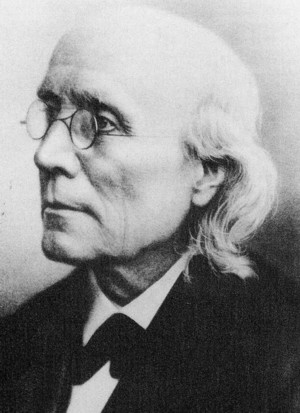
COPY OF AN EXTRACT FROM A LETTER FROM PROFESSOR
FECHNER, DATED LEIPZIG, APRIL 25TH, 1883, TO DR. HUGO WERNEKKE
What Mr. Massey enquires about is undoubtedly in the main correct; the name of the Hindu concerned, when he was in Leipzig, was however, Nisi Kanta Chattopadhyaya, not Koot Humi. In the middle of the seventies he lived for about one year in Leipzig and aroused a certain interest owing to his foreign nationality, without being otherwise conspicuous; he was introduced to several families and became a member of the Academic Philosophical Society, to which you also belonged, where on one occasion he gave a lecture on Buddhism. I have these notes from Mr. Wirth, the Librarian of the Society, who is good enough to read to me three times a week. I also heard him give a lecture in a private circle on the position of women among the Hindus. I remember very well that he visited me once, and though I cannot remember our conversation, his statement that I questioned him about the faith of the Hindus is very likely correct. Apart from this I have not had personal intercourse with him; but, after his complete disappearance from Leipzig, I have been interested to hear about him, and especially to know that he plays an important role in his native country, such as undoubtedly he could not play here.
This led Massey (and some early Theosophists) to assume Nisi Kanta must have been K.H.’s pseudonym. Thus, K.H.’s identity remains a mystery, and his personal name has never been publicly revealed. Nisi Kanta was a historical Bengali scholar from a different part of India with a completely separate life trajectory from Leipzig studies to Hyderabad principal and also having Theosophical acquaintance in 1896.
The Fechner story in K.H.’s 1881 letter remains a minor unresolved point that gets treated as non-dispositive and is either a forgotten separate meeting or a small recollection slip. Charles J. Ryan’s 1936 article “An Important Correction” argued that the two persons are distinct, suggesting two possible reconciliations: (1) K.H. had a separate, very brief conversation with Fechner (so short the elderly professor forgot it, remembering only the more conspicuous meeting with Nisi Kanta), or (2) a minor recollection error.
Fechner however remembered the Bengali scholar clearly because Nisi Kanta had lived openly in Leipzig for a full year (mid-1870s), joined the Academic Philosophical Society, and stood out as a foreign lecturer. Fechner was elderly and partially blind by 1883, relying on notes read to him three times a week by the Society’s librarian.
The man he met and spoke with about Yogis, Fakirs, and Vedantic pantheism was a Bengali Brahmin scholar (1852-1910) named Nisi Kanta Chattopadhyaya (Dr. N.K. Chattopadhyaya), who lived in Leipzig in the mid-1870s, lectured on Buddhism at the Academic Philosophical Society, spoke on Hindu topics (including women’s position), and visited Fechner once. He later became Principal of Hyderabad College (in south India), authored books on Oriental philosophy, Vedanta, and other subjects. In one of his own books (The Reminiscences of the German University Life), he explicitly recounts meeting and escorting “the old sage” Gustav Theodor Fechner home and discussing Yogis, Fakirs, and Fechner’s Zend-Avesta (a work on Vedantic pantheism). He was interested in Theosophy, because in 1896 he personally presented Katherine Tingley (then head of the Point Loma Theosophical Society) with an autographed copy of one of his books.
This is the report of a lecture he delivered on 30 April 1892 at Secunderabad (Hyderabad, India). He later presented an autographed copy of this work to Katherine Tingley (then head of the Point Loma Theosophical Society) in Bombay in 1896. This copy was preserved in the Oriental Department of the Theosophical Library at Point Loma, California:
“I once met Prof. Gustav Fechner, the author of a book called ‘Psycho-Physik’ in which he has enunciated certain laws whose importance … is as great as Newton’s Law of Gravitation … I had the privilege of escorting the old sage home and on the way he asked quite a number of questions about the Yogis and the Fakirs of India … Seeing more of him by and by I came to discover that he was quite a mystic, and had actually written a book called the ‘Zend-Avesta’ a masterly exposition of Vedantic pantheism in the light of modern science.”
This settles the controversy, that Nisi Kanta was the real man that G.T. Fechner met.
G.T. Fechner’s letter (Leipzig, April 25, 1883, to Dr. Hugo Wernekke from C.C. Massey) states verbatim: “the name of the Hindu concerned, when he was in Leipzig, was however, Nisi Kanta Chattopadhyaya, not Koot Humi.”
Early Theosophists (notably C.C. Massey in the 1880s) hoped or assumed it might be the case that Nisi Kanta Chattopadhyaya was K.H.’s secret Leipzig persona, and pre-1936 writings were anxious about the possibility. Charles J. Ryan, a respected long-time Theosophist, published the definitive correction in The Canadian Theosophist (15 December 1936, pp. 326-329). Mary K. Neff’s research which documented K.H.’s German period (Leipzig/Zurich/Würzburg) details K.H.’s European travels, also does not equate the two men.
The letter to A.P. Sinnett in 1881 (July 5) mentioned earlier does not specify the location he spoke with him as being in Leipzig, but the Fechner story is not the only or main proof of K.H.’s European tour years (Leipzig/Zurich/Würzburg period as a chela). One concrete incident from this phase is preserved in A.O. Hume’s Hints on Esoteric Theosophy (1882, p. 37). While still a student and chela in Germany, K.H. was called as a witness in a forgery trial involving a young friend. Through his mentor’s occult intervention, the incriminating document was made to disappear when K.H. examined it (“I see nothing written here”), leading to the friend’s acquittal.
A.O. Hume wrote this account of the incident:
“Take a case said to have occurred many years ago in Germany, in which a Brother, who has corresponded with us, is said to have taken part. He was at this time a student, and though in course of preparation was not then himself an Adept, but was, like all regular chelas, under the special charge of an Adept. A young friend of his was accused of forgery, and tried for the same. Our Brother, then a student as above explained, was called as a witness to prove his friend’s handwriting; the case was perfectly clear and a conviction certain. Through his mentor, our Brother learnt that his accused friend did not really deserve punishment that would necessarily fall on him, and which would have ruined not only him, but other innocent persons dependent on him. He had really committed a forgery but not knowingly or meaningly, though it was impossible to show this. So when the alleged forged document was handed to the witness, he merely said: “I see nothing written here,” and returned the deed blank. His mentor had caused the entire writing to disappear. It was supposed that a wrong paper had been by mistake handed to the witness; search was made high and low, but the deed never appeared, and the accused was perforce acquitted.” (A.O. Hume, Hints on Esoteric Theosophy, Vol. 1. Bombay, India: The Theosophical Society, 1882, 29)
This is the only concrete evidence of K.H.’s sojourn in Germany, and it is unconnected to Fechner or Nisi Kanta. Nisi Kanta lived openly in Leipzig in 1875 and returned to India, while in the 1880s, K.H. was with Morya at Tashi-lhunpo, so we can conclude that the two men simply crossed paths with the same elderly philosopher in Leipzig.
SECRET IDENTITIES, MYTHIC NARRATIVES OF SECRET CHIEFS AND COMPOSITE PICTURE
Apparently, The University of Leipzig kept detailed matriculation registers, many of which still survive in the Leipzig University Archives (UAL), with searchable lists of only the full legal names of foreign students (including Americans) from the period 1781-1914.
Another clue, that K. Paul Johnson suggested and Joscelyn Godwin thought was plausible, was that K.H. could have been Keshab Chandra Sen (whose name was often abbreviated in 19th century German publications and due to this transcription error, the “Ch.” was sometimes misread as “H.” in German Fraktur type). K.H. could easily be a misreading of K. Ch. in old German script. Keshab Chandra’s philosophy focused on the unity of religions, the divine in nature, the nature of the soul and universal spirituality which Fechner was also interested in.
To describe Keshab Chandra Sen’s philosophy:
- Sen criticized Hindu caste, narrow ritualism, and also Christian denominationalism; calls for a religion of the heart beyond sects.
- Treated scriptures (Vedas, Bible, etc.) as inspired but fallible, to be judged by conscience and spiritual experience.
- Taught that all religions are partial rays of one divine light; often uses the metaphor of many paths to one summit, i.e., a common view about the Sanatan dharma.
- Wrote and spoke of a coming universal religion uniting the truths of Hinduism, Christianity, and other faiths; insists no single creed has a monopoly on truth.
- Taught Christ as being a universal spiritual figure, not the property of Western Christianity; reads Christ through Vedantic and devotional lenses.
- Framed himself as a bridge between India and Europe, bringing India’s spirituality to the West and receiving Western ethical and organizational ideas.
- Strongly focused on moral reform, purity, temperance, social uplift, and personal holiness.
- His personality was gentle, refined, earnest, conciliatory, often pleading for harmony and mutual understanding.
- Taught doctrine of direct communion with God, inner realization, and the presence of the divine in the soul.
However, Keshab Chandra Sen did not believe in Jesuit, Dugpa and Bon conspiracies or in Jesuit infiltration of political and occult movements like K.H. in the letters. Nothing in Sen’s writings, sermons, or political activity suggests anything close to anti‑Jesuit rhetoric, but the opposite. He was beloved by Christian audiences and deeply admired Christian ethics.
This issue also reflects another more nuanced Bengali, Mohini Chatterji, who defected from the Theosophical Society due to the approach of the Mahatmas and the Society towards Christianity. Like Keshab Chandra Sen, Mohini preferred mutual cooperation over competition between Hinduism and Christianity, and thus he returned to the conciliatory approach of the Brahmo Samaj.
From this theory, K.H. could have been a fusion of multiple contributors composed of or combining (1) Indian reformist ideas (Sen, Brahmo Samaj, Hindu universalism), (2) Western Enlightenment anticlericalism (d’Holbach, Voltaire, British anti‑Jesuitism), (3) someone with familiarity with English prose, (4) French idioms and philosophical structure, and (5) Blavatsky’s mediation, covering for the identity or identities. The writers I can mention (outside of David Reigle and other Theosophists) suggested that K.H. was a composite character of Keshab Chandra Sen (Brahmo Samaj leader), Sirdar Dayal Singh Majithia, Thakur Singh Sandhanwalia and other Punjabi and Bengali reformers. The works of (a) Shibnarayan Dhar’s Keshub Chunder Sen: A Sketch of His Life and Career (1910), Brian A. Hatcher’s Bourgeois Hinduism, or the Faith of the Modern Vedantists: Rare Discourses from Early Colonial Bengal (Oxford UP, 2008) and Karl Baier’s Meditation and Modern Buddhism: Encounters with the West from the Late 18th Century to Today (Brill, 2022) show how Sen’s universalist Hinduism resembles K.H.’s teachings, (b) the works of Kumkum Chatterjee (2009), Kenneth W. Johnes (1989) and Timothy Larson (2011) on Keshab Chandra show that his 1870-71 European tour made him known to the same liberal and esoteric circles that later embraced Theosophy; (c) and some of the same authors show, that his public image (gentle, refined, philosophical) resembles the way K.H. is described, and (d) his name (K. Ch. Sen) could be misread in German script as K. H. Sen.
CURIOUS PATTERNS OF K.H. NOTICED IN THE MAHATMA LETTERS
The problem is that Sen’s writing style is not Frenchified, like K.H.’s tone reflecting European rhetorical structures, Enlightenment philosophy and French intellectual culture. Writers like Paul Zweig, René Guénon, Hugh Urban, Godwin and K. Paul Johnson were very suspect of the unusualness of the letters, and all wrote that they notice linguistic fingerprints and in other ways indicate a cross‑cultural intellectual network, or hybrid literary creation. These authors make notice, that K.H. in The Mahatma Letters uses French idioms, writes in a European philosophical style, employs French punctuation habits (e.g., spacing before colons, dashes), uses French‑derived vocabulary uncommon in Indian English of the period and occasionally spells words in a French‑influenced way. It indicates someone familiar with and shaped by French occultism, French socialist mysticism, Enlightenment philosophy and nineteenth-century esoteric circles. This issue led historians like K. Paul Johnson to the indication, that the K.H. persona is a literary construction.
Logically, we can conclude that K.H. indeed had a European education, exposure to French literature, familiarity with Western philosophical debates and fluency in European intellectual style. Other authors suggested that the person who wrote the letters was a Western author, but this is inconclusive and cannot be adopted as a solidified thesis. It cannot be H.P. Blavatsky, since Jinarajadasa’s 1946 study concluded that: (1) the handwriting of the Mahatma Letters is not Blavatsky’s, (2) the letters show multiple hands, not one, (3) some letters were written in ways Blavatsky could not have physically produced and under difficult conditions not capable of attributing to ordinary writing (e.g., simultaneous letters, letters appearing in sealed envelopes), therefore, (4) the letters were not authored or penned by Blavatsky alone.
To complicate the situation and theory even further in the section above, David Reigle’s meticulous research showed that some technical Buddhist terms used in the letters were not available in English sources at the time Blavatsky wrote them, suggesting that: (1) Blavatsky did not invent those terms, (2) someone with access to Tibetan or Sanskrit sources contributed, or (3) Blavatsky had access to Asian informants or texts not known to scholars. The ideas expressed by K.H. indicate that he is “Frenchified,” but also unlike an ordinary Western author, ideas attributed to him exactly match genuine Gelugpa and Dzogchen teachings not widely known in the West in the 1880s. David Reigle also analyzed the Tibetan-style signatures in the letters and argues they are not obviously forged, so Reigle does not adopt the theories of the other researchers, showing that despite d’Holbach parallels and Frenchified tone, the teachings still reflects real Tibetan Buddhist knowledge, that was not accessible to the West at the time and have been gradually revealed through Tibetan scholarship.
However, David Reigle does not settle the Western fingerprints in K.H.’s writing (anti‑Jesuit rhetoric typical of British Protestants, no trace of Kashmiri linguistic influence nor Tibetan syntax or idiom), which still require explanation. The explanation has been thus far, that the writings are prepared in a manner a Western audience will understand, hence the comparison of a Western thinker’s doctrines with their own.
“Why does an “Indian” sadhu write like a French‑educated European rationalist?” is a question the skeptical have asked. K.H. being “Indian” does not entirely contradict the Western linguistic fingerprints, since the persona is described as being an Indian, learned in European ways (and fond of it, particularly France) and is often with Morya who is often alongside or in the trans-Himalayan region. The other explanation to this composite-authorship theory, is explained by more unverifiable occult phenomena, along the lines of: “they had various disciples that the information was passed through, and that the letters were not all written directly by these adepts.” This could just be explained by natural means, as composite informants and authorship.
Overall, for K. Paul Johnson who has suggested for our generation of esotericists an end to anonymity (Occultists with Aliases Face Unintended Consequences), concerns with the consequences of aliases/pseudonyms/anonymity have been raised, though it has been defended by Theosophists.
He states for example:
“The term occultism has problems in the 21st century and esotericism is the preferred label among academic scholars. My observation of the difference is that there are opposite approaches to secrecy and transparency. Esotericists have always been generous and constructive to me, while occultists have often approached historical research with four dangerous proclivities: obscurantism (the practice of deliberately preventing the facts or full details of something from becoming known), obstructionism (the practice of deliberately impeding or delaying the course of legal, legislative, or other procedures), obfuscation (the action of making something obscure, unclear, or unintelligible), and ostracism (exclusion from a society or group). Occultist types hoard, hide, misrepresent, and even destroy historical evidence seeking power through secrecy. Esotericists collect, explain, publish, and preserve literature from past secret traditions, not feeling bound by an ethos of secrecy or religious rivalry.”
This secrecy became a major downfall for the Theosophical Society narrative, and new mythology was constructed from it by commercialist, Christo-millenarianist copyists, which took over the milieu of “modern alternative spirituality” — a timeline not really envisioned by 19th century occultists. A good case study of individuals falling out of favor with aristocratic practices of pseudonyms, and the entire games and methods of secrecy is Adam Weishaupt after his exile. However, the development of military-industrial surveillance technology (also in almost every home device through presence recognition) and war in the Middle East in the 20th-21st century truly complicates this issue.
JINARAJADASA’S RESEARCH ON KH LETTERS
In Did Madame Blavatsky Forge the Mahatma Letters, Jinarajadasa meticulously examined over 1,300 pages of letters from six distinct Mahatmas (Koot Hoomi or K.H., Morya or M., Serapis, Narayana, Hilarion, and Djual Khool), using photographic reproductions to demonstrate stylistic consistencies, distinct individuality and discrepancies with Blavatsky’s own script. Each Mahatma’s handwriting is unique and psychologically integrated, reflecting a “masterful” quality absent in Blavatsky’s impulsive, variable style. For instance, K.H.’s script is elegant, flowing, and consistent in blue pencil or ink, with precise letter formations (e.g., a distinctive “t” crossing and looped “d”s). K.H.’s handwriting remained unchanged from a 1870 letter to Blavatsky’s aunt (pre-Theosophical Society) to 1886 annotations, spanning 16 years. This refutes Hodgson’s claim of Blavatsky’s “failing powers” altering later forgeries. A post-1891 K.H. letter (after Blavatsky’s death) in the same script further disprove her involvement.
F.G. Netherclift’s analysis alongside Richard Hodgson, based on limited samples was flawed. Hodgson relied on Netherclift, who flip-flopped: initially deeming K.H. scripts genuine and not Blavatsky’s, later calling them “undeniably hers” with “flimsy” disguise. Jinarajadasa exposed Netherclift’s unreliability through cases like Parnell (1888 forgery misidentified), Truscott libel (contradicted by witnesses), and Bynoe (1895 disguised handwriting error). Independent experts, including a medical handwriting specialist, confirmed the scripts’ authenticity, noting psychological depth (e.g., K.H.’s reflective, Morya’s authoritative traits) incompatible with disguise.
Letters materialized through a process of precipitation (materials varied, e.g., rice paper, sealed envelopes), often in witnesses’ presence, with varied inks and papers. Hodgson’s report ignored multiple scripts and post-Blavatsky receipts (e.g., 1900 K.H. final letter). Jinarajadasa concluded forgery would require near impossible coordination across continents and collaborators, and he continued to argue this refutation is proof of genuine esoteric transmissions.
Jinarajadasa argued, that the authenticity of the letters can be demonstrated by shifting focus to their philosophical content as evidence of adept involvement. Modern claims of adepts similar to Mahatmas persist in esoteric Zoroastrianism, Central Asian and Middle Eastern traditions, though are often anecdotal or faith-based, and will likely always lack empirical “proof,” but supported by historical texts, oral traditions and pilgrimages.
KOOT HOOMI AND MORYA CONNECTION TO TIBET AND THE PANCHEN LAMA
“There is beyond the Himalayas a nucleus of these Adepts, of various nationalities, and the Teshu Lama knows them, and they act together, and some of them are with him and yet remain unknown in their true character even to the average lamas—who are ignorant fools mostly. My Master [Morya] and KH and several others I know personally are there, coming and going, and they are all in communication with Adepts in Egypt and Syria, and even in Europe.” (H.P. Blavatsky, Letter to Franz Hartmann, 1886, published in The Path, March 1896, p. 370)
K.H. is described as having another role and duties to take up, and the roles of both Morya and K.H. have been elaborated further in other sources. In the draft copy of the “First Report” of the Society for Psychical Research on H.P. Blavatsky, Koot Hoomi is described as “the relic-bearer to the Teshu-Lama, an office in Thibet resembling that—say of Cardinal-Vicar, in the Roman Catholic Church…” (October 1884, p. 16).
The draft (pre-Hodgson investigation) recorded Theosophist testimony on K.H.’s Tibetan office. The final 1885 Hodgson Report dismissed the phenomena as fraud, but Theosophical scholarship (and partial SPR re-examination by Vernon Harrison, 1986) rejects it as biased and methodologically flawed. The draft quote remains valid primary evidence of early testimony.
While all the officials in the Panchen Lama’s court were all Tibetans, K.H. was said to be an Indian. H.P. Blavatsky stated explicitly that the nucleus of adepts (including Morya and K.H.) at Tashi-lhunpo ‘remain unknown in their true character even to the average lamas, who are ignorant fools mostly.’ The office (relic-bearer/chöpön or master of ceremonies, likened in the SPR draft to a Cardinal-Vicar) was an esoteric, non-public role held by non-Tibetan adepts. David Reigle’s textual and historical alignment confirms an 1882 ceremony reference in the Mahatma Letters, which matches real Tashi-lhunpo festivals (Waddell, Tibetan Buddhism, 1895), with K.H. functioning in some sense, in that capacity.
A disciple of K.H. that disappeared during his ordeals in Tibet, Damodar K. Mavalankar called him:
“. . . my venerated GURU DEVA [Koot Hoomi] who holds a well-known public office in Tibet, under the TESHU LAMA.” (Damodar K. Mavalankar, Damodar and the Pioneers of the Theosophical Movement, compiled and annotated by Sven Eek, 1965, p. 340)
There was a major ceremony held at Tashi-lhunpo on June 30, 1882, where K.H. would have been.
Sourced from Tibetan Buddhism: With Its Mystic Cults, Symbolism and Mythology, and in Its Relation to Indian Buddhism, by L. Austine Waddell, 1895, p. 508, it is said of the ceremony:
“During this feast many of the monks encamp in tents, and colossal pictures are displayed. Thus at Tashi-lhunpo the pictures are hung from the great tower named Kiku. At this festival, held there on June 30th, 1882, Lāma Ugyen Gyats’o informs us, a great picture of Dipaṁkara Buddha was displayed about a hundred feet long, in substitution for pictures of the previous days. Next day it was replaced by one of Ṣākya Muni and the past Buddhas, and the following day by one of Maitreya (Jam-pa).”
A letter from K.H. received only after July 15, 1882 states:
“In about a week—new religious ceremonies, new glittering bubbles to amuse the babes with, and once more I will be busy night and day, morning, noon, and evening” (The Mahatma Letters to A. P. Sinnett, chron. ed. letter no. 68, p. 203).
Of Morya, Vera P. Zhelihovsky [Blavatsky’s sister] tells of having heard from H.P. Blavatsky many times, that “Master M.: Was (or is) a high official with the Teshu Lama in Tibet, a hutuhtu, or ‘bearer (or carrier) of sacred things,’ in the sense of relics (…) See her words in Russkoy Obozreniye, VI, Nov., 1891, p. 292, footnote.” (Boris de Zirkoff, Blavatskaiana, Historical Index, vol. 3).”
“. . . the Tashi Lama (whose Master of Ceremonies one of our own revered Mahatmas is).” (Henry Steel Olcott, Old Diary Leaves, Fourth Series, p. 6)
It has been noted in The Panchen Lamas and the Theosophical Mahatmas, that “the nearest thing to the office described above would probably be the chöpön (mchod dpon), “head/chief/master/overseer of offerings/worship/ceremonies/religious services,” who could thus be called the master of ceremonies.”
This is part of a series that provides a better understanding of the role and history involving “the Masters.” that were said to be secret sponsors behind the Theosophical Movement and its operations. These circles of adepts, including their disciples and associates were said to have activities in South Asia, the Middle East, North Africa, the Americas and Europe.
- Speculations About Thakar Singh Sandhawalia: Were the Mahatmas Sikh/Sant Mat
- Tamil Swami Ramalingam Pillai’s Prophecy
- Was Morya the Maharajah Ranbir Singh
- Hilarion Smerdis, Serapis Bey and the Legend of the “Brotherhood of Light” and Luxor
- Political Operations in Cairo and War Treaty in Cyprus involving Hilarion and Ooton Liatto
- Thakur Singh Connection and Damodar meets the Mahatmas
- Olcott meets His Master in Lahore: K. Paul Johnson versus Olcott’s Testimony
- Olcott’s Strained Relationship with Blavatsky and the Judge Case
- Witnesses of Morya, Identity of Koot Hoomi and Connections to Tibet and the Panchen Lama
- Sarat Chandra Das: The Bengali Spy, Sengchen Tulku and the Maha-Chohan Connection


 The American Minervan

Leave a comment