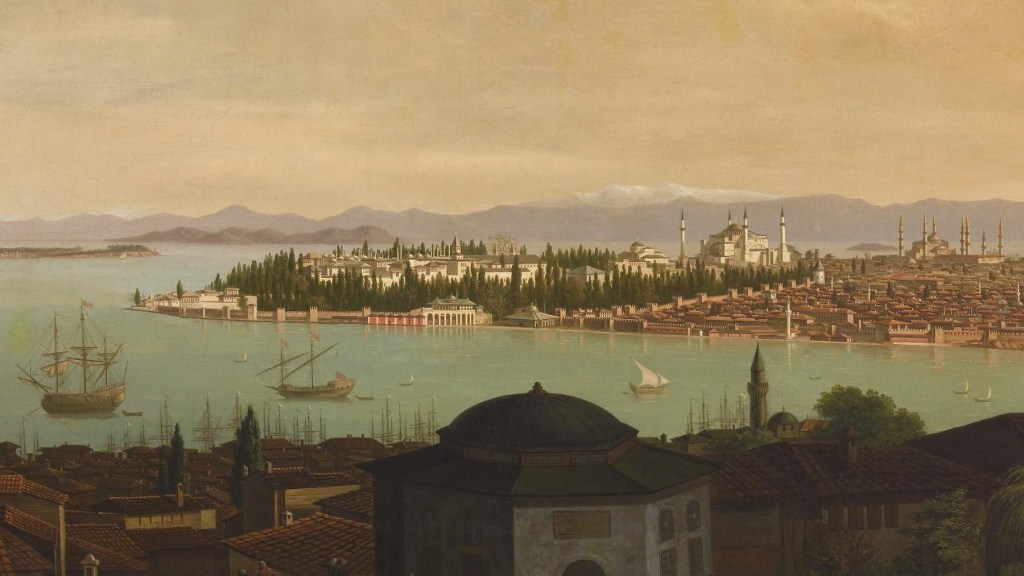
A theosophist in 1880 provides an early critique of Western imperialism and materialism that connects religious perversion directly to economic and technological exploitation, and calls for a regeneration of altruistic ethics.
A NATION OUT OF EXCUSES
If Americans have learned anything about our political circumstances, it is that when John Adams wrote, that “the American Constitution is meant for a religious and moral people,” it shows how we have collectively (particularly to the world on the outside) failed to display this religious and republican character to the world. Our excuses as a “young nation” have worn out.
In Islamic eschatology, it is understood that it will be nearly impossible to escape the levels of deceit of the Dajjal, even those who plan and are arrogant that they would not fall for such deceit. This arrogance itself means, one is already in its snares. This provides some understanding as to what underlies anti-American discourse from an Islamic perspective looking at the “levels of deceit” (chess moves) that Israel and U.S. political class, intelligence and military apparatus are constantly engaged in, no matter who is in the White House.
The problem with this kind of discourse, far from the days of Jamal al-Din, is that in one sense, it is grounded in legitimate and factual critique; but in another sense becomes a mirror of Christian discourse and polemic against the East, or “the Orient.” It can then be co-opted to serve as disinformation or accompany justifications for war and terrorism. The discourse against what is seen as the “Dajjalic West” or Molochian West have roots long before the Islamic Republic of Iran and brings immediately to mind the discourse popularized by nineteenth-century thinkers like Rifā‘a al‑Tahtāwī, Jamal al-Din and Muhammad Iqbal against European materialist philosophy, moral laxity and subjugation. Shah Waliullah Dehlawi in the previous century to the Ottoman reformers warned that societies collapse when material desire becomes their god.
COLONIAL WEST VERSUS ISLAMIC MORAL ORDER
Early descriptions and comparisons of the Christian West as being ruled by greed, materialism, and worldly corruption appear in Ottoman, Arab, and Indo‑Muslim critiques of Europe from the seventeenth-nineteenth centuries. Europe was seen as powerful but spiritually bankrupt, i.e., rich in wealth, but poor in virtue. Ottoman intellectuals like Kâtib Çelebi, Mustafa Na‘ima and other Ottoman reformers critiqued European states as the embodiment of avarice, mercantile ambition and masters of the world that have lost their soul contrasting the commercial greed, colonial expansion, and financial corruption of the Occident to Islamic moral order.
This brings us to the case in Theosophy of the Ottoman Muslim (considered an adept and “unknown sage”) under the anonymous title “Turkish Effendi” published in Blackwood’s Edinburgh Magazine in 1880. An effendi indicates high social status or role in the imperial bureaucracy, but he was also member of the Theosophical Society at the time and wished to remain anonymous. Both the British government official (who had to have been an ambassador or British MP or MP‑elect around 1879-1880, sat in the House of Commons and involved in foreign policy and diplomatic travel in Asia Minor) and the Turkish Effendi did not want to be compromised.
TURKISH EFFENDI AND THEOSOPHIST ON THE GREAT MAMMON
This Muslim theosophist associated also with the Brahmo Samaj criticized the West and its attitude towards Islam and the East as Mammon. Mammon is associated with the spirit of egoist materialism (a false god, or spiritual impediment), ecclesiastical corruption tied to power and wealth, spiritual blindness and moral decline. This letter does not descend to a mere polemic like in modern discourse, since every charge is grounded in personal observation and historical example, and every criticism is balanced by admiration for the original Christian ideal. The result is a powerful, still-relevant diagnosis of the moral contradictions at the heart of Western civilization and advocates for honest self-examination that remains as pertinent today as when it first appeared in 1880.
This January 1880 issue of Blackwood’s Edinburgh Magazine (Volume 127) was first printed under the title “A Turkish Effendi on Christendom and Islam.” It consists of an introductory narrative by a British government representative, a traveler and would-be reformer who met the Effendi during official work in Asia Minor — followed by the long personal letter the Effendi addressed to him. The British representative explains that he dined with the mysterious sage, engaged in extended conversations, asked him to summarize his views in writing, received the original draft, and then polished the English style while preserving every idea exactly as the Effendi approved it. The letter itself is signed simply “A Turkish Effendi” and opens with “My Dear Friend,” and the Effendi explicitly states that any Theosophical Society member reading it will recognize him as one of their number and will honor his request for continued anonymity.
Blavatsky reprinted the entire article verbatim in The Theosophist (March 1880), and it later appeared as Blavatsky Pamphlet No. 8. This pamphlet’s foreword notes that the writer’s reference to the Theosophical Movement suggests he was probably one of the adepts and initiates active in the Near East at the time. No other name has ever been attached to the letter, and the anonymity the Effendi requested remained respected.
The unnamed British government representative who met the mysterious sage while on official business in Asia Minor describes visiting the Effendi’s secluded farm (purchased five years earlier in a glen) and receiving the letter after extended conversations.
The letter opens with a brief autobiography that establishes the author’s credentials for offering an informed comparative judgment, as the Effendi described himself as the son of a high-ranking Ottoman official who mixed freely with Europeans, giving the young man early fluency in Greek, French, and Italian. After his father’s death at age twenty he inherited wealth and devoted it to systematic travel and study. He spent a year in Rome, then ten years in England (living under an Italian alias, mastering the language, institutions, literature, and religion and adding German philosophy). He visited the continent and Turkey twice more, spent a year in America, traveled on to India from Japan and China resuming oriental dress and studying the Brahmo Samaj among fellow Muslims for two years, lived three years in Ceylon immersed in the occult dimensions of Buddhism, passed a year in Teheran, and resided five years in Damascus performing the Hajj out of curiosity. Five years before writing he bought a farm in a beautiful glen in Asia Minor, where he devoted his remaining days and fortune to relieving local distress. This cosmopolitan formation, he explains, freed him from the usual prejudices of his countrymen and equipped him to judge religions not by claimed divine origin, but by their practical moral results on human conduct.
THE THREE BRANCHES OF ANTI-CHRISTENDOM
He states his core criterion: every religion must be measured by the degree to which it regenerates the world through altruistic ethics rather than by promoting enlightened selfishness. Pure original Christianity, he declares, sets the highest standard. Christ’s teachings are supremely altruistic and, if literally applied, would indeed transform humanity.
Yet the three great branches (Greek, Catholic, Protestant) have inverted those teachings into what he pointedly calls “Anti-Christendom.” The focus on personal soul-salvation, whether by faith or works breed a self-centered morality that places one’s own welfare and that of one’s immediate circle above the neighbor’s. In practice this produces Mammon-worship tempered in Catholic lands by lust for spiritual and temporal power, in Greek lands by racial aggrandizement, and in Protestant lands by unbridled greed. Western civilization, the concrete expression of this inverted faith, deploys mechanical inventions (railroads, telegraphs, ironclads, Gatling guns) not to elevate “barbarous” peoples but to exploit and destroy them. Indigenous races either perish (as with the Red Indian of America, the Australian, and the New Zealander) or survive only by converting wholesale to the new religion of avarice, as in Japan.
The individual illustrates to us the process with the Ottoman Empire, to which it claimed he belonged. The Ottoman Empire was contaminated first by the corrupt, superstitious Christianity of Byzantium, then steadily undermined by five centuries of contact with Christian subject populations and more recently, by modern Western greed made possible by steam and electricity. British and Russian reforms in Asiatic Turkey are, he argues, hypocritical pretexts for financial speculation rather than genuine improvement. He predicts that the very tools of Western progress will ultimately destroy the civilization that created them; and class war between capital and labor will be the causal retribution for eighteen centuries of systematic violation of Christ’s altruistic law.
Throughout, his tone remains courteous and non-vindictive, but the effendi acknowledges that sincere Christians exist and that he would gladly accept correction from his British friend. He notes that, although Islam’s ethical code is inferior to Christ’s, its professors have remained more faithful to their Prophet’s spirit than Christians have to theirs, e.g., the Muslim Slavs of Bosnia and Herzegovina display more genuine Christian virtues than their Christian neighbors. He closes his statements by inviting Theosophical Society members worldwide to recognize him while respecting his privacy, and he reaffirms that his sole motive is the advance of truth.
This letter functions on several levels: (a) it supplies a sophisticated Muslim perspective on the “Eastern Question” then dominating British politics; (b) performs a penetrating comparative-religion analysis that anticipates later theosophical emphasis on universal ethics over dogma; (c) offers an early critique of imperialism and materialism that connects religious perversion directly to economic and technological exploitation.

 The American Minervan
Leave a reply to Dominique Johnson Cancel reply