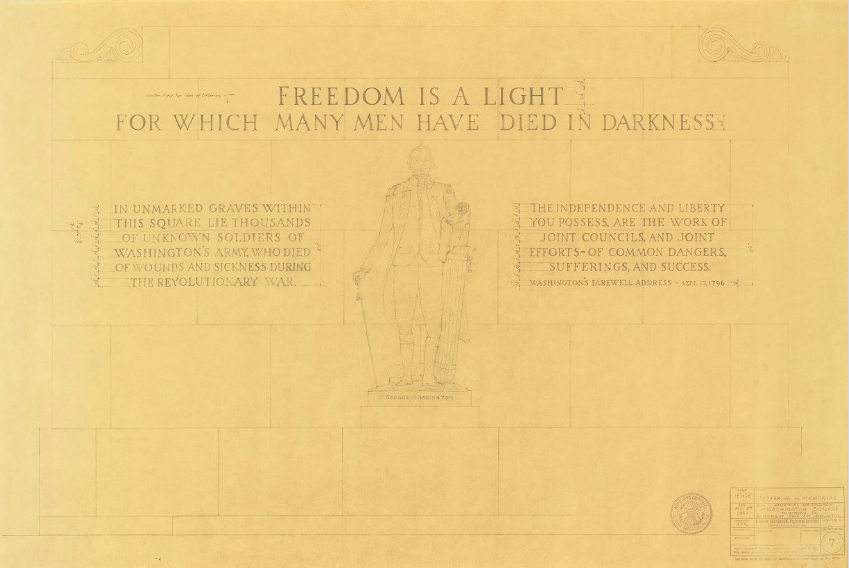
George Washington’s private correspondence, public statements and testamentary provisions regarding slavery, Native American policy, and republican governance are examined to provide a historically accurate portrait that resists modern ideological co-optation, that reduces Washington to a caricature of racist villainy or conscripts him as a patron of white ethnonationalism and “remigration.” Relying exclusively on primary sources like his letters, the Farewell Address, 1799 Will, and executive documents, these demonstrate Washington’s private evolution on slavery, his explicit rejection of colonization and deportation schemes, and his “civilization through assimilation” policy toward Native Americans, revealing a figure far more complex, conflicted than either modern caricature allows.
- INTRODUCTION
- WASHINGTON’S EARLY AWARENESS (1750s-1770s)
- POST-REVOLUTIONARY-TRANSFORMATION (1783-1786)
- STRATEGY DURING THE PRESIDENTIAL WARS (1789-1797)
- THE WILL OF 1799: THE DEFINITIVE ACT
- WASHINGTON REJECTION OF REMIGRATION
- WASHINGTON VERSUS THE COLONIZATION MOVEMENT
- AGAINST CARICATURES AND FAR-LEFT REDUCTIONIST CRITIQUE OF WASHINGTON
- WASHINTON ON PARTISAN FACTIONALISM: FAREWELL ADDRESS 1796
- SUPPORTING CORRESPONDENCES
- STATED POLICY: CIVILIZATION THROUGH ASSIMILATION
- WASHINGTON’S POLICIES AS PRESIDENT
- FAILURE OF THE CIVILIZATION POLICY
INTRODUCTION
George Washington has become a contested symbol in twenty-first-century American culture wars. On one flank, elements of the academic and activist left have reduced him to a slaveowner whose legacy is irredeemably tainted, a figure to be toppled from pedestals both literal and figurative, his name stripped from schools, his monument recontextualized as a shrine to white supremacy.
On the opposite flank, elements of the far right have attempted to claim him as a forerunner of racial separatism, a builder of a deliberately whites-only republic, and a spiritual ancestor of modern movements advocating “remigration” or the mass deportation of non-white populations from Western nations. Both readings are historically illiterate. Both project contemporary ideological categories onto an eighteenth-century figure whose worldview was shaped by forces neither side understands or cares to understand.
Washington’s own words preserved in thousands of letters, public addresses, and legal documents now freely accessible through the Papers of George Washington (University of Virginia Press) and Founders Online reveal a man who privately detested slavery, contradicted himself in his public actions, fear the loss of all his “property,” actively worked toward its gradual abolition while undermining it in instances it personally affected his livelihood, rejected the removal of freed Black people from America, warned prophetically against partisan faction, and pursued a Native American policy that was paternalistic and ultimately disastrous.
Washington was a man of profound contradictions, whose moral vision of republicanism in the American colonial era frequently exceeded his political will, and whose successors lacked even the vision.
WASHINGTON’S PRIVATE STATEMENTS AGAINST SLAVERY
The documentary record of Washington’s private views on slavery is extensive, consistent, and damning to anyone who claims he completely regarded the institution with moral indifference. From the mid-1770s onward, his correspondence reveals a man who understood slavery to be wrong, who wished it abolished, and who took concrete, if agonizingly incremental, steps toward that end.
WASHINGTON’S EARLY AWARENESS (1750s-1770s)
George Washington expressed private criticisms of slavery throughout his adult life, particularly in letters where he did not have to worry about public or political repercussions.
As early as 1757, during the French and Indian War, Washington demonstrated awareness that slavery rested on coercion rather than consent. Observing British attempts to recruit enslaved people to their cause, he noted sarcastically that the Crown “promises liberty to all slaves who will join them,” a remark that reveals, at minimum, his recognition that enslaved people desired and understood freedom, and that the institution was maintained only by force.
More striking is the 1774 letter to Bryan Fairfax, in which Washington made a direct parallel between the colonists’ political subjection to Britain and the enslavement of Black people:
“I am convinced that no man can be a slave holder and be a true patriot at the same time (…) The crisis is arrived when we must assert our rights, or submit to every imposition that can be heaped upon us, till custom and use shall make us as tame and abject slaves, as the blacks we rule over with such arbitrary sway.” (George Washington to Bryan Fairfax, 1774)
The significance of this passage cannot be overstated. Washington did not merely use slavery as a metaphor for political oppression, a rhetorical device common among the Founders. He explicitly names slaveownership as incompatible with patriotism and acknowledged the “arbitrary sway” under which Black Americans suffered. This is not the language of a man at peace with the institution.
PENNSYLVANIA’S GRADUAL ABOLITION ACT IN 1980
Pennsylvania’s 1780 Gradual Abolition Act was one of the first in the U.S. It prohibited importing new enslaved people for permanent residency and freed any non-resident’s enslaved people after six continuous months in the state (with some exemptions, such as for members of Congress).
When the national capital moved to Philadelphia in 1790, Washington (a Virginia resident) brought enslaved household staff. To avoid losing them to manumission (or freeing of slaves) under Pennsylvania law, he consulted Attorney General Edmund Randolph and implemented a rotation system advised by his secretary Tobias Lear. Enslaved people were periodically sent back to Mount Vernon (or sometimes New Jersey) before completing six months, “resetting the clock” on their residency. Washington instructed secrecy, instructing Lear to keep the plan known only to him and Martha Washington, using pretexts to deceive both the enslaved people and the public so as to avoid scrutiny in abolitionist-leaning Philadelphia (with its strong Quaker community). This applied to household staff including Martha’s maid Ona Judge, the cook Hercules, valet Christopher Sheels, and others like Moll, Austin, Giles, and Richmond, some of whom were dower slaves from Martha’s estate, complicating ownership. (Erin Blakemore, George Washington Used Legal Loopholes to Avoid Freeing His Slaves, 2015).
This was a deliberate, documented workaround rather than seeking exemptions or challenging the law publicly. Washington was careful not to establish legal residency in Pennsylvania.
POST-REVOLUTIONARY-TRANSFORMATION (1783-1786)
The period between the end of the Revolutionary War and the Constitutional Convention witnessed a decisive intensification of Washington’s anti-slavery convictions. Three letters from this period are indispensable to the historical record.
The first is Washington’s letter to the Marquis de Lafayette, dated April 5, 1783. Lafayette had proposed a joint experiment in gradual emancipation: the two men would purchase a plantation and free its enslaved workers, integrating them as free citizens on American soil. Washington responded with unmistakable enthusiasm:
“The scheme, my dear Marquis, which you propose as a precedent, to encourage the emancipation of the black people of this Country from that state of Bondage in wch. they are held, is a striking evidence of the benevolence of your heart. I shall be happy to join you in so laudable a work…” (George Washington to the Marquis de Lafayette, April 5, 1783. Papers of George Washington, Confederation Series)
Two elements of this exchange deserve emphasis. First, Lafayette’s proposal was explicitly integrationist: freed Black workers would remain on American soil as free citizens, not be transported to Africa or the Caribbean. This is the exact opposite of “remigration.” Second, Washington did not merely tolerate the proposal; he called it “laudable” and expressed happiness at the prospect of joining it. The man whom modern white ethnonationalists claim as their forerunner was, in 1783, eagerly discussing a plan to free enslaved people and integrate them into American society.
The second critical document is the letter to Robert Morris, dated April 12, 1786, and arguably the single strongest anti-slavery statement Washington ever committed to paper:
“There is not a man living who wishes more sincerely than I do, to see a plan adopted for the abolition of it [slavery]—but there is only one proper and effectual mode by which it can be accomplished, & that is by Legislative authority; & this, as far as my suffrage will go, shall never be wanting.” (George Washington to Robert Morris, April 12, 1786. Papers of George Washington, Confederation Series, Vol. 4)
Washington was writing on behalf of Philip Dalby of Alexandria, whose enslaved person a Quaker society had attempted to liberate. Even while defending Dalby’s legal rights under existing Virginia law, Washington inserted this extraordinary declaration of personal abolitionist conviction. He wanted slavery abolished. He wanted it abolished by law. And he pledged his own political support (“suffrage”) to that end. It is difficult to imagine a more explicit statement from a sitting Virginia planter in 1786.
The third is the letter to John Francis Mercer, dated September 9, 1786, in which Washington made a concrete personal commitment:
“I never mean (unless some particular circumstances should compel me to it) to possess another slave by purchase; it being among my first wishes to see some plan adopted, by the legislature by which slavery in this country may be abolished by slow, sure, & imperceptible degrees.” (George Washington to John Francis Mercer, September 9, 1786, see Papers of George Washington, Confederation Series, Vol. 4)
Washington kept this pledge. After the Revolution, he ceased purchasing enslaved people. The phrasing “slow, sure, & imperceptible degrees” reveals his preferred strategy: gradual abolition through legislative action, proceeding steadily enough to be irreversible but slowly enough not to shatter the fragile Union. Whether this strategy was morally sufficient is a legitimate question. That it existed at all demolishes the claim that Washington was indifferent to slavery’s injustice.
STRATEGY DURING THE PRESIDENTIAL WARS (1789-1797)
Washington’s public silence on slavery during the presidency has been cited as evidence of hypocrisy or moral cowardice. The charge is understandable but historically naive. Washington believed, correctly, as subsequent history demonstrated, that pushing abolition openly from the presidential chair would have fractured the fragile Union before it had consolidated. The Constitution itself was a compromise with slaveholding states; the Three-Fifths Clause was the price of Southern ratification. Washington understood that premature confrontation on slavery would produce not abolition but disunion, and likely civil war, decades before the North had the industrial and demographic capacity to win one.
His private convictions, however, did not waver.
In a 1793 letter to John Carey, Washington restated his position with characteristic firmness:
“I am principled against this kind of traffic in the human species…I am happy in believing that the great majority of the people of the United States are averse to the practice.” (George Washington to John Carey, 1793)
Washington was not speaking abstractly about an unfortunate institution but condemning slavery as a form of commerce in human beings. This is not language that would not have been out of place in an abolitionist pamphlet. Here is the contradiction however, and his defense of property rights.
However, George Washington signed the Fugitive Slave Act of 1793 into law as president and actively sought to enforce it against his own escaped enslaved people, while using legal strategies to maintain ownership of those in his Philadelphia household. The law allowed enslavers (or their agents) to seize suspected fugitives in any state or territory and present them before a federal judge or local magistrate. Upon proof (oral testimony or affidavit) that the person owed service under the laws of their home state, the official had to issue a certificate authorizing removal. It imposed fines (up to $500) on those who interfered, rescued, or harbored fugitives. The Act did not use the word “slave” and applied nationwide, reinforcing the Fugitive Slave Clause in the Constitution.
Congress passed the Act in response to disputes over the return of people escaping enslavement, notably a case involving a fugitive named John Davis between Pennsylvania and Virginia. Washington signed it on February 12, 1793. As president and a major enslaver, Washington supported and used this federal mechanism. It aligned with his interest in protecting “property” rights amid growing sectional tensions.
THE CASE OF ONEY IN 1796
Another example of enforcement against slaves was Ona (Oney) Judge, an enslaved woman born around 1773 at Mount Vernon to an enslaved mother (Betty) and indentured white father. She served as Martha Washington’s personal attendant and accompanied the family to New York and then Philadelphia. On May 21, 1796, while the Washingtons dined, Ona escaped the President’s House in Philadelphia.
Washington responded aggressively by placing a runaway advertisement in the Philadelphia Gazette offering a $10 reward, describing her. He enlisted Secretary of the Treasury Oliver Wolcott Jr. to coordinate with New Hampshire officials and agents for her capture. This shows Washington using the spirit (and mechanisms) of the 1793 Act he signed, even while president, while trying to avoid public controversy in the North.
THE WILL OF 1799: THE DEFINITIVE ACT
If Washington’s letters reveal his private convictions, his last will and testament executed on July 9, 1799, five months before his death constitutes his definitive public act on slavery. The provisions are remarkable in their specificity, their generosity, and moral clarity.
Washington ordered all 123 enslaved people he personally owned to be freed upon Martha Washington’s death. He made detailed provisions for their welfare:
- Education and apprenticeship for children: The young were to be “brought up to some useful occupation, agreeably to the Laws of the Commonwealth of Virginia providing for the support of Orphan and other poor Children.”
- Lifelong support for the elderly and infirm: Those too old or disabled to support themselves were to be maintained “comfortably clothed and fed by my heirs” from the estate, in perpetuity.
- An explicit prohibition on deportation or sale: Washington expressly forbade “the Sale, or transportation out of the said Commonwealth, of any Slave I may die possessed of, under any pretence whatsoever.”
- Special recognition for William Lee: His personal valet during the Revolution received immediate freedom and a $30 annual annuity “for his faithful services during the Revolutionary War.”
This was the largest single manumission by any Founding Father. It was deliberately kept secret during Washington’s lifetime to avoid political backlash in Virginia, where the planter class regarded any act of emancipation as an existential threat to the social order. Martha Washington chose to free her husband’s slaves early, on January 1, 1801, reportedly fearing for her safety in a situation where, as the Custis family later recalled, “the freedom of so many depended on her death.”
A necessary qualification: of the 317 enslaved people living at Mount Vernon in 1799, Washington could legally free only the 123 he personally owned. The remaining 153 were “dower slaves” belonging to the estate of Martha’s first husband, Daniel Parke Custis, held in trust for the Custis heirs. An additional 41 were rented from neighboring estates. Virginia law prevented Washington from manumitting anyone he did not personally own. He freed every human being he had the legal power to free. No other slaveholding president did as much.
WASHINGTON REJECTION OF REMIGRATION
“There is not a man living who wishes more sincerely than I do, to see a plan adopted for the abolition of [slavery].” (George Washington to Robert Morris, 12 April 1786)
“I never mean…to possess another slave by purchase; it being among my first wishes to see some plan adopted… by which slavery in this country may be abolished.” (George Washington to John Francis Mercer, 9 September 1786)
The claim that George Washington advocated, supported, or would have endorsed the removal of freed Black people from the United States is a fabrication. It is not merely unsupported by the evidence, but it is actively contradicted by every relevant document in the historical record.
There is no statement in any surviving letter, diary, public paper, or legal document in which Washington proposes the deportation of freed Black Americans to Africa, the Caribbean, or anywhere else.
What the evidence does show is the opposite. Washington’s will explicitly kept freed slaves in Virginia, bound to Virginia law and Virginia society. He funded their education and support in the Commonwealth. He prohibited their transportation out of the said Commonwealth under any pretense. When early versions of the colonization idea were presented to him, for example, by the Quaker correspondent Warner Mifflin in 1794, Washington showed polite dismissal and zero interest in pursuing the concept.
In the 1780s, he enthusiastically entertained Lafayette’s proposal to emancipate and integrate enslaved workers as free citizens on American soil, a plan predicated on the assumption that freed Black people would remain in the United States. After Martha’s death in 1802, the freed people mostly continued to live and work at Mount Vernon or in surrounding Virginia communities. Washington’s heirs did not attempt to deport them, because Washington’s will had forbidden it.
WASHINGTON VERSUS THE COLONIZATION MOVEMENT
The historical contrast is instructive. The American Colonization Society, the organization that promoted the deportation of freed Black Americans to Liberia was not founded until 1816, seventeen years after Washington’s death. The colonization movement was championed by Thomas Jefferson, James Madison, Henry Clay, and later Abraham Lincoln in his early career. It represented a strain of anti-slavery thought that regarded Black and white Americans as permanently incompatible and sought abolition only on the condition that freed people be removed from the country.
Washington never endorsed this position. He never suggested that Black and white Americans could not live together. He never attached a condition of expatriation to manumission. His actual vision for freed Black Americans as expressed in his will and his correspondence was education, vocational training, and permanent residence in the United States as free people supported by his estate if necessary. The word for this is integration, not expulsion.
Modern movements that invoke Washington’s name in support of racial exclusion or mass deportation are not merely misreading the historical record. They are inverting it.
CARICATURES AND FAR-LEFT REDUCTIONIST CRITIQUE OF WASHINGTON
The progressive critique of Washington is that ‘he was a white supremacist racist slaveowner, and everything else is apologetics, and we will never be able to solve the race issue in this country until we acknowledge and establish this position as historical fact.’ The critique has the virtue of containing a true premise (e.g., Washington did own slaves), and the vice of deriving from it a conclusion that the evidence does not support.
Washington privately declared slavery morally wrong in letters spanning three decades, and repeatedly expressed his wish that slavery be abolished by law and pledged his political support to that end. He stopped buying enslaved people after the Revolution and never resumed; and had never sold a slave to the Deep South, a practice that would have broken up families and consigned individuals to far harsher conditions on cotton and sugar plantations. In 1799, he carried out the largest single manumission of any Founding Father, with detailed provisions for education, family unity, and lifelong support for the elderly and infirm. Lastly, he explicitly prohibited the deportation or sale of any freed person from Virginia.
Washington did all this knowing it would enrage most of his fellow Virginia planters and could never be said publicly without destroying the fragile constitutional union he had spent a decade building. Being the only slaveholding president who actually freed all the human beings, he had the legal power to free, at enormous personal cost to his estate and political risk to his reputation.
None of this erases the fundamental moral fact that Washington owned human beings for most of his life. But reducing him to a one-dimensional villain has been an unfortunate pattern. It tells us nothing about Washington and everything about the intellectual poverty of a framework that cannot accommodate moral complexity.
The claim that Washington envisioned or desired a “whites-only republic” is also contradicted by every piece of relevant evidence: never once suggested that freed Black people should be deported or “sent back”; explicitly kept his freed slaves in Virginia and funded their education and support within American society; enthusiastically entertained Lafayette’s integration proposal; his will, his final, most deliberate public act was a document of emancipation and integration, not exclusion; his Farewell Address, which white nationalists selectively quote, contains not a single reference to racial purity, racial hierarchy, or racial exclusion. Its warnings are directed at partisan factionalism, foreign entanglement, and regional sectionalism, not at racial diversity.
Conscripting Washington as a patron saint of racial exclusion is too simplified. The historical Washington would have found the claim incomprehensible, not because he was a racial egalitarian by modern standards (he was not), but because his vision of the republic’s future was defined by union and gradual reform, not by racial purification.
WASHINTON ON PARTISAN FACTIONALISM: FAREWELL ADDRESS 1796
Washington’s Farewell Address, published in the American Daily Advertiser on September 19, 1796, is the most widely cited of his public statements and the most consistently misappropriated. Both political sides quote it selectively to support their preferred narratives. The full text drafted in collaboration with Alexander Hamilton and James Madison reveals his vision of REPUBLICANISM as a coherent political philosophy centered on national unity, institutional integrity, and a profound distrust of permanent political parties.
The key passages on faction deserve quotation at length, because their prophetic accuracy is difficult to overstate:
“The alternate domination of one faction over another, sharpened by the spirit of revenge natural to party dissension… is itself a frightful despotism.” (Washington, Farewell Address, September 19, 1796)
“The spirit of party…agitates the community with ill-founded jealousies and false alarms, kindles the animosity of one part against another, foments occasionally riot and insurrection. It opens the door to foreign influence and corruption…” (Ibid.)
“However combinations or associations of the above description may now and then answer popular ends, they are likely, in the course of time and things, to become potent engines, by which cunning, ambitious, and unprincipled men will be enabled to subvert the power of the people and to usurp for themselves the reins of government, destroying afterwards the very engines which have lifted them to unjust dominion.” (Ibid.)
“Let me now … warn you in the most solemn manner against the baneful effects of the spirit of party generally … A fire not to be quenched, it demands a uniform vigilance to prevent its bursting into a flame, lest, instead of warming, it should consume.” (Washington, Farewell Address. Source: American Daily Advertiser, Philadelphia, 19 September 1796; The Papers of George Washington, Presidential Series, Vol. 20)
The cumulative force of these passages is unmistakable. Washington did not view partisan competition as a healthy feature of republican governance. He viewed it as a disease, a “frightful despotism” that invited demagogues, inflamed regional and ideological hatreds, and opened the republic to foreign manipulation. The modern assumption that competing parties are normal or beneficial would have struck Washington as dangerous.
SUPPORTING CORRESPONDENCES
The Farewell Address was not an isolated rhetorical performance. Washington’s private correspondence confirms that his hostility to faction was deep, consistent, and grounded in firsthand experience of its destructive effects.
To Thomas Jefferson, on July 6, 1796, while drafting the Farewell Address:
“…the real cause is to be found in the ambitious & wicked projects of a few men, who, by the arts of deception, have contrived to make the people believe that they are contending for principles, when in fact they are only contending for power.” (George Washington to Thomas Jefferson, July 6, 1796)
To John Adams, on September 25, 1798, after retirement:
“The jealousy of a standing army, and the evident tendency of the system of parties, are two of the most powerful engines which the enemies of this country have made use of to undermine its liberties.” (George Washington to John Adams, September 25, 1798)
Washington’s position was consistent throughout his public life, and he viewed permanent political parties as one of the greatest threats to the republic. He believed a healthy two-party system was impossible with one side inevitably seeking domination and revenge and producing an escalating cycle of recrimination that would ultimately destroy republican self-governance. There are no known letters from Washington praising the two-party system, endorsing the permanence of faction, or expressing optimism that partisan competition would produce good outcomes. His view was uniformly, emphatically, prophetically negative, but this didn’t stop parties — it pushed their political conflicts underground and thus his inaction unintentionally accelerated their development, lending the argument to Madison, that factions are inevitable and should be managed, not removed.
WASHINGTON AND NATIVE AMERICANS
No aspect of Washington’s legacy is more difficult to assess honestly than his relationship with Native American peoples. His policies were a compound of genuine (if paternalistic) benevolence, strategic calculation, and brutal military force. The documentary record resists simplification against the view of him strictly as either a genocidal monster of some progressive accounts or the benign father figure of Federalist-era propaganda.
STATED POLICY: CIVILIZATION THROUGH ASSIMILATION
The foundational document of Washington’s Indian policy is his letter to James Duane, dated September 7, 1783. Written in the immediate aftermath of the Revolution, it laid out a framework that would govern federal policy toward Native peoples for the next four decades:
“The gradual extension of our Settlements will certainly cause the savage, as the wolf, to retire; both being beasts of prey, tho’ they differ in shape…In a short time it will be no more in our power to prevent it than to stop the current of a river with our hands…The best way to prevent it is to make them happy under our protection, by teaching them agriculture and the domestic arts, and by purchasing their lands at a fair price.” (George Washington to James Duane, September 7, 1783)
The language is jarring to modern ears — the comparison of Native people to wolves reads, at first glance, as dehumanization. But careful analysis reveals a more complex meaning. The comparison refers to the hunting lifestyle, not to racial inferiority. Both hunters and wolves, Washington argued, would retreat before the advancing agricultural frontier. His explicit solution was not extermination but incorporation: teach agriculture, purchase lands at fair prices, and bring Native peoples “under our protection.” The cruelty lay not in the intention but in the presumption, or the unexamined certainty that European-style agriculture was self-evidently superior to indigenous ways of life.
Washington’s instructions to Governor Arthur St. Clair (1789-1791) elaborated the same vision in the language of paternalistic guardianship:
“The Indians…are to be considered as our children…Impress upon the Indians the necessity of living in peace with their white brethren (…) The United States, to prove their good intentions, will purchase their lands at a fair price.” (George Washington, Instructions to Governor Arthur St. Clair, 1789-1791)
To the Cherokee Nation, on August 29, 1796:
“I have always told you that the United States would be your friends and protectors…I wish you to live like the white people…to cultivate the earth, to raise hogs, cattle, and sheep…Your father, the President, will never abandon you while you follow his advice.” (George Washington to the Cherokee Nation, August 29, 1796)
And in a private letter to Tobias Lear, on May 6, 1794, Washington stated his position with unusual directness:
“I would not wish to see the Indians extirpated… My plan would be to draw them as near as possible to the habits of civilization.” (George Washington to Tobias Lear, May 6, 1794)
The consistency of the message across public and private documents, spanning more than a decade, is significant. Washington’s stated policy was assimilation, not annihilation. He wanted Native peoples to adopt agriculture, literacy, and European social structures, and to be absorbed gradually, peacefully, and by their own consent into the American republic. Although, from what can be gathered, the policy was paternalistic, culturally arrogant, and ultimately catastrophic in its consequences.
WASHINGTON’S POLICIES AS PRESIDENT
Washington’s presidential actions largely tracked his stated principles, though the gap between aspiration and execution was often wide:
The Treaty of New York (1790) for instance was signed with the Creek Nation, marking the first treaty negotiated under the new Constitution. It guaranteed Creek lands in what is now Alabama and Georgia. The treaty was later broken, not by Washington, but by the state of Georgia, acting against explicit federal policy.
Washington also created a network of government-run trading houses designed to protect Native peoples from the predatory practices of private traders, particularly the sale of alcohol and the use of fraudulent debt to extract land cessions.
In 1792-1793, Washington sent federal troops to punish white squatters who had murdered peaceful Cherokees, signaling an assertion of federal authority on behalf of indigenous people against white settlers.
In his presidency, he also funded teachers, farmers, and blacksmiths to live among cooperating tribes and teach European-style agriculture and trades.
Against this record of paternalistic benevolence must be set two episodes of extreme military violence, both of which Washington personally authorized.
The first was the Sullivan Campaign of 1779. During the Revolutionary War, several Iroquois nations allied with the British and launched devastating raids on frontier settlements. Washington responded by ordering General John Sullivan to conduct a scorched-earth campaign through Iroquois territory:
“[L]ay waste all the settlements around…that the country may not be merely overrun but destroyed…the Indians be driven to the greatest distance.” (George Washington to General John Sullivan, 1779)
Sullivan’s army burned forty Iroquois towns, destroyed vast quantities of stored grain, and rendered thousands of people homeless in the approaching winter. The campaign shattered the military power of the Iroquois Confederacy and dispossessed them of millions of acres in what is now New York State.
The second was the Northwest Indian War (1790-1794), in which Washington sent three successive armies against the Western Confederacy of tribes resisting American expansion into the Ohio Country. The first two campaigns ended in humiliating defeats. General Harmar’s expedition in 1790 and General St. Clair’s catastrophic loss in 1791 were the worst defeat ever inflicted by Native Americans on the United States Army. The third, under General Anthony Wayne, culminated in the Battle of Fallen Timbers (1794) and the subsequent Treaty of Greenville (1795), which forced the cession of most of present-day Ohio.
These were wars of conquest and land acquisition, brutal by any standard. They caused enormous suffering among indigenous peoples and cannot be excused by the standards of any era. Washington waged aggressive wars to take Indian land, authorized the destruction of villages and crops, and presided over a policy that ultimately dispossessed indigenous peoples of millions of acres. This conquest constitutes ethnic cleansing, or forced removal of populations from desired territory.
FAILURE OF THE CIVILIZATION POLICY
Washington’s “civilization policy” failed because it contained a fundamental and irresolvable contradiction: it required Indians to become sedentary farmers on the very land white settlers were simultaneously stealing.
The structural causes of failure were overwhelming:
- Treaty violations: The United States never honored the treaties Washington signed. Federal promises of territorial integrity were systematically broken by state governments, squatters, and land speculators—often with the tacit acquiescence of Washington’s successors. When the Supreme Court ruled in the Cherokees’ favor in Worcester v. Georgia (1832), President Andrew Jackson reportedly responded, “John Marshall has made his decision; now let him enforce it,” and proceeded with the forced removal known as the Trail of Tears.
- The paradox of assimilation: The more successfully Native tribes adopted Washington’s civilization program, the more vulnerable they became. The “Five Civilized Tribes” of the Cherokee, Choctaw, Chickasaw, Creek, and Seminole adopted written constitutions, literacy, European-style agriculture, and in some cases Christianity. The reward for their “civilization” was not acceptance but intensified dispossession: the more productive their land became under European-style farming, the more valuable it looked to white settlers.
- Demographic reality: In 1790, approximately 100,000 Native Americans lived east of the Mississippi, compared to roughly 5 million non-Indian inhabitants. The sheer demographic imbalance made the survival of autonomous indigenous societies mathematically improbable under any policy short of rigorous federal enforcement — enforcement that no president after Washington was willing to provide.
- The cotton gin: Eli Whitney’s invention in 1793 made Deep South land astronomically profitable for cotton cultivation, transforming Cherokee, Creek, and Choctaw territory from a strategic buffer into the most coveted real estate on the continent.
- Cultural suicide as the price of survival: The civilization policy demanded that Native peoples abandon their languages, religions, social structures, and relationship to the land as the condition of their physical survival. Even in the best case, if every treaty had been honored and every settler restrained, the policy amounted to cultural extinction purchased at the price of biological survival.
Washington’s own prediction came true in the worst possible way. In his 1783 letter to Duane, he wrote: “…in a short time it will be no more in our power to prevent [the Indians’ destruction] than to stop the current of a river with our hands.” He thought the kindest thing he could do was to slow the current. The current only sped up after he left office.
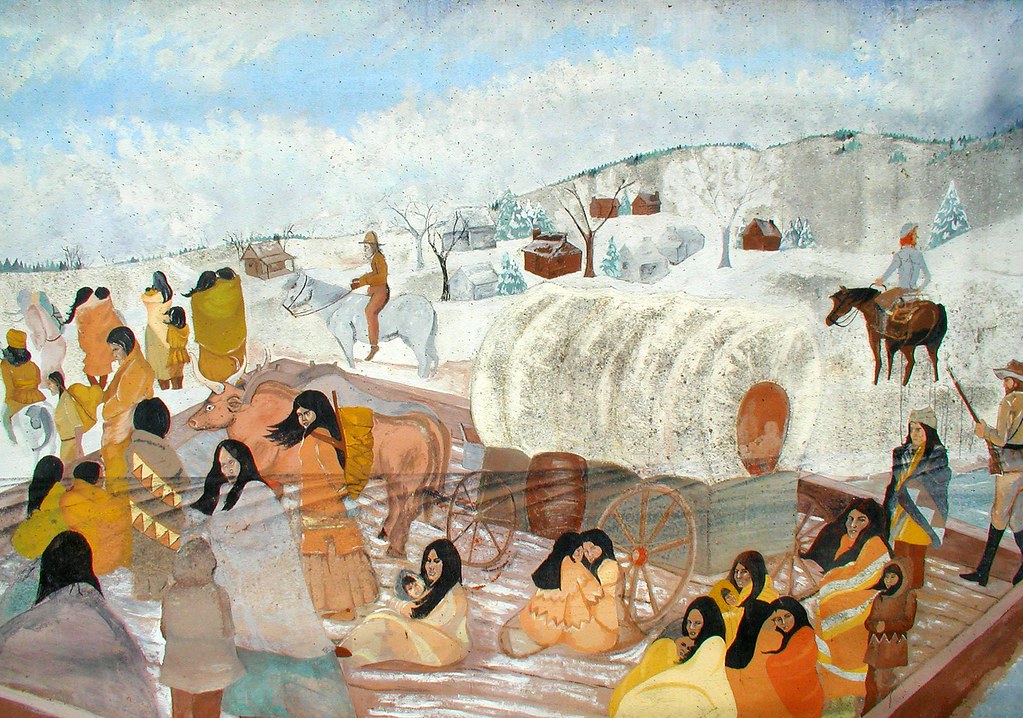
The result, by the 1840s, was one of the cruelest ironies in American history: the very tribes that adopted Washington’s civilization program most enthusiastically — the Cherokee, who created a written alphabet, published a newspaper, drafted a constitution modeled on the American one, and built prosperous farms were the ones forcibly marched on the Trail of Tears, dying by the thousands on a journey from their ancestral homeland to barren territory in what is now Oklahoma. They had done everything Washington asked. It availed them nothing.
Still, George Washington’s own words and actions provide a different portrayal than the far-left caricature and the far-right co-optation of his legacy. He was a slaveholder who privately detested slavery and freed every person he legally could at enormous cost to his estate and risk to his reputation, while prohibiting their deportation from Virginia. He was a conqueror of indigenous lands who explicitly rejected extermination in favor of a disastrously paternalistic policy of assimilation that failed because of its naïveté and the rapacity of his successors.
We should be talking about his prophetic warning about the spirit of faction, that would “become potent engines, by which cunning, ambitious, and unprincipled men will be enabled to subvert the power of the people and to usurp for themselves the reins of government.” (George Washington, Farewell Address, Sep. 17, 1796)
He was a man of profound contradictions, operating within constraints that were partly structural:
- Virginia property law
- Fragility of the constitutional union,
- Three-fifths compromise
But also, partly personal, because of
- Economic dependence on enslaved labor
- Inability to imagine a society in which racial hierarchy did not exist
- Conviction that gradual reform was safer than revolutionary confrontation.
The modern impulse to flatten this complexity into a simple verdict as hero or villain, patron saint or unforgivable sinner is not the most valid position. This makes him a man of his time who saw farther than most of his contemporaries, acted on his convictions more courageously than most of his peers, and nevertheless participated in systems of oppression whose full horror he understood but could not bring himself to destroy.
Washington’s own summary of his Native policy, written in 1795, captures the tragedy of his entire legacy:
“I am disposed to do them all the good in my power, without involving the United States in trouble or expense.” (George Washington to Thomas Jefferson, 15 March 1795)
He thought the kindest thing he could do was slow the current by turning Indians into yeoman farmers under U.S. protection. In reality the current only sped up, and the “protection” he envisioned never materialized after he left office. The result by the 1840s, was that the very tribes that adopted Washington’s civilization program most enthusiastically were the ones forcibly marched on the Trail of Tears, where tens of thousands died, and almost all remaining Indian land east of the Mississippi was taken.
The policy was disastrous not because Washington was uniquely evil, but because it was naïve, internally contradictory, and powerless against the combined forces of American demographics, greed, and state sovereignty. It promised survival through assimilation, but it delivered extinction or expulsion instead. One cannot refute that Washington waged aggressive wars to take Indian land, authorized the destruction of villages and crops, and presided over a policy that ultimately dispossessed millions of acres. That is conquest and ethnic cleansing by any honest reading. You can refute the claim that he desired or contributed to a deliberate genocide of Native Americans as a people, built on a British model of a “civilizing mission,” that differed from the Spanish-style inquisition.
He viewed enslaved people as property, expressed frustration at “ingratitude” in escapes, and prioritized control. At the same time, he privately expressed unease with slavery later in life and arranged in his will (executed after his 1799 death) to free the people he personally owned (though dower slaves followed Martha’s line, and provisions were conditional). The irony and contradiction in his legacy were that he led a revolution for liberty and neo-classical colonial republicanism while enforcing and evading laws on slavery.
George Washington left several key public writings reflecting on republicanism that maintained his emphasis in his first inaugural address on “the preservation of the sacred fire of liberty and the destiny of the republican model of government” (George Washington on the Sacred Fire of Liberty and the Republic), as staked on the American experiment, tied to private morality and civic virtue. His voluntary resignation of military power (1783) and refusal to seek a third term exemplified republican aversion to monarchy or perpetual rule, modeling the civic virtue of Cincinnatus.
He emphasized in his last writings the importance of the union, civic virtue, the dangers of faction and foreign influence, popular sovereignty, rule of law, and the responsibilities of citizens in a free government. He warned that “history and experience prove that foreign influence is one of the most baneful foes of republican government,” that the unity of Government constitutes the people as one. He advocated commercial relations with minimal political connections abroad and warned against “overgrown military establishments” as “particularly hostile to Republican Liberty.” Just as I have tried to maintain, he believed that virtue or morality was a necessary spring of popular government, and that the Constitution be “sacredly maintained,” the administration stamped with “wisdom and virtue,” and that Americans achieve happiness under liberty in a way that recommends republican government to the world.
REFERENCES AND RECOMMENDED READINGS
- The Papers of George Washington, Confederation Series, Vols. 1-6, Charlottesville: University of Virginia Press.
- The Papers of George Washington, Presidential Series, Vols. 1-21, Charlottesville: University of Virginia Press.
- The Papers of George Washington, Revolutionary War Series, Charlottesville: University of Virginia Press.
- George Washington, Farewell Address, American Daily Advertiser (Philadelphia), 19 September 1796.
- George Washington, Last Will and Testament, July 9, 1799. Fairfax County Court Records; transcribed at National Archives and mountvernon.org.
- American State Papers, Indian Affairs, Vol. 1. Washington, D.C., Gales & Seaton.
- Erin Blakemore, George Washington Used Legal Loopholes to Avoid Freeing His Slaves, 2015
- Jared Sparks, ed. The Writings of George Washington, 12 Vols. Boston: 1834-1837. Just replace the number with the volume number and use search to locate specific texts.
- Colin G. Calloway, The Indian World of George Washington: The First President, the First Americans, and the Birth of the Nation. Oxford: Oxford University Press, 2018.
- Ron Chernow, Washington: A Life. New York: Penguin Press, 2010.
- Joseph J. Ellis, His Excellency: George Washington, New York: Alfred A. Knopf, 2004.
- Fugitive Slave Laws, Encyclopedia Virginia
- François Furstenberg, “The Significance of the Trans-Appalachian Frontier in Atlantic History.” American Historical Review 113, no. 3 (2011): 647-677.
- Philip D. Morgan, “‘To Get Quit of Negroes’: George Washington and Slavery.” Journal of American Studies 39, no. 3 (2005): 403-429.
- Henry Wiencek, An Imperfect God: George Washington, His Slaves, and the Creation of America, New York: Farrar, Straus and Giroux, 2003.
 The American Minervan
Leave a comment