On Rota’s Bianchi e neri, Verdi’s Un ballo in maschera, satirical journalism, and how Italian audiences laughed at America’s pretensions to freedom.
- INTRODUCTION: THE ITALIAN INDICTMENT OF EARLY U.S. REPUBLIC — Introduction to the history and betrayal of Italian Republicanism.
- FROM THE CARBONARI TO MAZZINI — tracing the transformation from reactive conspiracy to affirmative moral philosophy grounded in Doveri dell’Uomo.
- THE CATTANEO-MAZZINI DIVERGENCE — expanded treatment of how both men condemned American slavery from different structural angles (unitary vs. federal republicanism), with Cattaneo’s surgical argument that slavery was a royalist remnant, not a federal defect.
- THE KOSSUTH CONTRAST — exploration of Kossuth’s cynical refusal to denounce slavery during his 1851-52 American tour vs. Mazzini’s unwavering moral consistency, and what that fault line revealed about European revolutionary movements.
- THE ITALIAN STAGE — on Rota’s Bianchi e neri, Verdi’s Un ballo in maschera, satirical journalism, and how Italian audiences laughed at America’s pretensions to freedom.
- GARIBALDI’S SOUTH AMERICAN REVOLUTIONS — the multi-racial, internationalist context of the Guerra Grande.
- THE TRANSATLANTIC CIRCUIT — Garrison-Mazzini parallels, Fuller’s Roman dispatches, Roberts’s research on Mazzini’s influence on John Brown, and the pathway into Black Republican political thought.
- ITALY’S DIARCHY AND FASCIST ALLIANCE DESTROYS REPUBLICAN INHERITANCE — the Rosselli assassinations, the outlawing of Masonic networks, and how the monarchist-conservative line triumphed over the Mazzinian tradition.
- NECESSITY FOR RETURN OF RADICAL REPUBLICANISM — the argument that this republicanism is foundational, not foreign, and belongs most urgently to those for whom its promise was most violently betrayed.
THE ITALIAN STATE: THEATER, SATIRE AND THE SPECTACLE OF AMERICAN HYPOCRISY
THE ITALIAN INDICTMENT OF THE AMERICAN SLAVEHOLDING REPUBLIC was not confined to the philosophical treatises of Mazzini or the analytical essays of Cattaneo. Betraying the idea of a slaveholding Republic as barbarous, it reached mass audiences through the most powerful media of the age, in the theater, the ballet, the opera house, the satirical press, and the political newspaper. In Risorgimento-era Italy, where literacy rates varied enormously but theatrical culture penetrated every social class, the stage was a political instrument of extraordinary power; and it was turned, with devastating effect, against the American pretension to republican virtue.
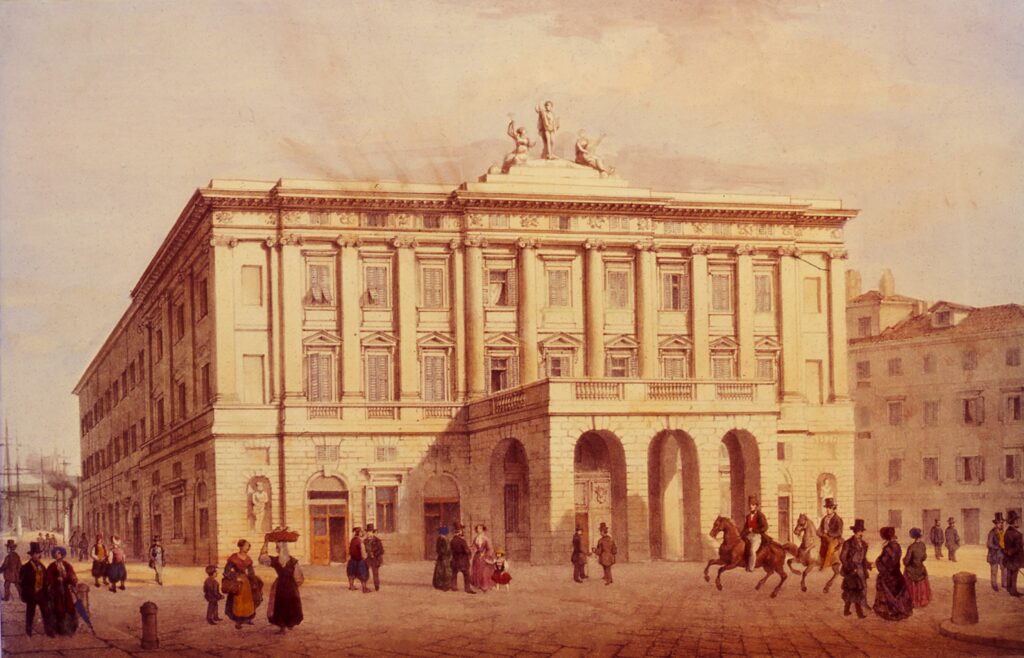
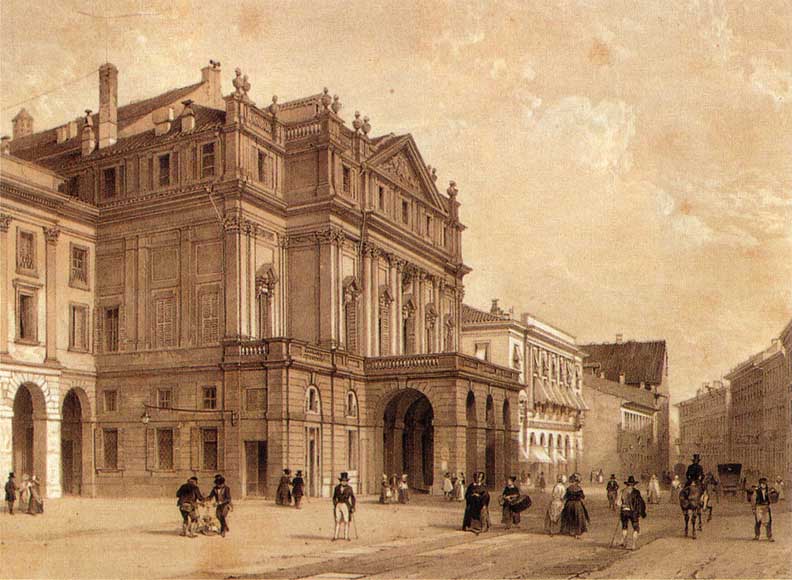
The pivotal event was the Italian reception of Harriet Beecher Stowe’s Uncle Tom’s Cabin, which arrived on the peninsula not primarily as a novel to be read but as a spectacle to be performed. In 1853, Milan’s Teatro alla Scala premiered Giuseppe Rota’s ballet Bianchi e Neri (Whites and Blacks), a free adaptation of Stowe’s novel choreographed to the music of Paolo Giorza. The ballet was not a subtle or nuanced work; it presented the dehumanizing brutality of a slaveholding society with, as Axel Körner has written, “unfailing clarity.” It was also an enormous popular success and became one of the greatest in the history of Italian ballet, performed under various titles (La Capanna di Tom in Bologna, I Bianchi e I Negri in Turin) at major theaters across the peninsula for decades.
What made Bianchi e Neri politically explosive was its context. Italian audiences of the 1850s were not passive consumers of exotic spectacle. They were a politically activated public, primed by decades of revolutionary struggle against Austrian and Bourbon domination to read every theatrical performance as a political text. When Rota staged the scene of the slave rebellion, he instructed the composer to introduce four bars of the Marseillaise into the score. The Milanese audience erupted into applause, and the Austrian police suspended the performance. It showed that the struggle of enslaved Black Americans against their oppressors was the same struggle that Italians were waging against theirs. The chains were the same chains. The slaveholder and the foreign tyrant were morally identical.
“From the very beginning, Bianchi e Neri was read politically. In the context of the ballet’s performance, America was compared to and put on equal terms with the despotism of the ancien régime, very much in contrast to the idea of a country based on Enlightenment ideals.” (Axel Körner, America in Italy: The United States in the Political Thought and Imagination of the Risorgimento, 1763-1865, p. 104)
The theatrical critique deepened as the decade progressed. Giuseppe Verdi’s Un ballo in maschera (A Masked Ball), premiered in 1859, and was set in seventeenth-century Boston. This relocation was forced by censors who objected to the original Swedish setting but one that Verdi and his librettist exploited to present American life as a theater of “exoticism, vice, and violence.” When Un ballo in maschera was performed on the same evening as Rota’s Bianchi e Neri, a programming choice that occurred at several Italian theaters, audiences received what Körner has described as “an extremely disturbing image of America, a negation of Italy’s own cultural values.” The double bill presented America as a society of moral squalor and systemic cruelty, a society that had forfeited its Enlightenment credentials through the practice of human bondage.
The Italian press amplified these theatrical critiques with a ferocity that startled American diplomats and visitors. Newspapers across the political spectrum, and Il Risorgimento, La Nazione, L’Unità Italiana, Il Diritto published editorial after editorial condemning the United States as a “false republic,” and a nation whose democratic institutions were rendered fraudulent by the institution of slavery. Italian audiences laughed at and criticized the American contradiction. The idea of a “free” America — “free for whom?” became a standing joke in Italian political discourse, a reductio ad absurdum deployed against anyone who cited the American model as an argument for or against particular Italian constitutional arrangements.
When the American Civil War erupted in 1861, Italian public engagement intensified to an extraordinary degree. Körner’s research has documented how the war became, in the Italian political imagination, as “so important to them that it almost became their own war.” (Körner, America in Italy, p. 7). This was not abstract sympathy. Italians used America as a symbolic mirror for their own political anxieties and aspirations during the Risorgimento, and audiences of the theater also understood the American war as a continuation of the same struggle they had waged, and were still waging, against the forces of aristocratic privilege, feudal hierarchy, and systematic human degradation. The abolition of slavery in America and the unification of Italy was perceived as “one single cause” — a struggle for the good of humankind as a whole. The Union’s victory was celebrated in Italian theaters and newspapers not as a foreign event but as a vindication of the universalist republican principles that Mazzini had articulated and that the Risorgimento had, however imperfectly, sought to enact.
This cultural dimension is essential to understanding the full scope of the Italian indictment. The philosophical critiques of Mazzini and Cattaneo provided the intellectual architecture. The theatrical productions and press campaigns made that architecture visible, audible, and emotionally accessible to audiences who might never read a philosophical treatise. Anti-American slavery sentiment became a feature of Italian national identity during the Risorgimento, because the Italian struggle for national liberation created a political culture in which the enslavement of any people was experienced as an affront to the principles upon which the Italian cause itself depended. To accept slavery anywhere was to undermine the moral authority of the fight against tyranny everywhere.
HALF-WAY RECAP ON REPUBLICANISM IN THE NINETEENTH-CENTURY
This series continues its argument against American conservative arguments and leftist (or far‑left) reductionist arguments about America and the history of Republican Tradition (including the word ‘republicanism‘ itself). The latter characterizes the style some theorists interpret this history and political concept, that compresses the entire, very diverse tradition of republican thought into a single explanatory frame of class domination, capitalist interests, or “bourgeois” ideology. It historicizes REPUBLICAN TRADITION through a 19ᵗʰ century Italian lens (especially Mazzini and associates), showing that sharp criticism of the U.S. government’s failures, particularly slavery and racial exclusion, can never be reduced to an essential characteristic of “radical left-wing” innovation for political tactic of a factional party but is an irrefutably legitimate defense of purer, more consistent republican principles against American hypocrisy.
Italian republicanism of the Risorgimento era and of Carbonari roots was the era’s most coherent and demanding version of republican thought. It was not merely anti-monarchical but grounded in an affirmative moral system of duties to God, Humanity, Country, Family, and Self. This made universal human dignity structural, hence a republic tolerating slavery or tyranny wasn’t imperfect, but disqualified as a republic. Rights alone were insufficient, because duty demanded active opposition to oppression anywhere. Excluding any group (e.g., the enslaved) violated the “law of life.” Mazzini even bound his compatriots to oaths in this fight. American republicanism, from this view in the young Italy by contrast, is indicted as compromised by “aristocratic, royalist remnants” (especially Southern slavery), interpreting the U.S. as a barbarous “false republic” or scandal rather than a beacon. This rigorous republicanism of the Risorgimento-era Italian model required such indictment to live up to its universalist logic. This draws on forgotten transatlantic history to argue that authentic republicanism should embrace, not fear, that critique.

 The American Minervan
Leave a comment