The Origin and Meaning of the motto “E Pluribus Unum”
In an era of deep national divisions, few phrases capture the American ideal better than E Pluribus Unum (“Out of Many, One). Adopted during the Revolutionary War, this Latin motto symbolized the fragile union of Thirteen colonies into a single republic. However, its roots run deeper, drawing from ancient Roman and Greek traditions of republican virtue, fraternity, and strength through diversity.Today, as debates rage over immigration, federalism, and national identity, understanding these classical origins reminds us why the Founders chose symbols of unity over division
INTRODUCTION
An early motto in the United States is embodied in the Latin expression E PLURIBUS UNUM, a Nation of Nations (Out of Many, we are One). The phrase “E Pluribus Unum” was suggested in 1776 by Pierre Eugène du Simitière, a Swiss-American artist and consultant, to the first committee designing the Great Seal of the United States comprising Benjamin Franklin, Thomas Jefferson, and John Adams. A similar expression appears in ancient sources, such as a variant in the poem Moretum (attributed to Virgil), describing colors blending into one (“color est e pluribus unus“), and in Cicero’s De Officiis, discussing social bonds creating unity from diversity.
As an unofficial motto of the United States, in 1956, during the Cold War era, Congress officially designated “In God We Trust” as the national motto originating from Civil War-era coinage in 1864, partly to distinguish America from atheistic Communism. “E Pluribus Unum” remains prominently featured on the Great Seal and currency, embodying its ideal.
This idea can indeed be related to philosophical and cosmological notions as a Masonic, Kabbalistic, Platonist, and Pythagorean cosmic mathematical problem about Cosmic Origins and the Divine Unity. The Latin motto can be speculated to be connected to what the French Protestant theologian Henry Corbin called, the “Paradox of Monotheism,” or resolving “the many” and “the one.”
After multiple committee revisions over six years, Charles Thomson, Secretary of the Continental Congress, finalized the Great Seal design in 1782. He explicitly explained that “E Pluribus Unum” symbolized “the union between the states and the federal government.” Congress adopted the seal on June 20, 1782, and it became the traditional, unofficial motto of the United States, reflecting the formation of one nation from thirteen colonies and later states.
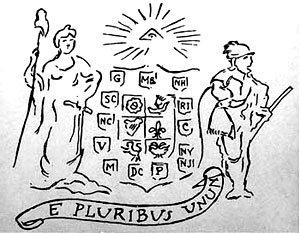
This was the first original use of the symbol that represented E PLURIBUS UNUM in an old London Magazine. Before the concept of a melting pot, the Union was likened to a bouquet of flowers. Other early depictions besides the illustration of “E Pluribus Unum” as a bouquet of flowers, representing diverse European origins uniting into one harmonious whole, include the thirteen shields. Common symbols included the rose (England), thistle (Scotland), harp (Ireland), fleur-de-lis (France), lion (Netherlands), and eagle (Germany). A thirteen-striped shield signified the states supporting Congress as the unifying chief, or a co-existing unity of the Thirteen Colonies.


The meaning given above of this illustration is directly connected to the history of many American colonial family lineage as well as of land, and the founding of cities, towns and states.

The symbolism in this illustration above is REPUBLICAN, and was a common Protestant Christian symbol for divine favor. In this depiction, the Eye of Providence (an eye in a triangle with rays) represents divine favor over the new nation, as a common Enlightenment-era Christian motif. The symbolism of the “Eye of God” in Masonic and Egyptian symbolism likewise refer to the Eye of RA (or INTELLIGENCE) or Providence as the founders might say, shining its rays of light over the Thirteen Colonies. Standing to the right is a soldier, and standing on the left is Columbia (the personification of the Thirteen Colonies) holding the Phyrgian cap of Liberty. The Phyrgian cap (on a liberty pole) symbolized freedom from tyranny, drawn from Roman republican traditions.
The symbolism of the thirteen stripes on the shield of the personification of America as Liberty is connected to this.
Thirteen stripes on the shield represent the states all joined and supporting a chief, which unites the whole and represents Congress. The six symbols of the shield as illustrated above represent the six main European Countries from which the States were peopled.
E PLURIBUS UNUM for the early United States was symbolized also alongside the FASCES. On this Dime coin from 1936, we find Mercury, God of Wisdom with the Phyrgian Cap, and on the back is displayed the Fasces (which represents the fraternal Republic). It reads alongside the Fasces correctly, e Pluribus Unum. The fasces (a bundle of rods with an axe) denoted strength through unity and magisterial authority in the Roman Republic. It appeared on U.S. coins (e.g., the 1916–1945 Mercury dime reverse) as a classical emblem of fraternal republicanism and constitutional law, long predating twentieth-century fascist appropriations. These classical elements express liberty, unity, and self-governance.

Nast, the creator of the symbolism for both the Republican and Democratic Party still used today, illustrated the meaning of this symbolism adopted long before the existence of Italian Fascism, as a symbol for Equality, Abolitionism, the Union of the States and Association of the People. It is not a symbol of authoritarian executive rule or autocratic law. In the United States, this unity or fasces is upheld by adherence to and observation of constitutional law. To break the bundle of sticks is to break the spirit of the People. Many of the symbols and their meanings intersect, as we find here.
In present-day protests in France, women protesters still utilized this symbolism by carrying a self-made fasces, donning and cosplaying togas and Phyrgian caps of the revolution.
Despite adopting “In God We Trust,” as the official motto, the classical vision endures, and only as a nation stronger together, drawing from diverse roots under shared republican virtues.
FURTHER READING NOTES
U.S. Department of State: “The Great Seal of the United States” (official booklet) and Patterson & Dougall, The Eagle and the Shield (definitive history of the Great Seal).



 The American Minervan
Leave a comment