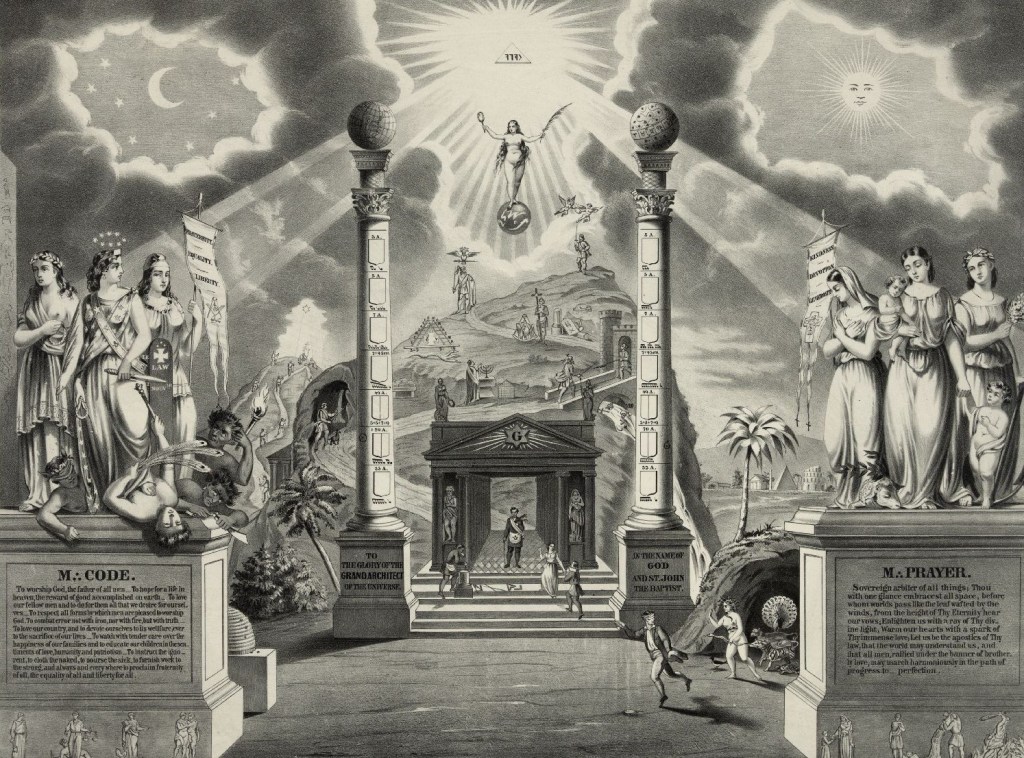
Conspiracy theorists have spent over a century cherry-picking Blavatsky to ‘prove’ she was a 33ʳᵈ degree Mason. Her own writings expose the tactic and habit of lies that cycles into the public as disinformation. Helena Blavatsky’s own words anticipate and challenge modern Illuminati, Protocols hoax and Judeo-Masonic conspiracies.
PART I: INTRODUCTORY VIEWS ON WESTERN MASONRY, MODERN TEMPLARISM, JESUIT INSTIGATION AND RIVALRY, Political SOCIALISM and her Vision of Ethical Reform
THEOSOPHISTS HAVE BEEN SLANDERED BY PERSONS of right and left political persuasion who dabble in conspiracy theorizing, each accusing the other political side (sometimes both) of being at the helm of world events. In this case, we find common accusations hurled, that this article destroys with no fault. The old conspiracy, that RU/UKR Buddhist and Theosophist Helena Blavatsky was a political socialist, that Theosophy leads to Bellamy-style utopian socialism, and that Helena Blavatsky was a 33ʳᵈ degree Mason. Dabblers in conspiracy theory, along with the speculative masses to whom these conspiracy theories were fed for years by Christians and persons of various religio-philosophical and political persuasion. This conspiracy, which is not rooted in any fact, was devised to imply Blavatsky and the Theosophical Movement — a “philosophico-religious Society” (HPB’s Scrapbook, Vol. 1, 36; Blavatsky Collected Writings Vol. 1, 90), was part of a “Luciferian” or world-controlling Judeo-Masonic cabal.
Edward Bellamy’s ideas have been misrepresented. Blavatsky applauds the work of Bellamy and his ideal of the organization of society, who called his idea ‘Nationalism’ of the Mazzinian spirit, promoting the idea of universal brotherhood or fraternity. It is true that early members of the Nationalist Clubs were also members of the Theosophical Society and involved in its activities, but this is misunderstood. Theosophy is seen as the foundation of all movements working towards the great amelioration and true fraternity of humanity — ideas no less expressed since the Catholic Church’s encyclical reactions to the early emergence of Socialism in Europe. Those who followed after Bellamy’s ideas envisioned a spiritual ideal of Socialism that required a great moral and mental stamina.
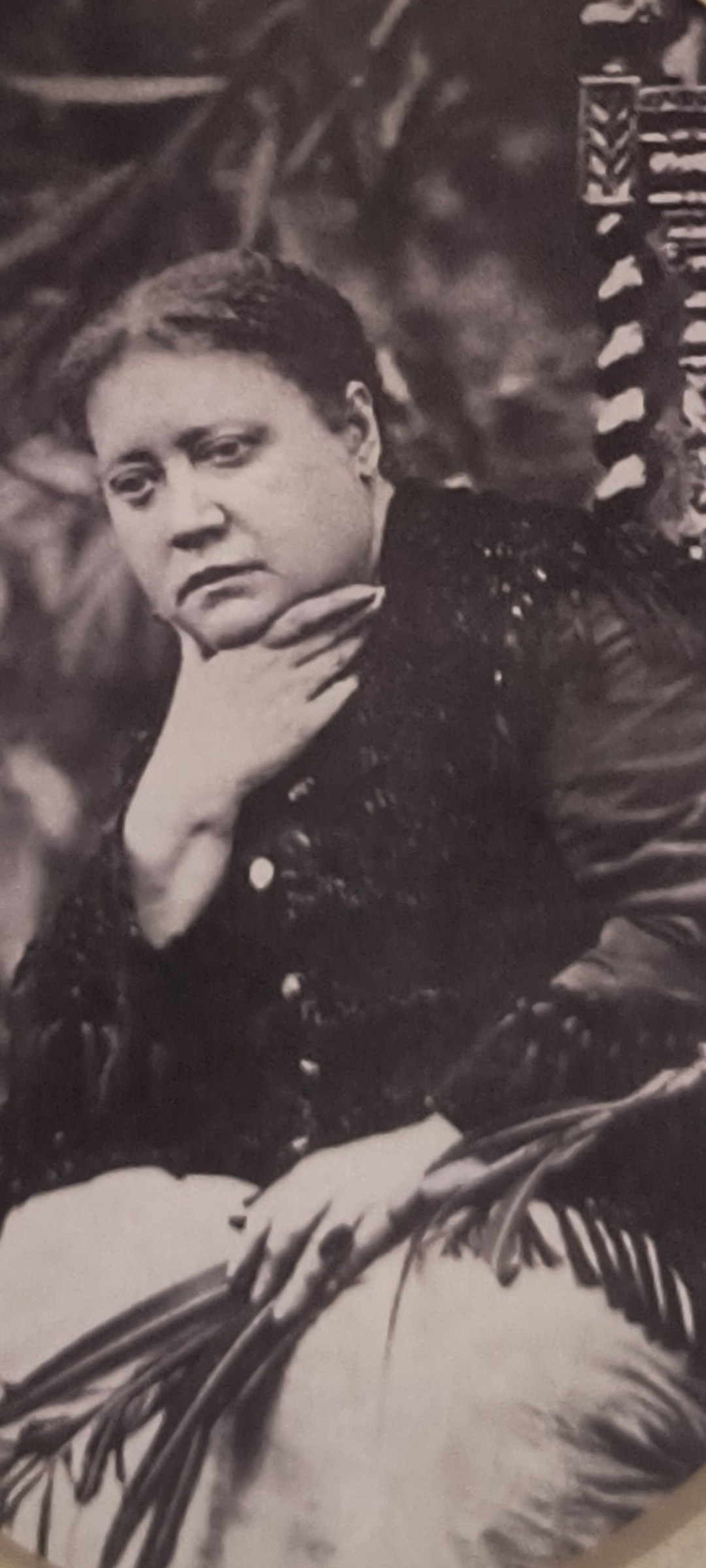
Anti-Masons misuse public knowledge of Occult Philosophy to distort it and argue, that high initiates of Freemasonry worship Lucifer as Light, which came from deliberate parsing and misrepresentation of Albert Pike’s line on Lucifer in Morals and Dogma. The metaphysical and scientific dialogue on the origin and nature of Light in this conversation goes beyond any equating to mythical elements in the Bible that conspiracies engage in. Such individuals will occasionally even use persons claiming to be former “high initiates” of Freemasonry who reveal blood ritualism, abuse, sexual perversion, blackmail and criminality behind lodge activities to fit their worldview.
First thing is, Blavatsky was not a political socialist; secondly, Theosophy does not lead to utopian socialism; and thirdly, Helena Blavatsky was not a 33ʳᵈ degree Mason, or associated with regular Freemasonry, as understood in the Western sense. Edward Bellamy, a Christian socialist had been falsely tied to Theosophy by a researcher under the name of Rex Curry, who fails to accurately detail that simply some members of his leagues were adherents of Theosophy. The facts pertaining to all this annihilates these three myths but also annihilates the Judeo-Masonic-Illuminati myth and challenges the underlying Christian polemical attack. If you have read from any author, or believed Helena Petrovna Blavatsky was a 33ʳᵈ degree Mason, a socialist, or part of any Western secret society plotting world control, you have been lied to by people who never read her 1878 letter addressing this issue or her actual views about Western materialism, Jesuits, Freemasonry and anti-Masonic conspiracism, the Rosicrucians, the Jewish Kabbalah, the roots of Templarism, American and European politics, Masonry’s true origins, the roots Church ritualism, and her refutation of Barruel’s Mémoires (1797) Illuminati conspiracy.
Blavatsky never endorsed — and in fact dismantled the very premises that later conspiracy literature rests upon, from Barruel to Robison to the fabrication of the Protocols to the ever-evolving modern Illuminati-Masonic-Jewish theories. Blavatsky’s analysis is scholarly, historical, and esoteric, rather than political and paranoid.
H.P. Blavatsky explicitly rejected regular membership in Western Masonry, rejected capitalist exploitation, socialism and communism, and identified Theosophy with the wisdom of the “Masters of the Orient” rather than with any modern secret society.
MASON JOHN YARKER ON HELENA BLAVATSKY’S MASONIC PATENT
Charles Sotheran put before her an honorary diploma (Patent) from John Yarker of the English Sovereign Sanctuary of the Ancient and Primitive Rite of Memphis-Misraim (often called the “Oriental” or “Egyptian” Rite), an achievement given in honor of her life’s work and service.
The circumstances under which H.P.B. received her Masonic Patent are described as follows by John Yarker who issued it:
“In the year 1872 I printed, at my own cost, a small book entitled, Notes on the Scientific and Religious Mysteries of Antiquity; the Gnosis and Secret Schools of the Middle Ages; Modern Rosicrucianism; and the various Rites and Degrees of Free and Accepted Masonry. At this time, I was Grand Master of the Ancient and Primitive Rite of Memphis, 95°; and before that of the combined Scottish Rite of 33°, and Mizraim of 90°; and among our initiates, 32°-94°, was Brother Charles Sotheran who left England and settled at New York. This brother lent a copy of the book just named to Madame Blavatsky, and she was good enough to refer to it in her Isis Unveiled, with some complimentary remarks . . .
“However, at the request of Bro. Sotheran I sent Madame Blavatsky the certificate of the female branch of the Sat Bhai (Seven Brothers, or seven birds of a species, which always fly by sevens); it was a system organized at Benares in India by the Pundit of the 43rd Rifles, and brought to England by Major J. H. Lawrence-Archer, 32°-94°. This led to a letter from Col. H. S. Olcott, setting forth the very superior qualities of Madame to the certificate sent, and vouching that she was proficient in all masonic sciences. On the 20th of August, 1877, the, then newly established Theosophical Society of New York sent me by the hands of Col. Cobb a certificate of Honorary membership accompanied by a pretty gold Jewel of the Crux Ansata of Egypt entwined with a serpent in green enamel.
“Both the Rites of Memphis and Mizraim as well as the Grand Orient of France possessed a branch of Adoptive Masonry, popular in France in the eighteenth and nineteenth centuries, and of which, in later years, the Duchess of Bourbon held the rank of Grand Mistress. We accordingly sent H.P.B. on the 24th of November, 1877, a certificate of the highest rank, that of a Crowned Princess 12°, said to have been instituted at Saxe, in the last quarter of the eighteenth century. The publication of this certificate led to newspaper questions and attack. The Franklin Register of 1st of February, 1878, contained an article by Bro. Leon Hynemann vouching for the reality of my signature, and another by Bro. Charles Sotheran who vouched for the possession by H.P.B. of Masonic initiation, and this was followed the next week (8th of February) by a slashing article from the pen of Madame herself against her calumniators. . . .” (Universal Masonry, Vol. 1, No. 4, October, 1910)
IN HER OWN WORDS, HELENA BLAVATSKY WAS NEVER A 33ʳᵈ MASON
Blavatsky herself directly addressed and refuted the Masonic claim against her in a public letter published in the Franklin Register and Norfolk County Journal (8 February 1878).
Blavatsky wrote:
“If you will kindly refer to my Isis Unveiled (Vol. II, p. 394), you will find me saying: “We are under neither promise, obligation, nor oath, and therefore violate no confidence”-reference being made to Western Masonry, to the criticism of which the chapter is devoted; and full assurance is given that I have never taken “the regular degrees” in any Western Masonic Lodge. Of course, therefore, having taken no such degree, I am not a thirty-third degree Mason. In a private note, also in your most recent editorial, you state that you find yourself taken to task by various Masons, among them one who has taken thirty-three degrees-which include the “Ineffable”-for what you said about me. My Masonic experience—if you will so term membership in several Eastern Masonic Fraternities and Esoteric Brotherhoods—is confined to the Orient. But, nevertheless, this neither prevents my knowing, in common with all Eastern “Masons,” everything connected with Western Masonry (including the numberless humbugs that have been imposed upon the Craft during the last half century) nor, since the receipt of the diploma from the “Sovereign Grand Master,” of which you publish the text, my being entitled to call myself a Mason.”
“That an American Rite, thus spuriously organized, declines to acknowledge the Patent of an English Sovereign Sanctuary, duly recognized by the Grand Orient of France, does not at all invalidate my claim to Masonic honours. As well might Protestants refuse to call the Dominicans Christians, because the Protestants broke away from the Catholic Church and set up for themselves, as for A. and A. Masons of America to deny the validity of a Patent from an English A. and P. Rite body. Though I have nothing to do with American modern Masonry, and do not expect to have, yet, feeling highly honoured by the distinction conferred upon me by Brother Yarker, I mean to stand for my chartered rights, and to recognize no other authority than that of the high Masons of England, who have pleased to send me this unsolicited and unexpected testimonial of their approval of my humble labours.” (Franklin Register and Norfolk County Journal, Franklin, Mass., February 8, 1878)
Thus, she accepted the honorary diploma but rejected any affiliation with American or European (“modern”) Masonry. This defense can also be read in The Author of Isis Unveiled defends the Validity of her Masonic Patent.
In A Signal of Danger (1889), Blavatsky says that “As far as we are concerned, disciples of the Masters of the Orient as we are, we have nothing to do with modern Masonry.” However, there were many Masons that read and were genuinely interested in her works.
Eastern Masons of the Orient vs. American and European Masonry
The “Eastern Masons of the Orient” vs. “American and European Masonry” is a qualitative distinction she repeatedly elaborated upon that is relevant. The “Eastern Masons” are the living initiatory lineages and esoteric brotherhoods (Coptic, Druze, Sufi-influenced and other Oriental fraternities) that preserved the primeval Mystery-tradition and were in contact with the same adepts who inspired Theosophy. These are ancient, mainly non-political, wisdom-preserving bodies in the middle of climatic geopolitical changes1. “Modern” (i.e., Western, American, European) Masonry by contrast, is a 17ᵗʰ-19ᵗʰ century revival that she regarded as largely exoteric, politically compromised and riddled with materialists and “numberless humbugs” of the West she called them. Western Masonry had lost the inner light while retaining the outer forms, and the Masons interested in her writings were eager to restore it. Theosophists, as “disciples of the Masters of the Orient,” had “nothing to do” with the latter.
Two men, Charles Sotheran and James Sanua, in their different ways, validated Blavatsky’s distinction: Sotheran from the Western Masonic side (granting her the honor), and Sanua who embodied the authentic Oriental current she claimed as her own.
James Sanua (Ya‘qūb Ṣanū‘) was an Egyptian-Jewish playwright, journalist and Oriental Mason initiated in Egyptian lodges with strong Islamic and esoteric syncretism. He exemplifies the “Eastern Masons of the Orient” Blavatsky praised. Sanua moved in the same Cairo esoteric circles Blavatsky knew in the 1870s, and he was a close associate of Jamāl al-Dīn al-Afghānī, a Muslim reformist who was involved in Freemasonry, but for a political reason, and perhaps is the reason Blavatsky does not mention him. Sanua’s Masonry was not the “modern Western” variety but the living, knowledge-based, multi-confessional Oriental current that Blavatsky contrasted with European and American Masonry. While no single letter from Sanua to Blavatsky survives in the public record, his life and Masonic affiliation were cited by later esoteric historians on nineteenth-century Egyptian esotericism as the living proof of the “Eastern Masonic Fraternities” she referenced (see De Poli, Freemasonry and the Orient, 2019).
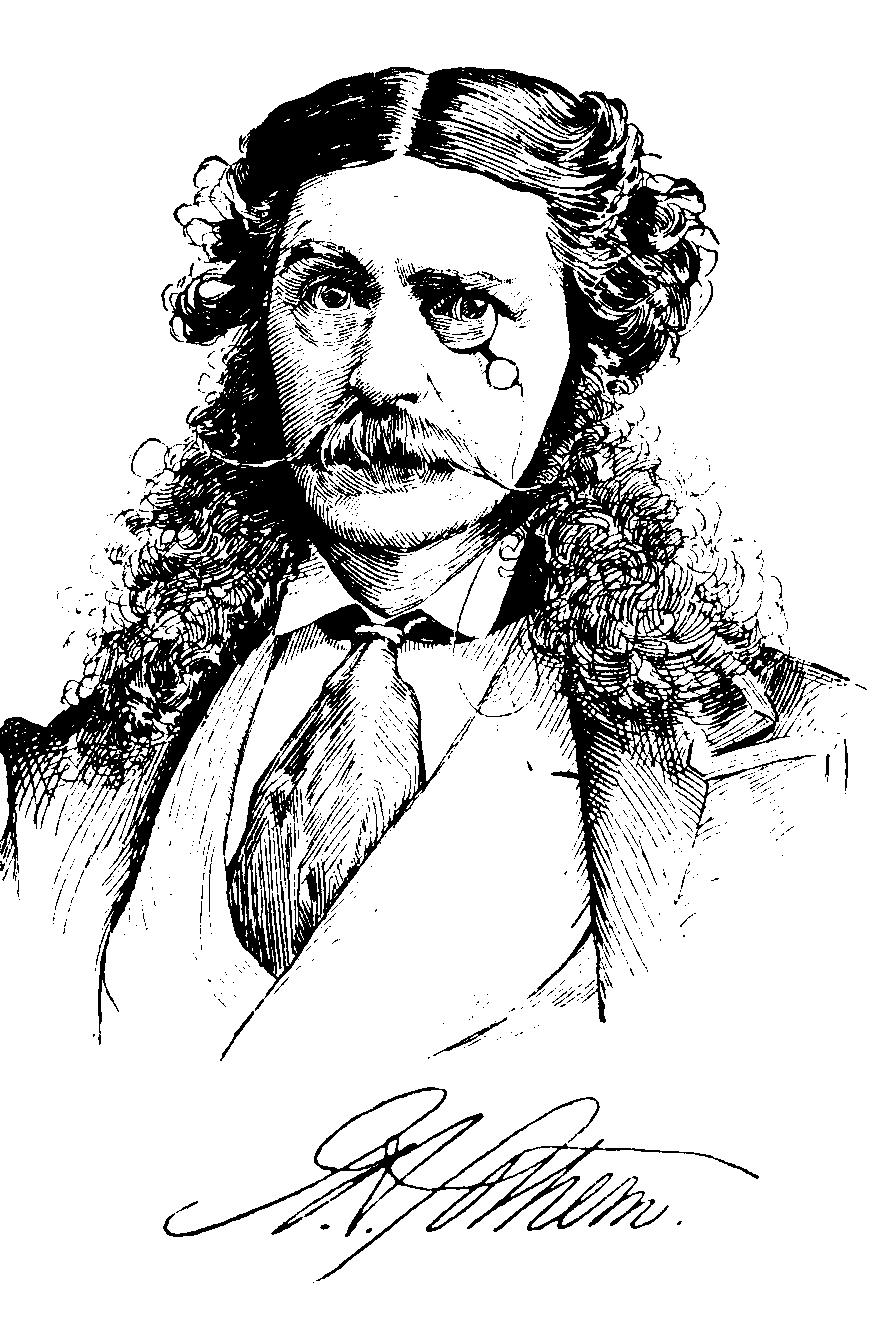
Charles Sotheran was a high-ranking American Mason, 33ʳᵈ degree and early former in the Theosophical Society’s history who resigned, and then later begged on his knees to Blavatsky (In H.P.B.’s Scrapbook, Vol. I, p. 112) to be permitted back. Sotheran saw Blavatsky as fully entitled to Masonic honors on the strength of her Oriental knowledge and her labors in Isis Unveiled.
TRUE ORIGINS OF Masonry IS NOT a Jewish or Satanic Plot
The attitude of established Christian powers, in particular the Catholic Church against modern Theosophy is established in the normative narrative towards Gnosticism, which is founded on lies that sustained the long two millennial reign of Christianity in the West. However, contrary to this narrative, Masonry was, in its origin, simply archaic Gnosticism, or early esoteric Christianity; and Church Ritualism was, and is, exoteric paganism, pure and simple. Both descend in direct line from initiated Gnostics, Neo-Platonists, and renegade Hierophants, but Masonry preserved the esoteric current while the Church externalized the exoteric pagan rites2.
Truth is, there is no “Satanic” or “Luciferian” inner doctrine in true (primitive) Masonry, for it is a survival of the ancient Mystery Schools. All “devil-worship” accusations towards Occult Philosophy are the product of Christian militant and fundamentalist misunderstanding of symbolic light, fire and sun-god language that actually points to the divine spark in every human being, which I have endeavored to explain as of late.
Blavatsky however does criticize certain branches of modern Masonry. These problems, according to her in her time, stems from Jesuit infiltration and political corruption of Freemasonry, not from any ancient “Jewish-Masonic plot.” She wrote a whole section titled “Jesuitry in Masonry” arguing how the Society of Jesus deliberately introduced ritualistic and political elements to control or mimic the Craft. Modern Masonic Templarism, not its original, was deliberately fabricated by Jesuits in the College of Clermont (Paris, 1735-1740) to infiltrate and control the Craft.
Although, other reasons are given for the degeneration of the craft by John Yarker, who became Master Mason at the age of just 21. Blavatsky quotes him explaining that Western Masonry has lost its inner spiritual purpose and become hollow focused on socializing, status, and superficial display rather than genuine esoteric or moral work. He argues that without reconnecting to its deeper, ancient, initiatory roots, the institution is essentially “a corpse without a soul.” He warned that Freemasonry had become a social club for people who enjoy fine dining and leisure rather than serious study or self‑improvement, and persons obsessed with regalia, titles and ornamentation instead of philosophical substance, i.e., materialism.
“Without such a union Western Masonry is a corpse without a soul. As Yarker observes, in his Notes on the Scientific and Religious Mysteries of Antiquity [p. 157]:
“. . . As the Masonic fraternity is now governed, the Craft is fast becoming the paradise of the bon vivant . . . the manufacturer of paltry masonic tinsel . . . and the masonic ‘Emperor’ and other charlatans who make power or money out of the aristocratic pretensions which they have tacked on to our institutions—ad captandum vulgus . . .” (Blavatsky quoting Yarker, The Author of Isis Unveiled defends the Validity of her Masonic Patent)
INSTIGATION OBSTRUCTING THE SPREAD OF THE TRUE WISDOM
From Blavatsky’s perspective, the entire edifice of the anti-Masonic-Illuminati-Judeo-Masonic panic is a red herring that distracts from the real battle: the recovery of ancient esoteric wisdom versus the forces of materialism and exoteric dogmatism (whether clerical or political). Unfortunately, the masses are greatly in number fooled to side with the latter and view the former as enemies of humanity, even as those institutions they trust are publicly and constantly engaged in deceit, perversion, spiritual fraud, crimes and exploitation of primitive fears.
The entire history of secret societies in the Mysteries was implicated in a grand conspiracy, that distinguishes no one, except all those named versus the particular religion or sect of the instigator or fabricator. This has nothing to do with the Kabbalah or its origins, and her references to Jewish Kabbalah treat it as universal ancient esotericism shared with Hindus, Egyptians, etc. Blavatsky did however reject the concept of chosen people in any manner of interpretation and argued that the claim of lost tribes was an invention.
As to the Bavarian Illuminati, it was a tiny, short-lived anti-clerical club that dissolved decades before Barruel invented his conspiratorial claims. Any later “Illuminati” can only be interpreted as either symbolic in relation to the Eastern Masters and ancient Magi or is a hijacked label. The masses associate the term with political, financial and business elite class who engage in antinomianism, sexual perversity, human trafficking, blackmail, death-threats, war and criminality. This is an inversion, that masses of people refuse to correct, and has crushed their spirit or entrenched them in their eschatological religious beliefs being wielded as a political tool, not by cabals, but by corrupt public political figures before them, openly.
THE GOLDEN ETHICAL REFORM: BLAVATSKY ON SOCIALISM, COMMUNISM AND PRACTICAL ALTRUISM
It was said that Engels did not like the Theosophists and Spiritualists, and although Marx and Blavatsky were contemporaries of their time, they never met. Marx hated Mazzini, while H.P.B. was acquainted with Mazzini and Garibaldi. Her path mirrors Mazzini’s early and later development in his thought on Socialism. Blavatsky sometimes said unflattering things about Socialists, Communists, and predecessors of the Bolsheviks. When the Soviets took over Russia, Theosophy was banned until its fall in a process between 1990-91. In her motherland, the Russian Empire, she made observations of changes that were occurring she felt unsettled by, although she also criticized the Tsar and the Romanovs for neglecting the peasants in her letters. However, this had everything to do with her principles she believed in, rather than a political ideology.
The heart of her fight is against the materialism of modernity (secular, religious, social or economic) and the zombification or dulling of the spiritual, divine nature in man.
As Girard stated in this vein:
“In at most a few decades, we’ll have transformed man [through anti-religious humanism] into a repugnant little pleasure-machine, forever liberated from pain and even from death, which is to say from everything that, paradoxically, encourages us to pursue any sort of noble human aim, and not only religious transcendence.”
René Girard
Blavatsky believed that a spiritual, ethical, psychological revolution was needed and thought that political reforms before this could not fundamentally change humanity. She thought the Communists would make things worse.
“To seek to achieve political reforms before we have effected a reform in human nature, is like putting new wine in old bottles. (…) No lasting political reform can be ever achieved with the same selfish men at the head of affairs as of old.” (Blavatsky, The Key to Theosophy, p. 231)
In the first instance Sotheran was kicked out, because he wrote an argument or uncomplimentary remarks toward H.P.B., and he resigned upon being harshly criticized because of political wrangling and unethical ideas after declaring himself a labour Socialist and involving himself in a violent strike (In H.P.B.’s Scrapbook, Vol. VII, p. 258).
“A Theosophist becoming a rioter, encouraging revolution and MURDER, a friend of Communists is no fit member of our Society. HE HAS TO GO.”
The communist believes that this must be achieved by physically overthrowing the selfish men at the head of affairs, and she warns this disguises a will to power, that contributes to the cycle of suffering by giving rise to a new despotic order.
Her views, especially as a Buddhist, is expressed in the Dhammapada (Chapter I, verses 3-5):
“He abused me, he beat me, he defeated me, he robbed me,”–in those who harbour such thoughts hatred will never cease.
“He abused me, he beat me, he defeated me, he robbed me,”–in those who do not harbour such thoughts hatred will cease.
For hatred does not cease by hatred at any time: hatred ceases by love, this is an old rule. (The Dhammapada from The Sacred Books of the East, translated by Various Oriental Scholars. Edited by F. Max Muller, Volume X: Part I)
Therefore, she called Socialism and Communism disguised conspiracies of brutal force against honest labor, though she tolerated an individual’s preference or private belief. Blavatsky believed in, according to her, a nobler and higher ideal of Socialism as a form of practical altruism, strongly firm in the ethics of Jesus and Siddhartha in The Key to Theosophy (Blavatsky, pp. 79-80).
Blavatsky turns the words against her used by her modern slanderers when saying boldly!
“Neither the true Christianity of Jesus – the great Socialist and Adept, the divine man who was changed into an anthropomorphic god – nor the sciences . . . nor the philosophies of today . . . will allow the Occident to attain its full efflorescence if it turns its back upon the ancient wisdom of bygone centuries. . .As long as intellectual progress will refuse to accept a subordinate position to ethical progress, and egotism will not give way to the Altruism preached by Gautama and the true historical Jesus (the Jesus of the pagan sanctuary, not the Christ of the Churches), happiness for all the members of humanity will remain a Utopia.” (Theosophy: Some Rare Perspectives, pp. 8-9)
The manner in which she uses the term Socialism is separated from any political or economic theory but is a reference to the essence of fraternity (or solidarity) and human dignity. She believed that a social revolution could be brought about, but that it must not occur by violent means of force or domination.
“The “happiness” you speak of will not come as long as moral progress slumbers in inactivity, paralyzed by the ferocious egotism of everybody, the rich as well as the poor (…) false fraternity (…) says to his fellow man, “Think as I do, or I will knock you down; be my brother, or I will run you down!”
“The Theosophical “missionaries” aim also at a social revolution. But it is a wholly ethical revolution. It will come about when the disinherited masses understand that happiness is in their own hands, that wealth brings nothing but worries, that he is happy who works for others, for those others work for him, and when the rich realize that their felicity depends upon that of their brothers – whatever their race or religion – then only will the world see the dawn of happiness.” (Blavatsky, Misconceptions, Theosophy: Some Rare Perspectives, p. 19-20)
DE-CENTERING ABRAHAMIC RELIGIONS
These facts alone constitute the 33ʳᵈ degree myth about Blavatsky as now dead. However, the bigger conspiracy edifice of the Illuminati panic, Templar-Masonic connection first invented by Abbé Augustin Barruel (a Jesuit priest) and the Judeo-Masonic conspiracy of the Protocols3 still needs burying. That is what the next part will counter with her own words and belief on Jesuit infiltration and the secondary, distorted role of Jewish Kabbalah. It will also, at its basis, go into the nature of the Sod (סוד, the esoteric “secret” or Mysteries) of the Jews as secondary transmitters, not originators or custodians of the primeval Secret Doctrine. Although, the Jews are late, secondary transmitters, not originators, who adapted, limited, and exoterized fragments of this knowledge, their Sodalites and Rabbins produced a noble esoteric current (Kabbalah) alongside a degraded, tribal exoteric religion centered on a national tutelary deity based upon and subsuming the qualities of the gods of Mesopotamia through erasure, omission and constant revision.
EXPLOITATION OF AMERICAN AND EUROPEAN CONSPIRATORIAL PARANOIA
Americans seem to be very ignorant when it comes to this history, since without the republican networks in this history, you would still be under a monarchy. Hardened, when presented with the facts, people refuse to correct their position, because their positions are too tied into certain Christian views of eschatological prophecy and who they are told are the enemies in a narrative that centers Christianity in the story of humanity, which Theosophy does not. In Barruel’s 1797 Mémoires pour servir à l’histoire du Jacobinisme, the Illuminati conspiracy begins as anti-revolutionary propaganda.
It is because Barruel was a Jesuit priest, that Blavatsky grounds her thesis on the fact that the entire conspiracy edifice rests on Jesuit-orchestrated scaremongering that is self-serving fiction for political theater and control of mass opinion.
“The greater part of the population is not very intelligent, dreads responsibility, and desires nothing better than to be told what to do. Provided the rulers do not interfere with its material comforts and its cherished beliefs, it is perfectly happy to let itself be ruled.”
ALDOUS HUXLEY
The real danger to humanity is the invention of and attachment to ecclesiastical rites, materialism and dogmatic orthodox Religion suppressing esoteric knowledge and instigating. This article is meant to antagonize Christianity, because its place, as well as Judaism and Islam in the entire human story are not told truthfully and has been designed to obscure the historical facts.
The American has been within this history conditioned through a bewildering series of conspiracies to fight against their own form of government and fight for clerical, traditionalist, messianic, monarchic and theocratic (Christocratic) visions4 of exploiters in our government, which it was explicitly founded against through REPUBLICANISM — a vital key to its regeneration. Even if this country were to collapse and fall into the wrong hands, REPUBLICANISM would still be its ultimate means for regeneration, so it is important to understand it. To understand it, one must be willing to challenge the whole edifice of the generally anti-gnostical conspiratorial narrative and attitude, because humanity both elite and the vulnerable appear lost in a fog of spiritual darkness and bewilderment, repeating old errors.
FOOTNOTES
- see Political Operations in Cairo and Cyprus: Meeting Hilarion and Ooton Liatto. ↩︎
- See Blavatsky’s Roots of Ritualism and Isis Unveiled, Vol. II. ↩︎
- For now, read Maurice Joly: Origins of the Protocols of Zion and its Impact on Theosophy. ↩︎
- See Christian nationalist congressman Rep. Andy Ogles post using Templar imagery. These are spiritual pretenders with no knowledge. ↩︎
—
[This article has been heavily revised, 3-24-2026. Formerly titled “Was Blavatsky a 33° Degree Mason”]
 The American Minervan
Leave a comment