
MAZZINI’S DIVINE IDEAL: DIO E POPOLE
FROM CARNONARO TO PROPHET
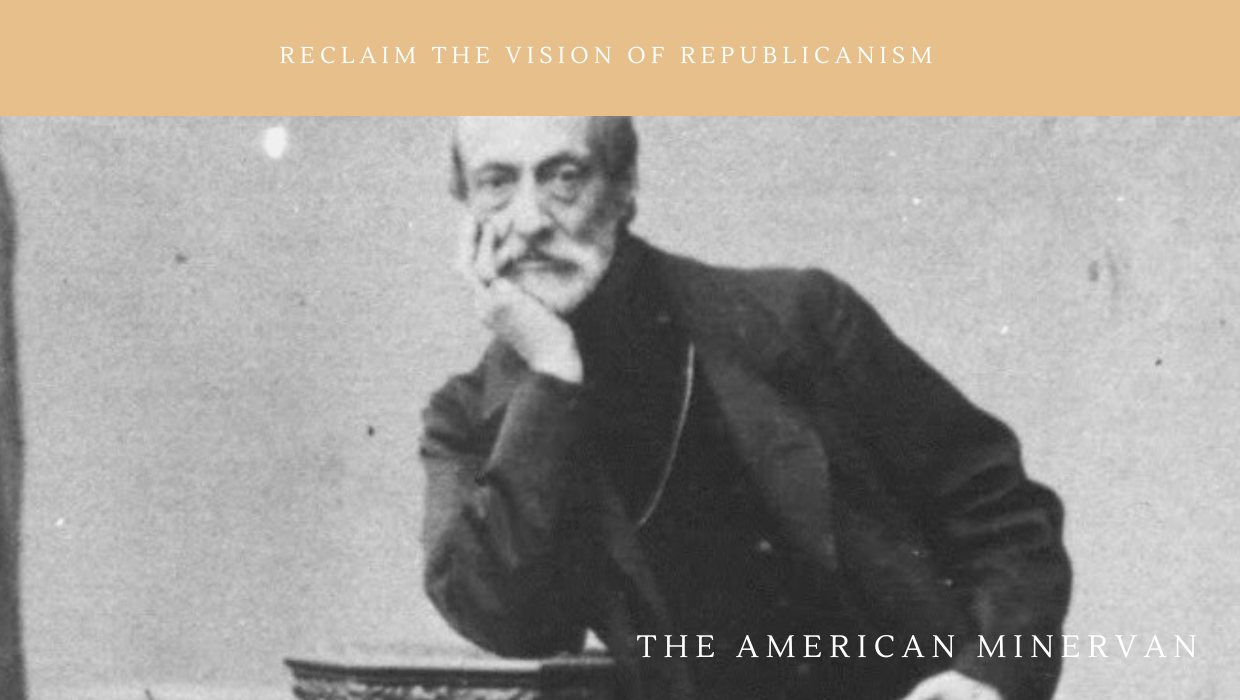
Giuseppe Mazzini was born in Genoa in 1805, into a family of the educated professional class — his father a physician and university professor, his mother a woman of deep religious conviction. Genoa, formerly an independent republic before its annexation to the Kingdom of Sardinia-Piedmont, nurtured in the young Mazzini both a republican sensibility and an acute awareness of national subjection. He studied law at the University of Genoa but was drawn irresistibly toward political activism. Around 1827, he joined the Carbonari; by 1830, he had been arrested, interrogated, and — upon his release — forced into exile. It was a transformative experience. Mazzini concluded that the Carbonari’s failures stemmed not merely from organizational deficiencies but from a fundamental absence of moral and philosophical coherence. The movement needed not better conspiracies but a new faith.
In 1831, from his exile in Marseille, Mazzini founded Giovine Italia (Young Italy), which was basically an organization that was at once a political party, a revolutionary network, and a vehicle for moral education.
Its motto was that of Mazzini: “God and the People.”
Its aim was the unification of Italy as a democratic republic achieved through popular insurrection and the moral awakening of the masses. Young Italy was explicitly republican where the Carbonari had been ambiguous; it was openly national where the Carbonari had been regional; and it was grounded in a systematic philosophy where the Carbonari had offered only ad hoc grievances.
THE DIVINE IDEAL: REPUBLICANISM AS MORAL NECESSITY
Mazzini’s philosophy, elaborated across decades of prolific writing, and most systematically in I doveri dell’uomo (The Duties of Man, 1860) and in the manifestos and journals of Young Italy, constituting a remarkable synthesis of political theory, moral philosophy and civil theology. At its heart lay a single, radical conviction: that republican self-governance was not merely a superior political arrangement but a moral and logical necessity, ordained by the divine structure of the universe itself.
“Neither pope nor king — only God and the people.”— Giuseppe Mazzini
This formula embodied Mazzini’s entire worldview. DIO, in Mazzini’s understanding, was not the distant clockmaker of the Deists nor the jealous sovereign of orthodox theology, but the immanent source of a moral law progressively revealed through human history. That moral law directed humanity toward ever-greater association, solidarity and self-governance. Every human being carried within them a spark of the divine, a capacity for moral discernment, a sense of duty and a longing for justice that could be realized only through free participation in collective self-rule. Monarchy, by its very nature, contradicted this divine plan. It substituted the hereditary accident of birth for the sovereign moral will of the people; it reduced citizens to subjects; it interposed between God and humanity a merely human intermediary who claimed divine sanction for worldly power. The republic, and the republic alone, aligned political organization with the moral order of the universe.

DUTY OVER RIGHTS
Mazzini’s greatest originality, and the feature that most sharply distinguished his thought from the mainstream of liberal political philosophy lay in his insistence that the foundation of political life was duty, not rights. The French Revolution had proclaimed the rights of man. Sure, Mazzini acknowledged rights but subordinated them to a prior and higher principle. Rights, he argued, were individual and potentially selfish. They could degenerate into mere claims for personal advantage. Duty, by contrast, was inherently social, moral and sacrificial. It bound the individual to purposes greater than the self: duty to God, the source of moral law; duty to Humanity, the great family of nations progressing toward universal brotherhood; duty to the Fatherland, the divinely appointed instrument of each people’s contribution to human progress; duty to the Family, the school of domestic virtue and the foundation of civic life.
“We must convince men that they are all sons of one sole God, and bound to fulfil and execute one sole law here on earth :— that each of them is bound to five, not for himself, but for others : — that the aim of existence is not to be more or less happy, but to make themselves and others more virtuous :— that to struggle against injustice and error, wherever they exist, in the name and for the benefit of their brothers, is not only a right, but a Duty :— a duty which may not be neglected without sin :— the duty of their whole life.” (Giuseppe Mazzini, The Duties of Man, 1835, p. 18)
A republic, in Mazzini’s vision, was the only political form that could cultivate this ethic of duty. Only where citizens governed themselves through universal suffrage, free association, and collective deliberation could the virtues of sacrifice, brotherhood, and social justice flourish. Monarchy, whether absolute or constitutional, fostered passivity, obedience, and the habits of servitude. The constitutional monarchy favored by moderate liberals was, in Mazzini’s view, merely a transitional compromise that preserved monarchical privilege, aristocratic distinction, and the sovereign’s prerogative to make war, all fundamentally incompatible with genuine democracy and popular sovereignty.
THE “HEREDITARY LIE” AND CRITIQUE OF MONARCHY
Mazzini’s critique of monarchy was unsparing. He regarded hereditary kingship as a “hereditary lie” — a system that clothed arbitrary power in the garments of tradition and sanctity. The doctrine of divine right, by which kings claimed to rule as God’s anointed, was for Mazzini a blasphemous usurpation: it transferred to a single family a sovereignty that belonged by divine intention to the entire people. Monarchy was not merely unjust; it was irrational and immoral, a relic of humanity’s political infancy that the progress of civilization must inevitably supersede.
“Countries of kings and privileged castes must give way to countries defined by the vote of free men.”— Giuseppe Mazzini
Mazzini extended this critique even to constitutional monarchy, which he regarded as an unstable halfway house between despotism and democracy. The monarch, however constrained by a constitution, retained prerogatives with command of the army, the power to dissolve parliament, influence over ministerial appointments that perpetuated inequality and frustrated the sovereign will of the nation. True democracy required the abolition of monarchy altogether and its replacement by a republic founded upon universal suffrage, civic education, and the ethic of duty.
THE NATION AS DIVINE GIFT

The environment in which Mazzini was born was characterized by great moral rigorism, with his early education entrusted to two Jansenist abbots, and this attitude thoroughly imbues his civic theology. Central to Mazzini’s thought was a concept of nationhood that was simultaneously political, cultural, and spiritual. The nation, for Mazzini, was not an accident of geography or a mere product of historical circumstance. It was a providential creation, a divinely ordained instrument through which each people fulfilled its distinctive mission in the progress of humanity. This must not be viewed in an abstract sense, as it views nature as process, and God moving in this process.
“God gave you a country… God divided humanity into distinct groups upon the face of our globe, and thus planted the seeds of nations.” — Giuseppe Mazzini, The Duties of Man
Each nation possessed a unique genius, a particular contribution to make to the common civilization of mankind. Italy’s mission, in Mazzini’s vision, was nothing less than the inauguration of a new epoch of human history, or a “Third Rome” that would succeed both the Rome of the Caesars (universal empire) and the Rome of the Popes (universal theocracy) with the Rome of the People: a republic that would inspire a federation of free nations across Europe and, ultimately, the world. National liberation was therefore not an end in itself but a stage in the progressive realization of humanity’s divine destiny.
INSPIRER OF EARLY THEOSOPHICAL EXPRESSION
Blavatsky was not a distant observer of the Italian republican struggle — she placed herself inside it. She reportedly met Mazzini in London in 1851, the very year he was organizing the Central European Democratic Committee, bringing together exiled republicans, radicals, and revolutionaries from across Europe. London in 1851 was the nerve center of European revolutionary exile with Mazzini, Ledru-Rollin, Kossuth, and others being all there; and the young Blavatsky moved through these circles during her early years of travel across Europe and the East. She claimed to have fought alongside Garibaldi’s volunteers at the Battle of Mentana on November 3, 1867, which was the failed attempt to liberate Rome from papal rule, crushed by French and Papal troops armed with the new Chassepot rifle. She stated that his sons could attest to this.
Mazzini’s vision of a “brotherhood of man” — nations united in a world republican federation, not a singular theocracy or despotism, humanity progressing toward moral unity under divine law correlated directly with the first and most fundamental Object of the Theosophical Society (1881): “To form a nucleus of the Universal Brotherhood of Humanity, without distinction of race, creed, sex, caste, or colour.” Clearly, “universal brotherhood” was seen as a sacred mission of necessity and the safety of humanity. It was seen as an ontological fact rooted in divine unity, not a sentiment, as it is manipulated to seem in our day.
Mazzini’s republican path insisted that the masses had to be awakened through moral obligation, not mere self-interest. In The Key to Theosophy, Blavatsky likewise insisted that a true theosophist must practice “renunciation of one’s personality,” “never to think of himself,” and to live “the life of abstinence, self-denial, and strict morality, doing his duty by all men.” They also both attacked materialism and dogmatic religion. One could say that Blavatsky saw herself as extending the Mazzinian revolution from the political-national plane to the spiritual-cosmic plane. Where Mazzini sought to overthrow kings and popes to establish the sovereignty of the people under God, Blavatsky sought to overthrow dogmatic religion and materialist science to establish the sovereignty of will of individuals. The enemies were the same: clericalism, absolutism, superstition, priestcraft, but the battlefield had shifted from the barricades of Naples and Rome to the inner life of humanity, for numerous reasons.
THE SPIRITUAL ELEMENT OF MAZZINI’S “RELIGION OF HUMANITY”
It is essential to understand that Mazzini was not an atheist, and neither is the concept of secularism in the republican vision. Mazzini was, in fact, deeply hostile to the atheistic and materialist currents within European radicalism, which he regarded as morally corrosive and politically sterile. He insisted that without a sense of the divine and without the conviction that human life was governed by a transcendent moral law, political movements would degenerate into selfish factionalism or nihilistic violence. His quarrel was not with God but with the Catholic Church as an institution. He regarded the papacy as a corrupted vessel: an institution that had betrayed its spiritual mission by accumulating temporal power, allying with reactionary monarchs, and reducing the living faith of Christianity to a system of rigid dogma, clerical privilege, and political manipulation.
In place of institutional Catholicism, Mazzini advocated what might be called a civil religion of humanity — a faith in moral progress, popular sovereignty, and the brotherhood of nations that drew upon Christian ethics while rejecting ecclesiastical authority. The republic was not a place to enjoy a superficial Epicurean-libertinian life or is merely a form of government but a moral community, a sacred enterprise in which citizens fulfilled their duties through the exercise of self-governance.
Mazzini’s intellectual lineage reached back through the Enlightenment to the civic humanism of the Italian Renaissance. Machiavelli’s Discourses on Livy, with their celebration of the Roman Republic’s civic virtue and their insistence that free institutions produced superior citizens, provided a crucial precedent. Leonardo Bruni’s humanist vision of the Florentine Republic as a school of civic excellence; the Enlightenment critiques of papal temporal power by figures such as Pietro Giannone; the French Revolutionary declaration that sovereignty resided in the nation — all these currents flowed into Mazzini’s synthesis and were transfigured by his distinctive moral and spiritual vision.
 The American Minervan
Leave a comment