The Carbonari piece introduced Mazzini’s moral philosophy, Italian republican critiques of American slavery, and the transatlantic influence on Black abolitionist thought. I wanted this piece to serve as a summation of an expansion of my arguments. It sets up a genealogy that most American political discourse has either forgotten or never learned, which is that the most rigorous, philosophically coherent definition of republicanism in the nineteenth century was not American — it was Italian. From that Italian vantage point, the United States was not the beacon but was the scandal. All of this is building off from my class last quarter where we ended the History of Europe at the rise of Absolutism.
🗡
MAZZINI’S SYSTEMATIZATION OF REPUBLICANISM
The Carbonari, for all their conspiratorial energy, operated within certain limits identified in The Carbonari Movement in Italy. They were against Austrian domination, Bourbon restoration, and Papal temporal power more than they were for a unified positive doctrine. Their republicanism was reactive, defined by opposition to monarchy rather than by internal philosophical coherence. Mazzini’s intervention was to transform this negation into an affirmative moral system.
In Doveri dell’Uomo, Mazzini did something that the French revolutionaries and scattered Italian secret societies had failed to do: he grounded republican government not in rights alone but in duty — duty toward God, humanity, country, family, and self, in that hierarchical order. This was not an incidental reordering. By placing Humanity above Country, Mazzini made it structurally impossible to claim the mantle of republicanism while excluding any portion of the human family from its protections. As he wrote, “wheresoever a fellow-creature suffers, or the dignity of human nature is violated by falsehood or tyranny — you are not ready, if able, to aid the unhappy, and do not feel called upon to combat… for the redemption of the betrayed and oppressed — you violate your law of life.” (see Joseph Mazzini, An Essay On the Duties of Man Addressed to Workingmen (1844-1858, Hanover College History Department).
That universalism was the blade. A republic that enslaved was not merely imperfect, but it was disqualified by its own internal logic.
The Young Italy manifestos made this explicit at the organizational level, explaining that all the men of the nation are called by the law of God and Humanity to be free and equal brothers, and only a republic could assure this. This was the structural foundation of the program. Every member swore an oath to that principle. Mazzini built a movement where universalism was not decorative.
ITALIAN INDICTMENT: AMERICA AS “FALSE REPUBLIC”
What makes the Italian case so devastating to American self-mythology is that it wasn’t one dissident intellectual making the critique. This was a broad cultural consensus across the peninsula’s political and artistic life.
Carlo Cattaneo, the great federalist republican and Mazzini’s intellectual rival on questions of Italian state structure, engaged the American contradiction directly. When the Milanese newspaper La Lombardia attacked American federalism by calling slavery “the iniquitous and foul gangrene” embedded in the republic’s heart, Cattaneo responded with surgical precision: slavery was not a product of federalism as such, but of the aristocratic, royalist remnants in the Southern states — the very states “where the royalist party and civil strife were dominant during the War of Independence.” He pointed out that slavery had been “abolished in all the federations of Spanish America” while it “survives in the royal colony of Cuba, and in the imperial possessions of France and Brazil.” (Joseph Rossi, Carlo Cattaneo and the United States of America). Cattaneo was defending the federal republican form while condemning the American content — a distinction that proved the form itself demanded emancipation, not toleration.
This was not confined to political treatises. As Axel Körner has documented in America in Italy, the United States became a “sounding board” in Italian political imagination where “utopia and dystopia seemed to live side by side.” Many Italians “did not think the United States had lessons to teach them and often concluded that life across the Atlantic was not just different but in many respects also objectionable.” (Axel Körner, America in Italy: The United States in the Political Thought and Imagination of the Risorgimento, 1763-1865). The theatrical dimension you mention is historically documented: Giuseppe Rota’s 1852 ballet Bianchi e neri, adapted from Harriet Beecher Stowe’s Uncle Tom’s Cabin, and Verdi’s Un ballo in maschera (1859), set in seventeenth-century Boston, were often performed on the same evening, presenting Italian audiences with “an extremely disturbing image of America, a negation of Italy’s own cultural values.”
This is the cultural landscape underlying this history, showing how Italian audience laughed at the absurdity of American “freedom” while their own republicans were articulating a liberty that was genuinely universal in aspiration. The contrast between Mazzini’s moral clarity and American equivocation was not abstract philosophy. It played on stages, circulated in newspapers, and structured diplomatic relations.
TRANSATLANTIC CIRCUIT: MAZZINI AND BLACK REPUBLICANISM
Enrico Dal Lago’s comparative study of William Lloyd Garrison and Mazzini in William Lloyd Garrison and Giuseppe Mazzini: Abolition, Democracy, and Radical Reform (2013) demonstrates that these two men both born in 1805, operating on opposite sides of the Atlantic understood “liberation from enslavement and liberation from national oppression as two sides of the same coin.” Their 1846 meeting at the home of reformer William Henry Ashurst in London was the physical intersection of two movements that had already been converging intellectually. Garrison’s newspaper The Liberator and Mazzini’s Giovine Italia operated on parallel models: journalism as revolutionary apostolate, moral persuasion as the precondition for political action.
So, there is a divergence between Mazzini and the Hungarian patriot Lajos Kossuth. When Kossuth visited the United States, he refused to denounce slavery — calculating that he needed proslavery American financial and military support for Hungarian independence. Mazzini did the opposite. He denounced both slavery and racism, characterizing abolitionism as a religious duty, or holy cause and supporting black voting rights after the Emancipation Proclamation (see 2008 Proceedings of the British Academy, The Relevance of Giuseppe Mazzini’s Ideas of Insurgency to the American Slavery Crisis of the 1850s).
This was a direct expression of his political program. A republicanism that carved out exceptions for political convenience was, in Mazzini’s framework, no republicanism at all.
Timothy M. Roberts’s research pushed this further into the crisis of the 1850s, showing that Mazzini’s ideas of popular insurrection influenced Brown’s ideology and actions, which precipitated the Civil War. The Felice Orsini assassination attempt against Napoleon III in 1858 and his subsequent execution shaped Garrison’s capacity to sympathize with Brown’s 1859 raid at Harpers Ferry (Heraclitus of Ephesus: Philosopher of the Ever-Living Fire in the Ionian Tradition). The Italian insurrectionary tradition provides a framework for understanding political violence in the service of emancipation.
Margaret Fuller, writing dispatches from revolutionary Rome for the New-York Daily Tribune, made the connection between Italian and American bondage explicit. She observed that Americans in Italy “talk about the corrupt and degenerate state of Italy as they do about that of our slaves at home,” using the same logic — “because men are degraded by bad institutions, they are not fit for better” — to justify both Italian subjugation and American slavery (see Paula Gemme, Domesticating Foreign Struggles: American Narratives of Italian Revolutions and the Debate on Slavery in the Antebellum Era). An American in Rome during the Risorgimento: Reforms and Manifest Destiny in Margaret Fuller’s Dispatches from Rome (1847-1849) reveals how Fuller’s Italian experience strengthened her anti-slavery faith and led her to condemn what she called America’s “boundless lust of gain” and its betrayal of its own founding promise.
GARIBALDI’S SOUTH AMERICAN REVOLUTIONS
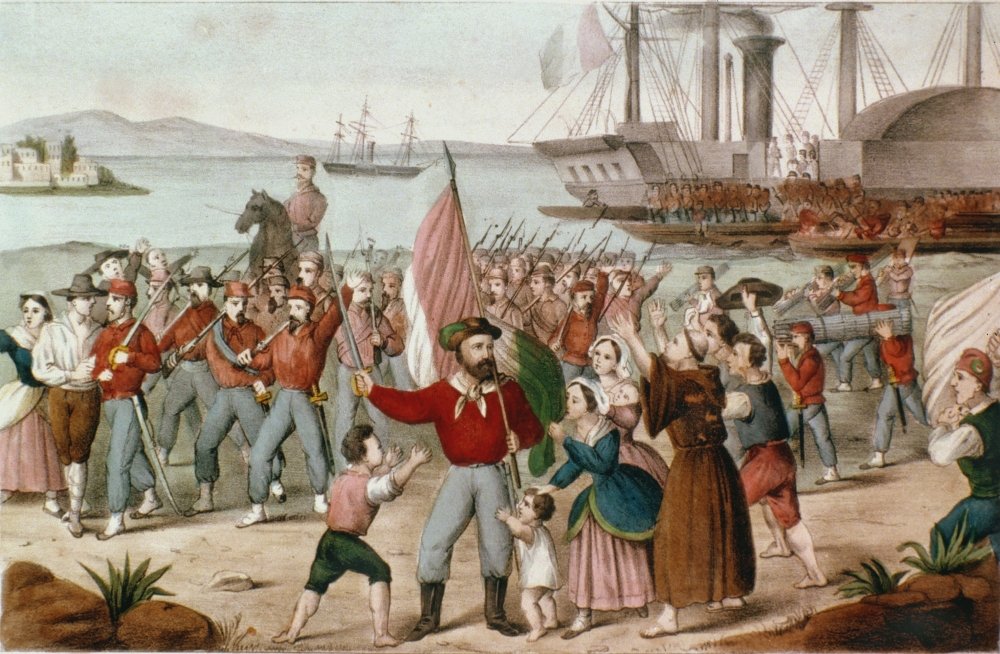
Garibaldi’s spread of Mazzinian republicanism through the Rio de la Plata is the missing piece in most American accounts. For over twelve years, Garibaldi fought in Brazil and Uruguay, first as a corsair, then as a commander of the Italian Legion in Montevideo during the Guerra Grande. His Redshirts, the iconic symbol of Italian liberation, wore ponchos adopted from that South American campaign (R. Bourne, Garibaldi in South America: An Exploration, London, Hurst, 2020, in Modern Italy, 28: 2, 2023, pp. 185-186). This was not merely military training — it was the practical application of a universalist republican philosophy in a multi-racial, multi-national context. Garibaldi was, as scholars have described him, “not simply a nationalist patriot, but the quintessential internationalist, fighting for whatever he thought would support the liberties of” subjugated peoples everywhere (ibid.).
This South American circuit connected Italian republicanism to liberation movements across the hemisphere and established the physical and ideological networks through which Mazzinian principles traveled northward into Black American political consciousness.
FASCISM AS THE DESTRUCTION OF THE REPUBLICAN INHERITANCE
The alliance of Victor Emmanuel III and Mussolini marks the terminal point of this republican inheritance. Fascism did not merely displace Mazzinian republicanism; but it systematically destroyed its institutional infrastructure. The squadristi attacked and razed the offices of L’Avanti!, the Socialist newspaper. Freemasonry was outlawed in blow to most non-Catholic anti-Fascists who had inherited the associational traditions of the Carbonari era. The Special Tribunal for the Defense of the State imprisoned or exiled thousands. The Rosselli brothers, Carlo and Nello, anti-Fascist intellectuals who explicitly carried the Mazzinian republican tradition were assassinated by Fascist agents in France in 1937.
This is the historical rupture that makes the recovery of Mazzinian republicanism simultaneously necessary and difficult. Fascism adopted and weaponized the conservative reactions — the Papal, monarchist, and nationalist currents that had always opposed the Mazzinian line, while destroying the universalist, egalitarian republican networks that had connected Italian liberation to global emancipation movements. No one has been held accountable for this, and instead scapegoats have been created within this history to sustain a particular modern international political mythology that has abused and manipulated this vision of democratic republican cosmopolitanism.
CONTEMPORARY STAKES
This tradition is neither “Marxist” nor “foreign” but rather foundational to the order. The specific form Mazzini gave it, grounding republican government in universal human duty rather than particular national interest, created a weapon against Power that could not be co-opted by Power. The early Black and Radical Republicans who studied the classics, who read Mazzini, who corresponded with Garrison, who followed Garibaldi understood this. Why do we not understand this? They built a repertoire of argument and action that was rooted in the deepest tradition of self-government and turned it against the slaveholding contradiction at the United States republic’s core. So, what conservatives in the United States often think is holding true to the original vision is a corruption.
That this history manifests strongly in a Black American must not be seen as paradoxical — it is logical. The tradition itself demands it, and I demand it of you. We must demand it of each other, and there will be better days ahead if we build from the foundations. Mazzini’s universalism, by its own internal structure, belongs most urgently to those for whom the promise of republican liberty was most violently betrayed.
 The American Minervan